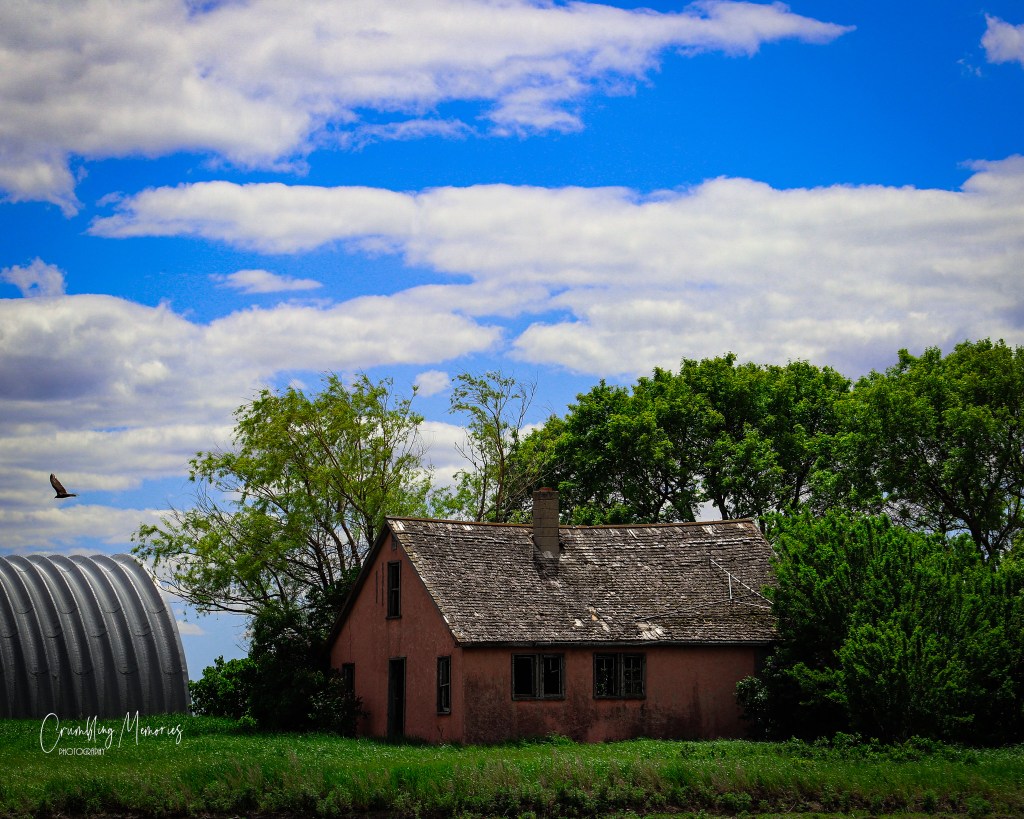
VAVAVOOM PART 1

Last Fall I attended at this old car lot that has been on my list to shoot for some time. I had no idea how many cars were there and didn’t give myself nearly as much time.

I called ahead to confirm with the landowner that it was okay for me to come. He charged me $20 to wander around his property and take whatever photos I wanted.

Given that I had another engagement to attend to, I did not get around the entire property but do plan on heading there again with Christian. The old cars don’t really interest him so I was happy when he asked if we could come along with me when I went back.

So in order to get all the photos I liked posted, I’ll do a handful every now and then and get them done, hopefully before we go again and I get to finish what I didn’t the first time.
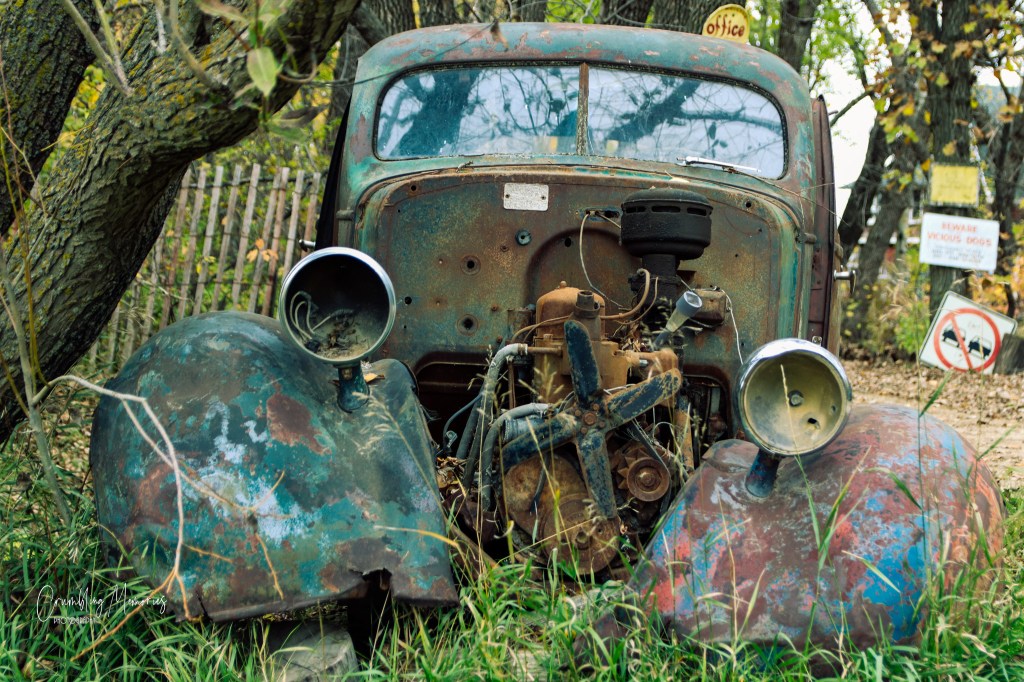
I don’t know a whole lot about cars but there were some really interesting vehicles on this lot. And the organization. Wow.

While I wandered the first part of the yard, I had the property guard dog with me. He was a little hearing impaired Jack Russell named Ketch. He quickly got bored of me and my continous stopping so he ditched me.

The weather was just right the day I went. It was slightly overcast and cool. The leaves were turning but hadn’t completely fallen. Parts of the lot were wet but not enough to get your shoes dirty or make it unmanagable.

I’ll post more in the upcoming weeks.

LIVIN’ ON THE EDGE

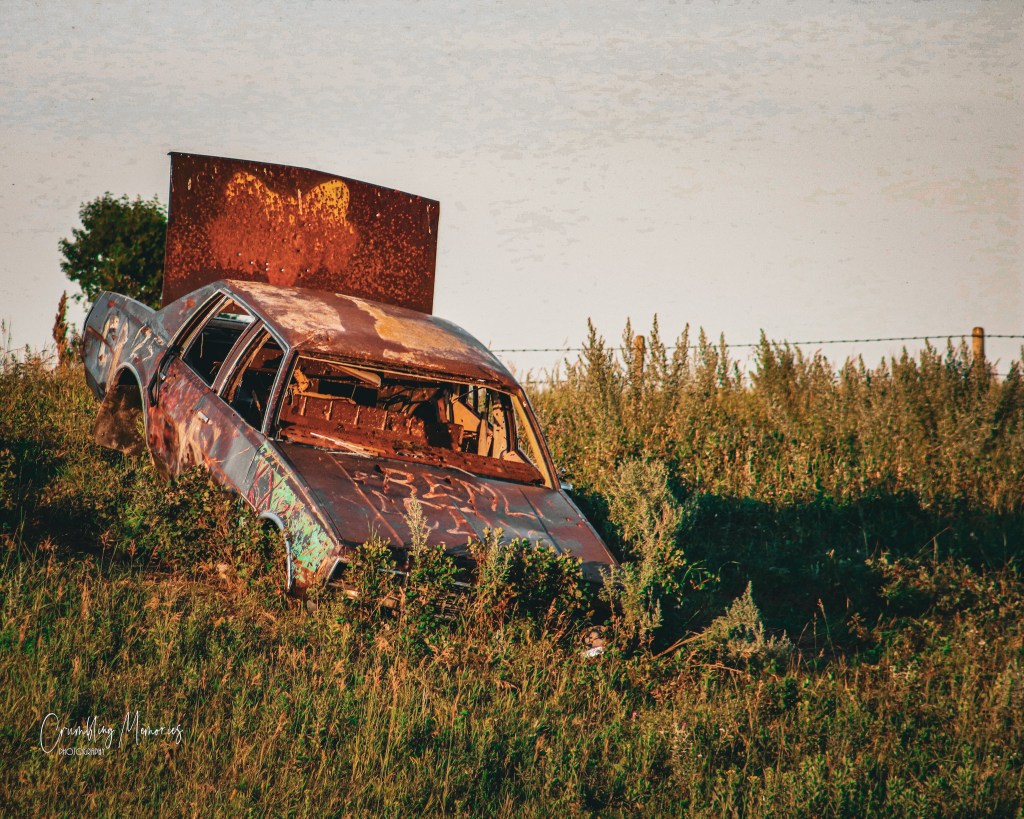
A hop, skip and a jump from where we had just shot a house from the roadside, Christian spotted this car in the field with the cows.

I thought for sure the cows were going to make their way over to the car but they did not and I was able to get the car from at least a couple angles.

ANOTHER CHECK-IN

The other night while hunting for houses, we came across this old house from many moons ago. Easily shot from the road, we stopped for a couple shots to add to our list of houses photographed. I wish I had kept better stats since the start of this hobby.

This is the house where I stepped on the board suspended over a hole. I was content on the road. I had been here many years ago and had investigated inside during that visit.

The sun was starting to set which was giving off that golden hour glow which I love.

I have a new system for keeping track of houses I want to shoot and houses I have shot. Its a work in progress and it appears to be a lot simpiler than the big old binder that Christian teases me about. I will hold on to the binder because when I search for the history, I do use the original page to record notes and the name of the blog post, date and contact information for permission.

HENDERSON SCHOOL, REVISTED

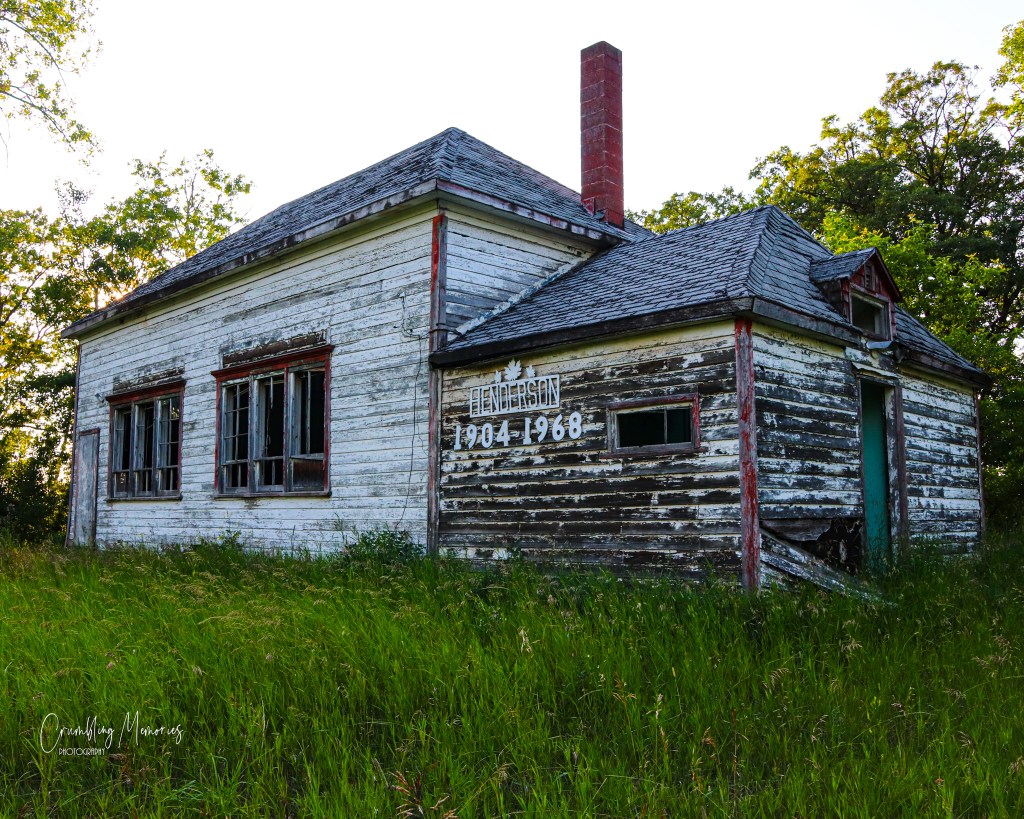
Its been some time since I’ve checked on this school and because we were in the area, we figured why not. It is not maintained like it was when I first visited.

And I do beleive that the school had far more windows intact when I was there last.

So if you are unfamiliar with the history, here is a quick recap. Built in 1904 this school operated until 1968 when it joined the current school division in the munincipality.

During the 1940s, the building was used for services of the Bannerman Church of Christ. It is my understanding, from a person who grew up and still farms in this area, that a local ladies group owned the school building for a while and held meetings here. Then the RM bought it back and has remained unused since then.

I had to go inside because I remember the inside of the school being in relatively good condition. The school desk and piano remains. And over the years, vistors have written on the chalkboard.

While school is out for summer for most, this place was pretty busy. Upon our arrival, a few birds took off out the windows. And, something was scurrying around in the ceiling. Given that we were blocking the main exit and the ceiling isn’t exactly stable, we left.

I’ll go back again in a few years and see how its making out.

CYPRIPEDIOIDEAE

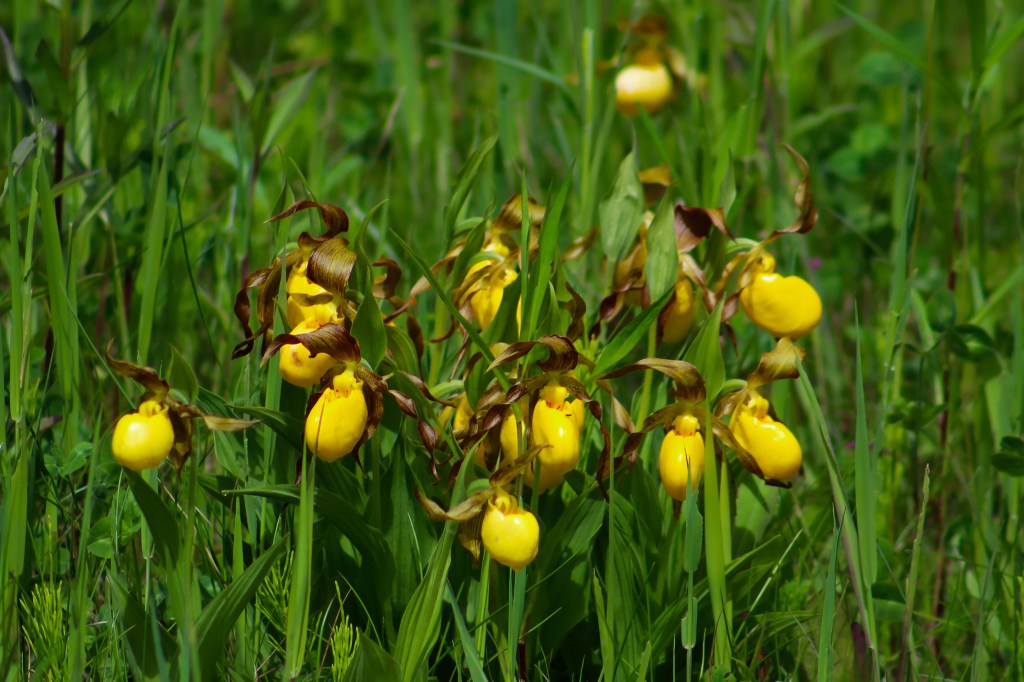
One of our most interesting wildflowers is the lady’s slipper – a variety of the wild orchid family – which is named for its shoe-shaped blossoms. There are six distinct species of lady’s slippers in Manitoba, as well as a couple of recently discovered hybrids. They range from quite common varieties, to fairly rare ones, with one variety classed as endangered. Some begin blooming in late May but most flower in June or early July.

The most common variety is the yellow lady’s slipper, of which there are two subvarieties – northern small and large yellow – though casual observers may not notice the difference. The size of the pouch and the stripes on it vary, as does the flower’s fragrance. The yellow lady’s slipper grows in a wide variety of habitat – meadows, forests, black spruce and tamarack bogs, as well as in disturbed areas such as roadside ditches. They may grow as single plants about 20 to 40 cm tall or, if the environment is suitable, may develop into large clumps.

So now that you know about lady slippers, here is the meaning of this post. On the way to Dauphin a few weeks ago, I was driving along and it was starting to rain. All along the park I had noticed yellow flowers in the ditch and was surprised at how many dandelions there were. Of course I was more focused on trying to spot a moose or a bear on the side of the road. They were actually lady slippers.

My Grandfather searched for them when I was a kid and could spot them a mile away, like a blueberry or a mushroom. To this day I can identify them without a flower if we are in the bush.

As a kid my Grandfather told me that the pink ones were rare and when I suggested that a few weeks ago on a Facebook post, I got my schooled in lady slippers. Turns out they aren’t rare and it appears these pretty little flowers are growing in abundance in our province.

BROOMHILL, SCOTLAND

Joe came to Canada with his parents and settled in the Carberry area in approximately 1883. Only a few years after their arrival, Joe’s mother passed away and the family made the decision to move west. The little town of Broomhill was named by them as it was reminiscent of a small town near their home in Scotland.

Joe and his father and siblings travelled by ox team approximately 135 kilometers to Broomhill. Joe settled on this land and just a few years later in 1895 married Janet. Together they raised two children. Unfortunately Janet passed away in 1908.

On July 17, 1915 Joe remarried and together they had one son, William. William was born at this homestead.

Joe and his brother Will had a contract to build a section of the grade for the new railway. Aside from that, Joe farmed but also helped Will run the general store which Will built and operated in the townsite of Broomhill in 1908.

Joe was a huge supporter of the community and was a school trustee for many years. He was a beekeeper, he loved to travel and watch sports. Joe moved to Broomhill in 1919 when his brother passed away to manage the general store.

In 1919 Alex and his family moved to this land and made it at home with his family. History says that upon their arrival to the home it was noted there was a large patch on the west side of the house. Said hole was made by a team of runaway horses and the end result was the tongue of the sleigh going through the house.

In March 1920 there was a severe, 3 day winter storm. As a result of the accumulated snow, there was no school and the drifts around the farm were very high. So high in fact that Alex could not get into the barn like he usually would so he had to use the Gothic windows and access the inside of the barn with his milk pails to tend to the cows.

Alex passed away at the home in 1944 only two years after his retirement from farming.

In 1948 the Talman family from Fertile, Saskatchewan purchased this homestead. Marion was a renowned dog trainer and because of this the headquarters for the field trials were held at this farm.

There are two houses on this property and I am going to assume that the second was the home of Marion’s oldest son and his wife who moved to the land shortly after his parents when their home in Fertile caught fire.

Alex and Annie served their community in many ways and were honored for their contributions to the many orgainzations that they volunteered their time to.

Its nice to find a rich history on a property after you’ve been to it and photographed it. When we were at this farm, I contemplated taking a photograph of the old barn and I’m happy I did because, while it doesn’t happen often, someone thought to mention it in their family history.

CHECKING IN

I thought I’d take a drive a few weeks back and check on an old house that is starting to feel its age and neglect.

The first time I was at this house (I’ve gone many times) she had a bit of a lean but she was standing up pretty straight considering. I seriously contemplated going inside but didn’t because I could see just about everything from the windows.

Over the years I have considered taking grad photos at this house but I never have. Maybe I will take the 2025 grads over here for a few shots and see what I get. Or maybe this house will be gone by then.

I’ll keep checking in periodically to see how she is making out.

THE LAIDLAWS and THE QUEEN’S OWN CAMERON’S

The first recorded landowner for this property is listed in 1891. I can find no history for that family or the 3 families after them which allegedly lived and farmed on this section of land before Mr. Laidlaw settled here. I can also tell you that the current residents are not so welcoming. While I only saw one who decided to photo bomb my roadside stop, there is two vultures who now reside at this house.

I can tell you about Walter though. Walter came to Canada when he was 28 years old. He left Scotland by steamship in 1904 and landed in Halifax. He carried on to Brandon and from wagon headed to Newdale, Manitoba where he worked for a few months. He worked for a few years firing a steam engine for a local man and then was a stooker for other farmers in the area. Walter and his wife settled here sometime around 1918.

In 1918 Walter married Jeanne from Switzerland. Jeanne immigrated from Switzerland to the Cartwright area and ran the millner shop. Two years later she married and the couple went on to raise 5 children of their own. All but one of their children served in the miltary except the eldest who as a child was kicked in the forehead but a horse. The boy was stitched up at the kitchen table but as a result of the accident, the injury left him with muscle damage to his eye which caused his eye to turn inward. Because of this, he was unable to serve like his siblings so he farmed with his Dad. It is said that the injury to his eye didn’t prevent him from being an excellent shot during hunting season.

In January, 1946, upon his return from serving with the Queen’s Own Cameron’s, in France, Belgium and Holland, the second eldest son, Herman, returned to the area and started farming his parents land. Herman later married but did not have children of his own. Herman passed away at the age of 82 years.

What is the Queen’s Own Cameron’s? Well I had to google it. Given that the family was of Scottish decent, it makes perfect sense as to why and how Herman ended up serving with them. Winnipeg has always had a strong Scottish tradition so after years of intense pressure from the local Scottish community, the government finally authorized the raising of a highland regiment in Winnipeg. Gazetted in 1910, the Queen’s Own Cameron Highlanders of Canada are the oldest highland regiment in Western Canada.

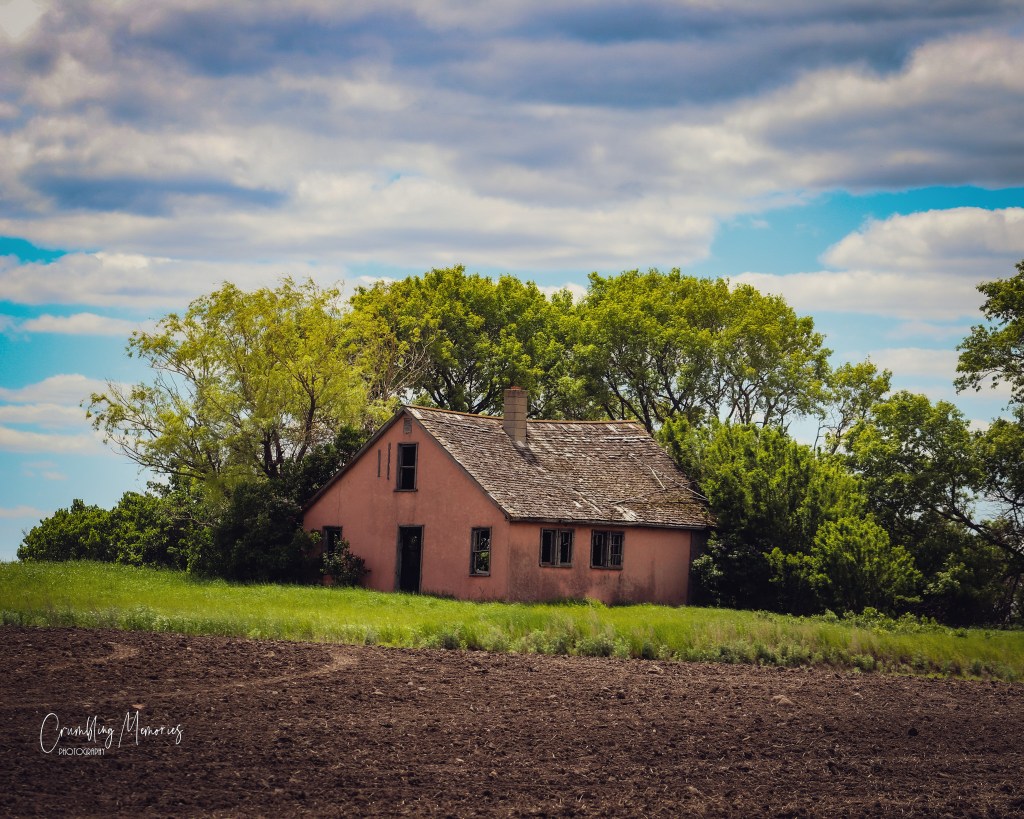
I love the color of this house! These were roadside shots so I don’t know how well the inside is holding up but one day I would love to get a closer look.

TRUSTEE TURNBULL

John Turnbull was the first recorded landowner of this section in the RM of Roblin and was the first trustee of the Badger Creek School District.

The third recorded owner of this land was born in Quebec. He attended McGill Law School and also served as King’s Council in the Sherbrooke Court.

In 1895 he married and started a family with his wife, Luna. They had 5 children. In 1914 when the war broke out, Albert was a Lieutenant Colonel. He joined the forces in the regular army and became a Major. Albert and his eldest son, who was 17 at the time, voluntereed for overseas service and were sent to England with the 117th Eastern Township Battalion. Albert returned to Canada but his eldest son was sent to Germany in 1917.

When the eldest son returned to Canada from Germany, the family decided to go west and in particular, the Cartwright area. Albert arrived in the area and found land and then returned to Quebec to purchase a herd of jersey cattle. John and Albert set back out west to their new home by railway, with the jersey cows. Albert and Luna’s oldest daughter remained in Quebec. Luna and the younger children made the 4 day trip by railcar and arrived on December 30, 1919. Upon their arrival the families new neighbours had a hot meal prepared for them.

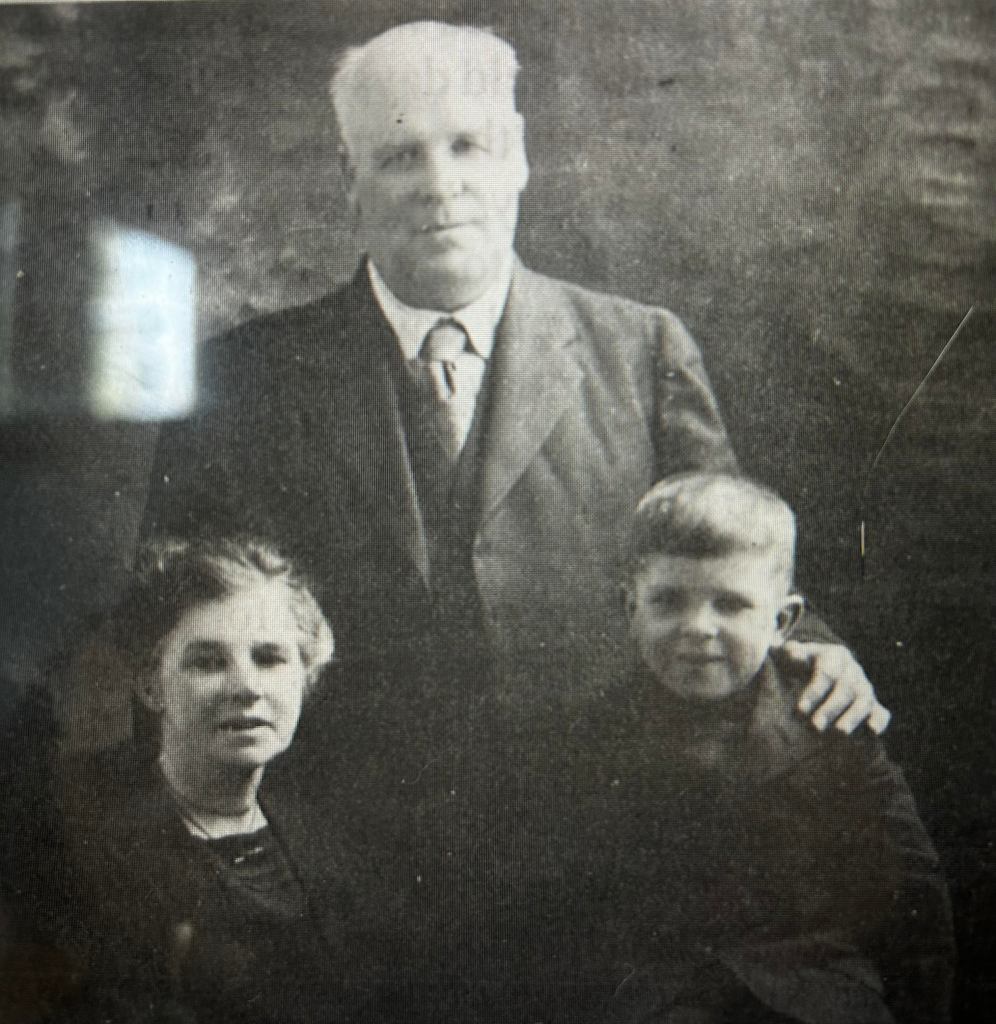
During my search of this family I came a cross this photograph of Albert and Luna with one of their jersey cows.

In 1921 50% of the herd developed TB. After thorough cleaning of the barns, Albert went back to Quebec and purchased more jersey cattle. He showed the animals in Brandon and Killarney. These cows which caught a lot of attention at the Killarney and Brandon Fairs.

In 1925 Albert and Luna went back to Quebec where Albert continued to practice law until he passed away in 1932 following an appendectomy. Luna passed away in 1946 after she fell and broke her hip and was recovering in hospital.

John, the oldest son, took over the farm when his parents moved back to Quebec. The family gave up the farm in 1933. He bought a farm North of Winnipeg for a short time but headed back home to Quebec.

I have no idea if it was the Turnbull family that built this house or the second landowners, the Taylors from whom Albert and Luna puchased this land from.

After John left the farm, his sister and her husband moved to the land and raised a family on this homestead. Then their son took it over but moved to Virden and later Pilot Mound.