My mother-in-law has been asking me about this place for years. I had never heard of it. So while my Mom was here and we were spending the day in Brandon, we drove over to check it out.
You are immediately greeted by the old store whose wrap around porch is full of antiques. We walked through twice and I’m sure we still missed a lot of stuff.
A lot of people were there for ice cream and then they headed out to the trails. We didn’t have proper footwear so we didn’t try it.
When I first saw this house posted online by another bando hunter, I immediately put it on my list to see. Back in May, a fellow bando hunter and I went there. One thing I did notice was the two lightning rods that were once attached to the house are now gone and the swinging door has one again closed itself, or maybe it had help.
Mr., born in England, immigrated to the United States and then ended up here in 1894. Upon his arrival he purchased this section of land. He met his wife when he got to Manitoba and they married in Brandon. From this union 3 girls were born. In 1902 he sold the farm to his brother-in-law and moved to town and purchased shares within the local flour mill and worked for many years in the community.
The history of the brother-in-law’s family is far more in depth but doesn’t really confirm anything about this house. Their earliest recorded history is 1196. In 1756 the family changed the spelling of their name, which really wasn’t that uncommon back then. The family are said to be the equivalent of English Feudal Lords and were the Lords of Duersen and Lissel in the Province of Brabant which is in the Netherlands. The earliest record of an ancestor coming to America was 1630. The earliest record on one coming to Canada was 1756 when they immigrated to Ontario. It is said that one of the children, at a young age, was lost in the woods and never found.
Now this is where it gets tricky. This family farmed on the NW corner of this section which would explain how this family is connected and how the original landowner met and married his wife. When they moved from the land to town to operate the flour mill, he sold the land to his brother-in-law. It is recorded that a farm on this land burnt down in 1916 when the family was away in Ontario. They lost everything in that fire.
I cannot confirm if this is a rebuild of the original home or if the house that burnt down was on another quarter of this section. Regardless this is quite the house. Unfortunately, it was not easy to photograph from the front given the tree line. And honestly, I didn’t even look at it from the back.
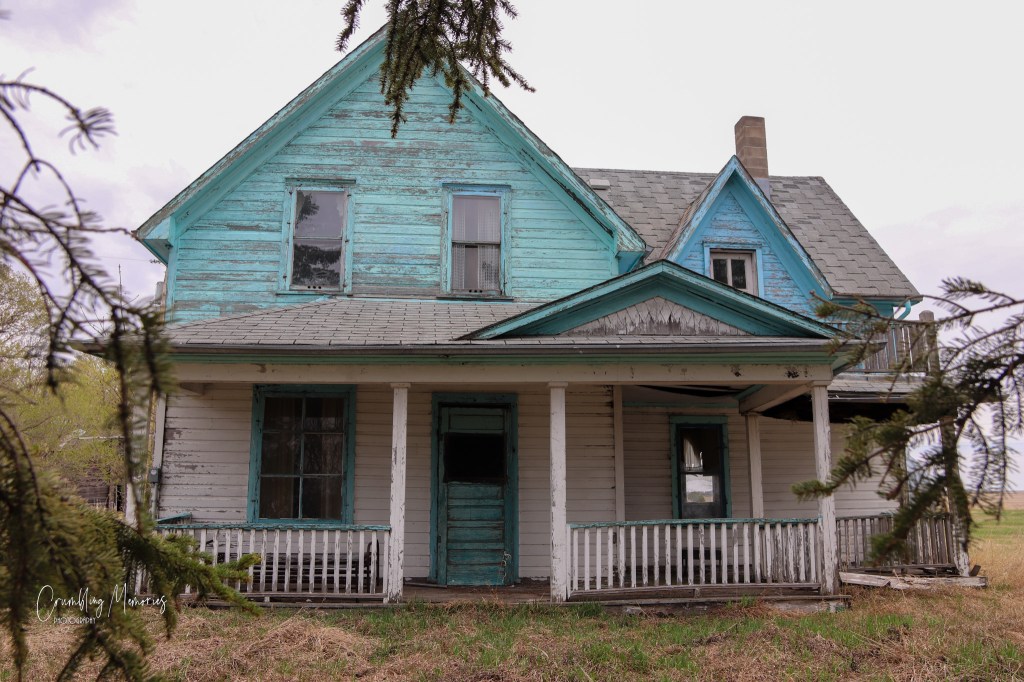
This is a neat old house which I thought would have been quite fancy for its time with its porch and upstairs deck. It certainly wasn’t your typical style home. The floors were caving in so we just peeked through the windows but inside there was plenty of old things to see.
It definitely goes up there on one of the neatest houses I’ve been to.
This sign is one of the coolest things I’ve seen given that it actually states when the homestead came to be. I have removed some of the information from this sign which gives away its location. I love that this sign confirms when this homestead came to be.
John & Mary, both born in Scotland in 1847 and 1845 immigrated to Ayr, Ontario in 1868 where they lived for 9 years. In 1877 they made their way to Manitoba by Red River cart and arrived in Portage la Prairie, Manitoba where they remained for 4 years.
In 1880 Mr. filed for this homestead and was one of the homesteaders in this district. That summer he built a soddy and the following year he moved his family here. Mr. & Mrs. raised 9 children on this land. For several years that soddy was a stop-over or half-way house for other farmers moving grained from Deloraine to Brandon. It was here that they would replenish their supplies and rest.
This house was built in 1885 and was last recorded to be owned by Mr. & Mrs. grandson, W. Jack.
Mr. & Mrs. retired to Victoria, B.C. in 1912.
All 9 of their children attended Millerway School which was built in 1884.
The couple had a happy life together and celebrated their golden wedding anniversary in 1919 (50 years) and their diamond wedding anniversary in 1929 (60 years).
Mr. passed away in March of 1931.
Mrs. passed away in August, 1935.
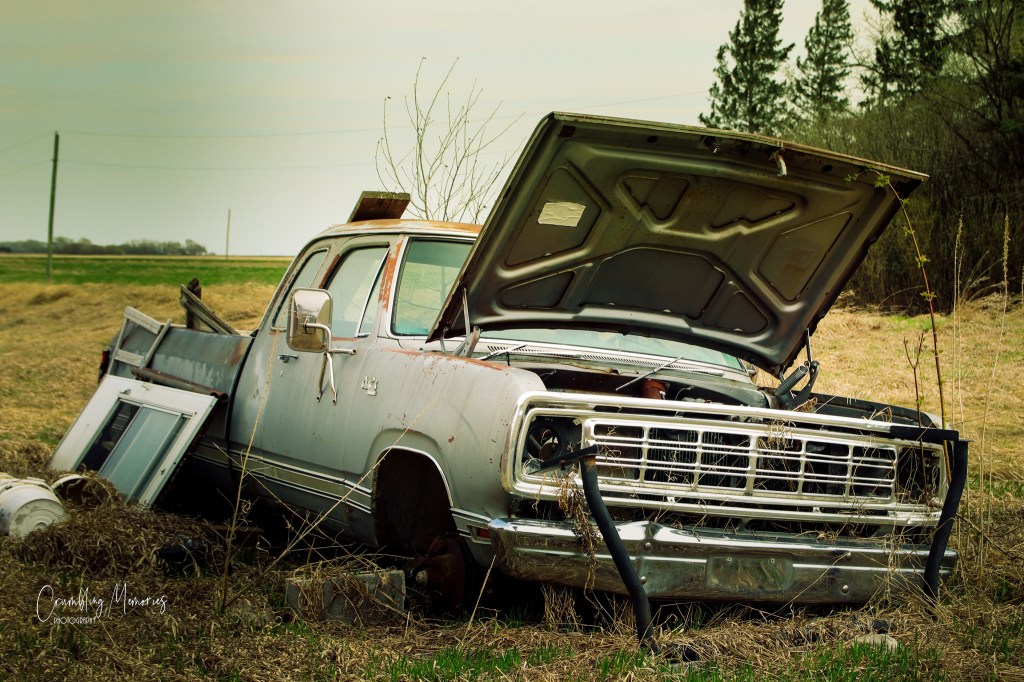
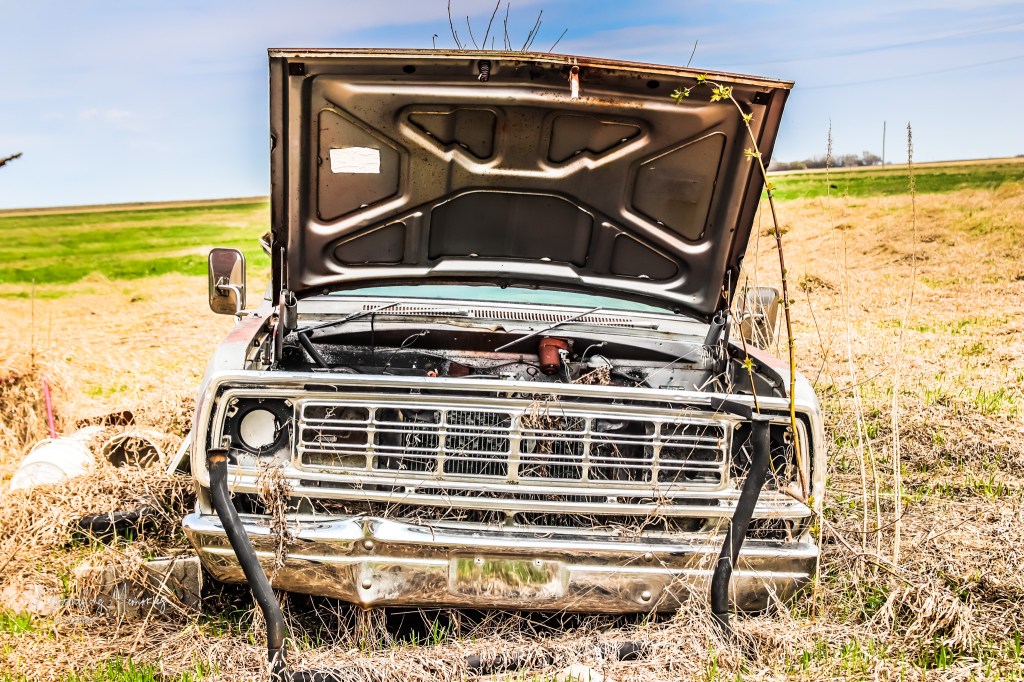
The best thing about a bando house hunt is when I find old cars there.
The original homesteaders of this property came to this land at the turn of the 19th century. The first official recording that they were the landowners is dated 1901. Owned originally by one of the brothers of this family, the first brother to own this land, William, turned the sod making it ready for farming and construction of a forever home.
In 1904 William sold the land to his brother James who lived here until he retired. At that time he son, namesake of his uncle and his dad, took over.
This property has a long drive and is beautifully treed. This is also the spot where Christian and I got most of our wood ticks that day. I’m sure that we picked off at least 50 at the end of this driveway before we got back in the vehicle.
In 1920 this land was sold Mr. Taylor but then repurchased it. James later sold the land again, this time moving to a different district to farm, but again bought the land back. It does not state why the land was sold but it does say it was purchased back due to adverse conditions.
James and his wife Bessie raised three children, mostly on this homestead. In 1930 they retired from active farming and moved to the closest town. Mr. died in September, 1953 and Mrs. not long after in April, 1954.
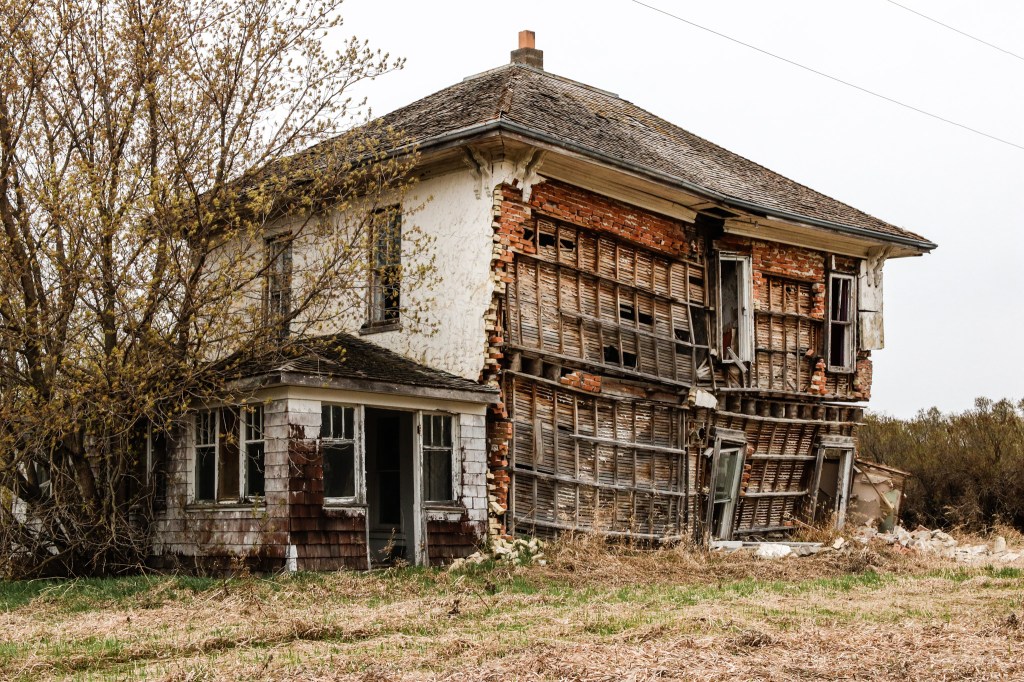
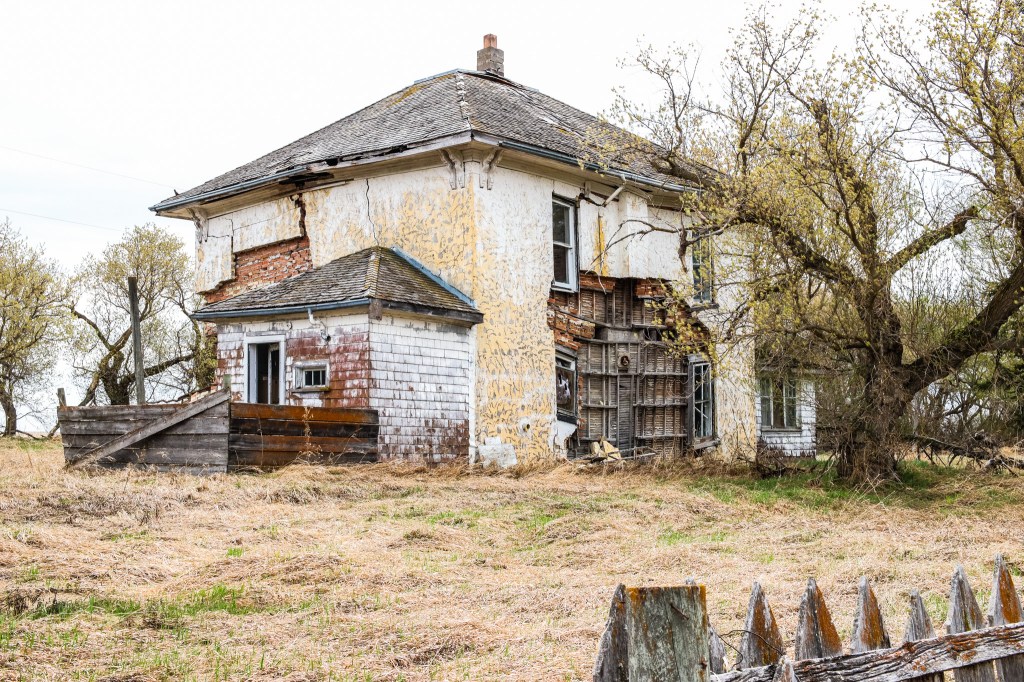
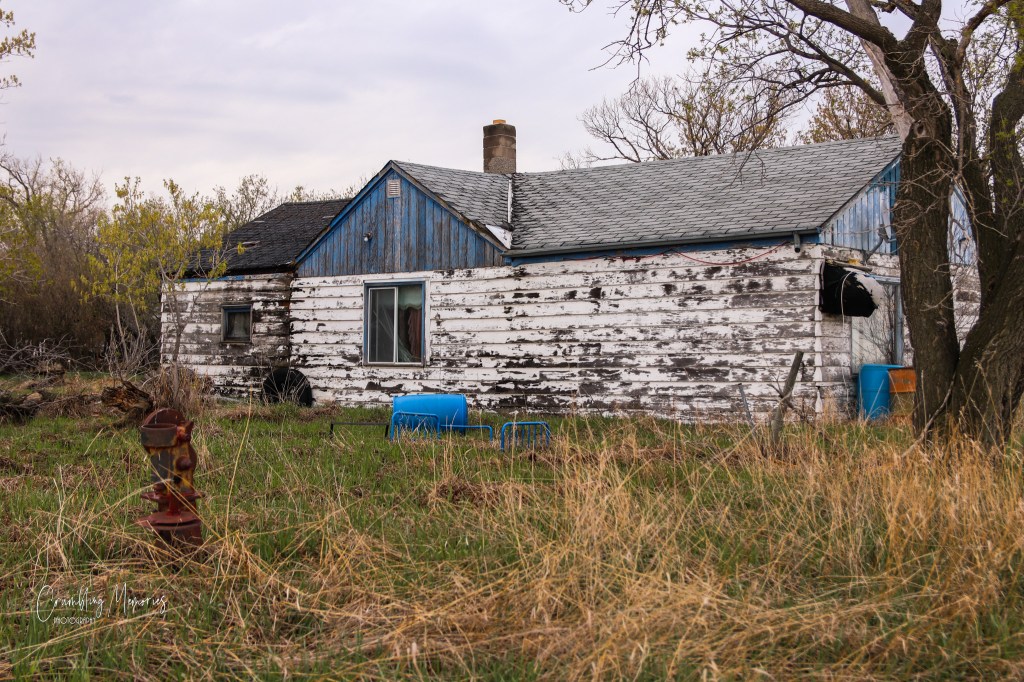
This was not the first house we went to on this day that was suffering from the same sort of decay. I am going to make the assumption that at one time, these were brick homes. In an effort to modernize them, stucco was applied over the brick. With time, the roof began to leak and the water ran between the two layers causing this deterioration to happen.
Inside the house we could see the remains of furniture and a bookshelf with puzzles and games.
Back to that day when Christian and I went out, one of the first houses we stopped at on our venture was this one.
Visible from the road, this was an easy stop. After fiddling around with my camera for a bit we got ourselves on the other side of the trees.
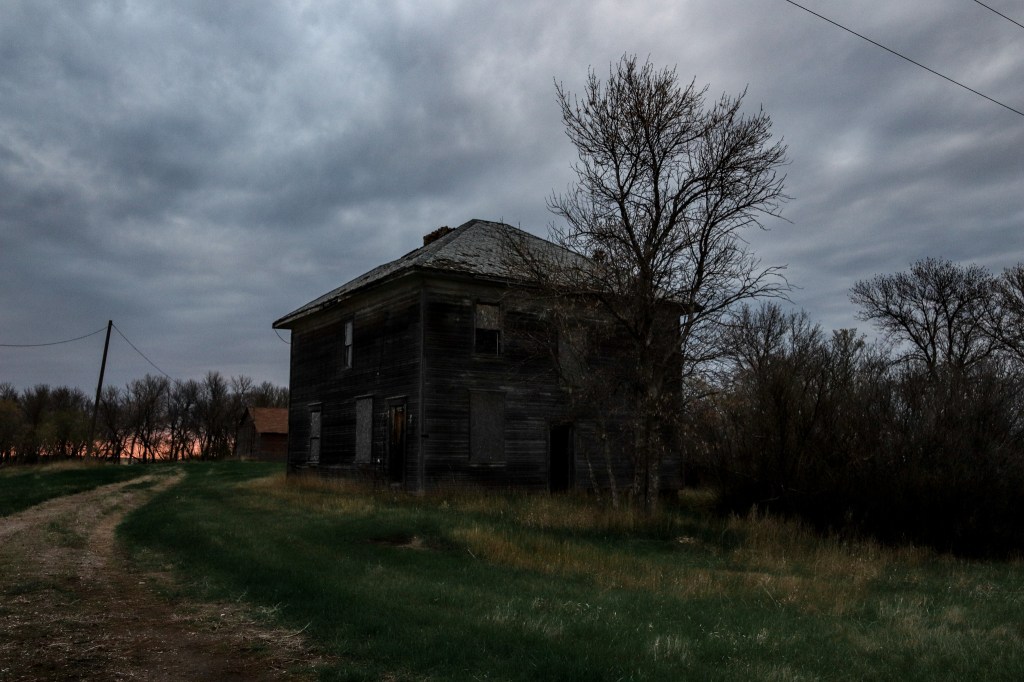
This big old two story house with the missing door upstairs wouldn’t want to be something I came across at night time. I wasn’t at all freaked out here but with the dead trees in the front, I could see how one would be.
The history I found on this homestead is not of the original homesteaders. That is of course somewhat disappointing to me but its better than nothing. That being said, here we go. The second homesteader of this land immigrated to Canada in 1903. Born in 1881 in Country Cork, Ireland, he moved to the area and married in 1908. Having worked for many farmers in the area and renting land to farm, he moved from the land he originally lived on and in 1921 eventually moved to Neepawa. In 1927, Mrs. passed away and he came back to the area.
In April, 1928 to be exact, the family moved back to Elgin, Manitoba but he again rented land. It wasn’t until 1942 that him and his children moved to this homestead.
Mr. retired from farming in 1951 at the age of 70 and moved to Brandon where he lived until he passed away in 1964. Mr. and his wife raised 6 children on various farms in the area as well as in Neepawa. Upon Mr.’s retirement, his youngest son and his wife took over this farm and raised their family here.
Last week I was out with a student taking her graduation photos. We were making our rounds and stopped at an old church. Well, the upkeep at the church isn’t what it used to be but we got her up there on the step and took a couple photos.
There was a nice rose bush by the door and she decided that she would like to lie down on the step with the bush beside her. So we started cleaning off the step and she looked at one of the big roses and inside was this BIG whitish/pink spider.
Of course our first reaction is to gross out and then flick it away. I wanted to try and get a couple of photos of the spider too because I had never seen one like it before and then proceed with the photography shoot. So we did that.
Tonight I posted these photos on Instagram and my nephew commented that he had seen these spiders before out at the cottage and wondered what they were so, I searched it.
This is the goldenrod crab spider or the flower spider. They are called crab spiders because of their unique ability to walk sideways as well as forwards and backwards. They have the ability to change between these colors based on their surroundings through the molting process or depending on the color of flower they are eating from. on that color.
These spiders do not spin webs but they do use silk to catch their prey. Once the female lays her eggs and the eggs hatch, the female dies.
The first recorded landowner recorded for this section of land is 1889 but there is no family history. So, I don’t know who built this house. Regardless, she’s a beauty.
In 1906 Mr. quit his job at the chair factory in Orangeville, Ontario to move to the area. He boarded a freight train with the machinery, furniture and household effects of the Anderson Family. Upon his arrival to the area he was hired as a farm hand on another farm. In 1911 he rented this land from the previous landowner.
In January, 1912 he married Helen, the daughter of the family whom he traveled with to the area with their belongings. They bought the land and lived there until 1954.
When they left the land they retired to Melita. During his active years Mr. was on the school board in the area and was a counsellor for 13 years. Their youngest son took over the farm and raised his family here.
Before marrying Mr., Helen was a school teacher at Brown’s School from 1909 to 1911. She began teaching at 16 years of age.
While walking up to this property we discovered that the Souris River runs through it. The water was full of ducks and small birds. In the distance I could hear an owl taunting me but I could not spot it.
There were two houses on this property . This newer house must have been what the family moved into when the original farm house was no longer livable. I love that the house was preserved to some extent.
Mr. & Helen raised 9 children on this farm, 4 boys and 5 girls. Mr. passed away in 1963 and the history that I found for this family was written on May 26, 1982 by Helen who was in her 90th year. I visited this house on May 13, 2023.
At the time that Helen wrote her family’s history, there were 25 grandchildren, 30 great-grandchildren and 5 great-great-grandchildren.
Then the 30’s rolled around and the family faced the depression, the dust bowl and the grasshoppers. At the time the family had a car, a piano and a telephone. Mr. sat down with his family and said something had to go. Helen said that the telephone had to stay, in case of an emergency. The children all wanted to piano for entertainment. So, Mr. put the car up on blocks and parked it. The family relied on a Bennett Buggy for transportation.
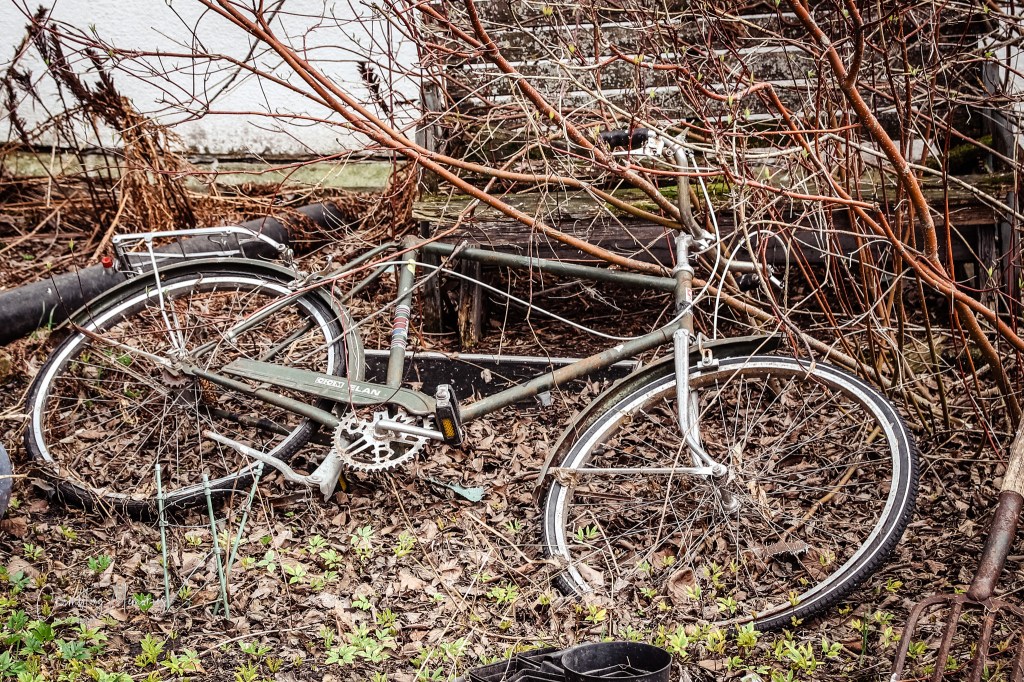
I did find this one strange piece of equipment in the yard. I took a photo of it with the hopes that my husband could identify what it might be but he wasn’t sure.
Now I’m wondering if the old car is somewhere on this property. Maybe the owl was trying to lure me further into the yard in the tall grass and treed area so I would see it!
Last week our school had a visitor, Bindi the burrowing owl.
Bindi is a 5 year old female owl who is the Ambassador for the Manitoba Burrowing Owl Recovery Program. The program helps owls have a successful nesting season by building artificial nests for them to settle in to and by protecting nesting sites from predators.
Bindi was pulled from one of these nesting sites as a small owlet. Bindi was small and frail and it was the intention of the biologists to fatten her up and send her on her way. She quickly imprinted on her handler and was no longer releasable. She was born in B.C and is 5 years old.
After an informative video presentation we were given the opportunity to touch Bindi and get our photo with her. She makes the cutest little noise when she “talks”. One of the best things about this presentation is that our grade 12 graduate has always loved owls and now she’s met one and touched one.
If you are looking for a cause to support, consider Bindi and the Manitoba Burrowing Owl Recovery Program.
TJB was born in 1872 to Empire Loyalist parents in DeCewsville, Ontario. TJB moved to Canada in 1892 in what was referred to as a “harvest excursion”.
What is an Empire Loyalist? Due to the American Revolution, approximately 8,000 Brits came to Canada and migrated to an area in Southern Ontario. Those people were among the first white settlers of the province and were instrumental to creating the Province of Upper Canada 1791.
Christian and I were on our way home for the day after an almost 11 hour day hunt and shoot. We had just finished up and the well groomed yard when he remembered this place which had some old cars which he knows I also enjoy photographing. It was getting pretty dark so we weren’t sure what we were going to get. Again, I wasn’t sure what I was going to get in this lighting and I also underestimate what I can do. That am I’m not much of a risk taker because don’t want to miss a shot.
In 1894 TJB married Emma in Deloraine. Emma was the first woman to live in Medora. The first home they built was where the Medora Service parking lot is now and they lived there until 1903.
TJB played for the local baseball team and was a goalie for a football team. He was the secretary for the Sunday School and the Literary Society. As well, he was a member of the Orange Lodge. The Orange Lodge is a group of Protestants who were committed to the protection of the principals of the Protestant Reformation and the Glorious Revolution of 1698 which enshrined civil and religious liberty for all. The Orange Lodge has existed in Canada since at least 1812.
Emma was a very involved in working with the church and was a life-member of the Women’s Institute. Emma was also a well known dress-maker.
From what I have read or found about this property, I can’t tell you anything about these old trucks nor can I link them to this family.
During my old car photo shoot, Christian was wandering around the house so I thought I had better get over there and take some photos before it was way too dark.
Here is where I get a confused by what history I have found. It says that TJB built the house in 1903 which is now owned by another farmer in the area. “This old house was moved to the farm.” So is this the house that was built on the service lot in Medora and moved here or was the house built on the service lot sold to the other farmer and he moved it to his own farm? Regardless, she is a big old beauty.
TJB and Emma raised 5 children on the homestead. Their oldest son George who was born in 1897 later left this property to his only son when he retired and moved to Medora in 1974.
TJB passed away on June 8, 1930 and Emma passed away on August 14, 1962.
Many moons ago, I remember that Northern Lights were something that you only saw when you headed North of the city. And the darker it was outside, the better they were. I do remember going to the cabin and see them, occasionally. I remember that when you were able to see them, it was a big deal because you didn’t get to see them very often. Not from the city anyways.
So what are Northern Lights? Well, they are electrically charged particles that have entered the Earth’s upper atmosphere at a very high rate of speed. They are said to be more common in the winter. That being said, are we seeing them more now because of all the smoke in the air?
Anyways, on the night of May 19th Colton came into the house after I had already snuggled in for the night to watch The Handmaid’s Tale. He said “you might want to grab your camera and come outside.” He showed me his phone. He said, I just got this photo of the Northern Lights at the end of the driveway with my phone.
Well, I got out of bed, grabbed my camera and went out to the driveway and that is not what I saw. I could see them faintly but nothing like Colton had captured. This is what Cade & I used to see when we lived up in Waywaysecappo. I haven’t seen them like Colton’s picture since we lived up there. I remember driving up highway 16 coming home from somewhere and watching them dancing in the sky while Cade drove. It was mesmerizing. I haven’t seen them do that since. Nor have I seen the colors I’ve been seeing lately on Facebook and Instagram. And maybe I’m seeing them more because I follow those pages more closely now but who knows.
Anyways, Colton agreed to drive me further North up highway 18 to see if they got better as we got out of town. I also envisioned an abandoned house that I like worked into my photo. No luck. At this point I decided my best bet was to message my friend Christian who in my opinion is a Northern Lights photography expert. He said, go home, set up your camera and try again later. They are there, there is no cloud cover. You just aren’t seeing them to the naked eye and you need to trust your camera. So I did.
Well, you can definitely see them but nothing like Colton’s photo. I must say though, I was excited to see all those stars. This also confirmed that there was in fact no cloud cover. So as per Christian’s suggestion, I went to bed but set my alarm for 2:30 a.m. to try again.
Okay, not to shabby. Again, stars galore. I must try to do more night photography this summer. I’m positive I say this every summer and never get out to do it. Now, in my defense, milky way season is over.
So, I’ll be watching my new Aurora Forecast app with the hopes I’ll get a shot.
The furthest I can go back on this property is 1922 when this property was bought by Jack & his wife. Married in 1908 the couple lived six miles south of Medora where they raised four children. In 1922 they moved to this property but I cannot confirm whether or not they built this house or if it was there when they bought the land.
Jack was born in Shropshire, England on February 5, 1879. He came to Canada in April, 1906 and met and fell in love with his wife. She was born in Montgomershire, Wales and also immigrated to Canada in 1906. Jack passed away in 1962 and his wife in 1965. Their only son took over this land.
Born in January 1913, C.S. received all of his school in the area. Fond of sports, he was active in hockey, curling and baseball. He farmed his parents land until he sold same in the Spring of 1969 when his nephew took it over.
A few years later, C.S’s nephew’s Grandson took over the land and I believe he still owns it today.
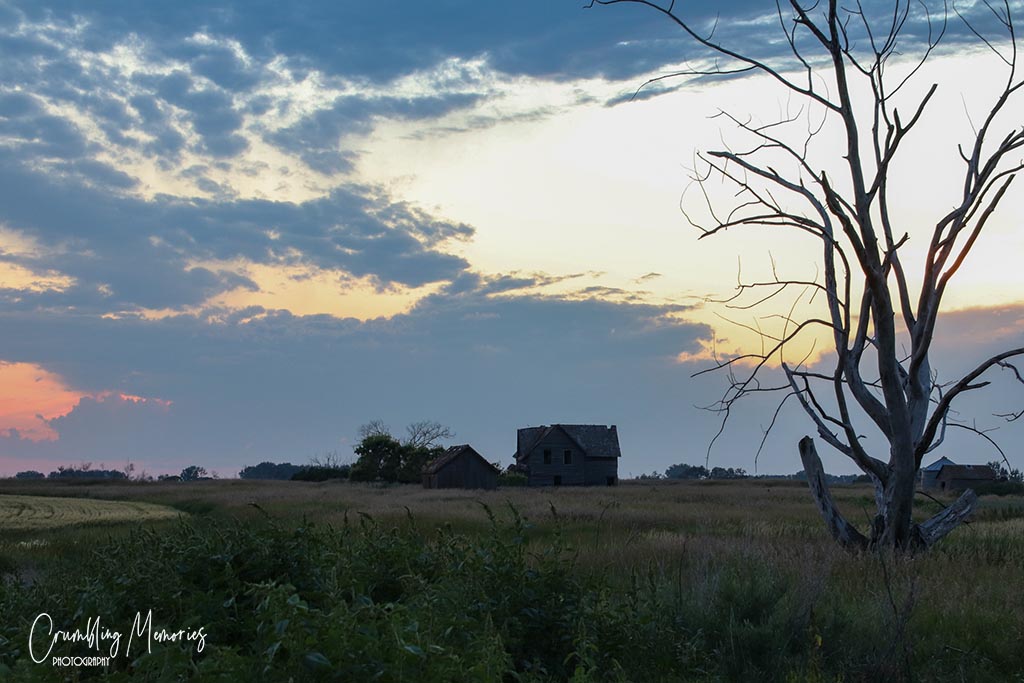
After a day of wood ticks, this stop was a blessing. The ride in was easy and the grass all around the house was cut. It was a nice change for the day. The dreary, cloudless, grey sky we had shot all day wrapped up with this beautiful sunset. This house had been on my to-do list for a long time and I’m happy that I finally got to it.
I haven’t started looking for a story on this place but I thought I’d share on shot I took.
This old farm was like a dream. Easy access and the yard was cut so no more tall grass and ticks. I loved how you could see the horizon through the windows.
On a recent trip to Winnipeg, I requested we make a little detour to check out a church in a small town and found these two cars.
Shooting from the road on a rainy day, I took these two photos with my iPhone. I wasn’t happy about the background but I still like the way they turned out.
Referred to as Homestead #3136, A.J.W was born on September 28, 1840 near Picton, Prince Edward County, Ontario. A.J.W graduated from a military school and later became a Captain of the 16th Battalion during the Fenian Raids. When he wasn’t serving he was a woodworker who specialized in making cases for organs and pianos.
It is said that A.J.W married his wife in Ontario in 1863 or 1864.
A.J.W and his wife raised four sons in Ontario and then decided to move to Manitoba through Emerson. They settled first in Rapid City.
In 1885 after snowshoeing to the area, he found this property. A.J.W moved his family to the land and there, they wintered, in a tent, on the property. The following summer, this house was built.
A.J.W passed away in 1909. His wife died in 1933.
While we were able to get right up to this home, I didn’t go inside or even look inside.
This house for me will always be known as the Coyote House. While making our trek down the road, along the field line, there was a dead coyote.
After a lot of thought, I have decided that I will be closing down this page at the end of the month. While I have contemplated ending the blogging and researching the history of homes as well, I’m not ready to give that up yet. I just have to know the story after finding and photographing these old houses. I have decided that I will continue to use the Crumbling Memories Photography Facebook page that I set up instead as that is a free site. If you are on Facebook, look for me there.
I will also post photos, without the history, on my Instagram page @sandy_phillips
I hope that those of you that check out my page will follow me over to one of those sites.
George was born in Hartlepool, England in 1837. On December 9th, 1859, he married Isabella and together they raised seven children.
In 1880 they arrived in Barrie, Ontario with the Hunt family. They stayed there for 6 years where they worked at a saw mill.
On April 1, 1886 the entire family moved to Manitoba. They considered stopping in the Red River Valley but worried about clearing all the trees and stopped for a short time in the Hernfield District before settling on this property.
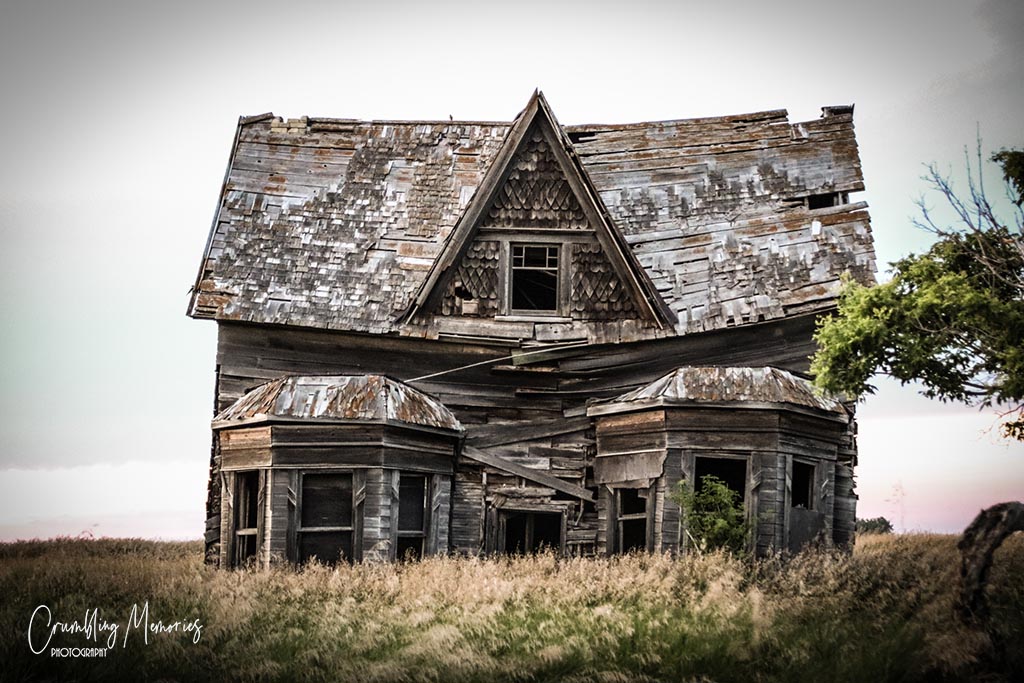
This photograph! Its a total fluke. It was close to dark when we arrived, as you will see from the other photos I post. I had been struggling with camera settings all evening but got this. Cade would like me to blow up and frame this for the living room. Not really my thing, to have my own art on display but I do really like this photo. Cade tells me that its one of his favourites that I have done. I am pleased that this turned out because I actually got a good idea of what this beautiful house looked like. This is by no means close to where I live but I do plan on going back.
Anyways, back to the history. Upon arrival to this area, the family needed to set up a homestead. There were few trees in the area but lots of uncultivated prairie grass. The family set up tents and got to work building a sod house, sod barn and even a sod grainary. I do not know when this house was built. But when they built it, they built it well. There is no shelter belt around the home and stands out in the wide open prairie.
Farmers in this area were said to make a week long round-trip trek to Brandon to sell their grain. They welcomed the arrival of the train to nearby districts which shortened their trip to sell their crops.
The entire family homesteaded in this area. George passed away from cancer in 1894 and Isabella died on February, 1909.
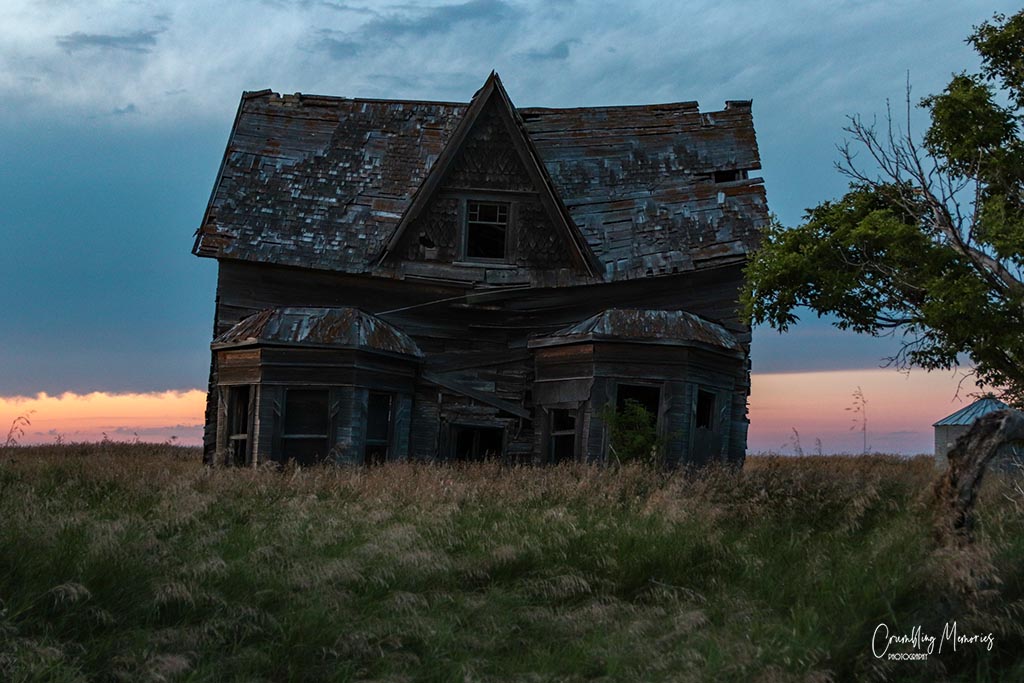
My companion on this trip was adamant that we get to this house and another to capture the sunset. We stood here for awhile as the sun quickly faded below the horizon. The sky changed quickly from the time we left Prohibition Church, made a pit stop at another house and then made our way into this one. Even for the 10 or so minutes that we stood in front of this house, it changed a lot.
I have to admit, I did not enjoy my walk into this property. Lots of badger holes, grass up to my waist in some areas. My exploring buddy led the way, which I am grateful for.
This is near the start of our walk in. I thought I’d like to stay along with field but that didn’t work for us getting back out. God I hate tall grass. I hate when I cannot see where my feet are landing.
I do believe that this is one of the oldest histories that I have found. When I was able to connect a family to this property I was really excited. From the map I am convinced that the other side of this house is just a amazing as this side and I have every intention of making the trek back to see it.
JFA, born in Ontario in 1850 followed his father to Clearwater, Manitoba in 1881. The following year he came to this property with his wife. Here they raised a family of 8.
It is said that JFA was the first settler to build a home in this township and range. He built a home of logs for his large family.
The homestead remained in the family and eventually, JFA’s grandson took over the farm where he lived with his wife. BA lived here with his wife Mary but they never had a family of their own.
I wonder if this is the original structure, refinished or if this is a new build all together. There was a garage on this site not far from the house with an old Ford truck parked in front of it. Not far off the drive was an old combine up against some trees. The grass was very tall and think and I wasn’t going to chance it.
I think this is a pretty big house for its time. I would love to see the inside. I would love to see what it looked like in its glory.
























 CRUMBLING MEMORIES