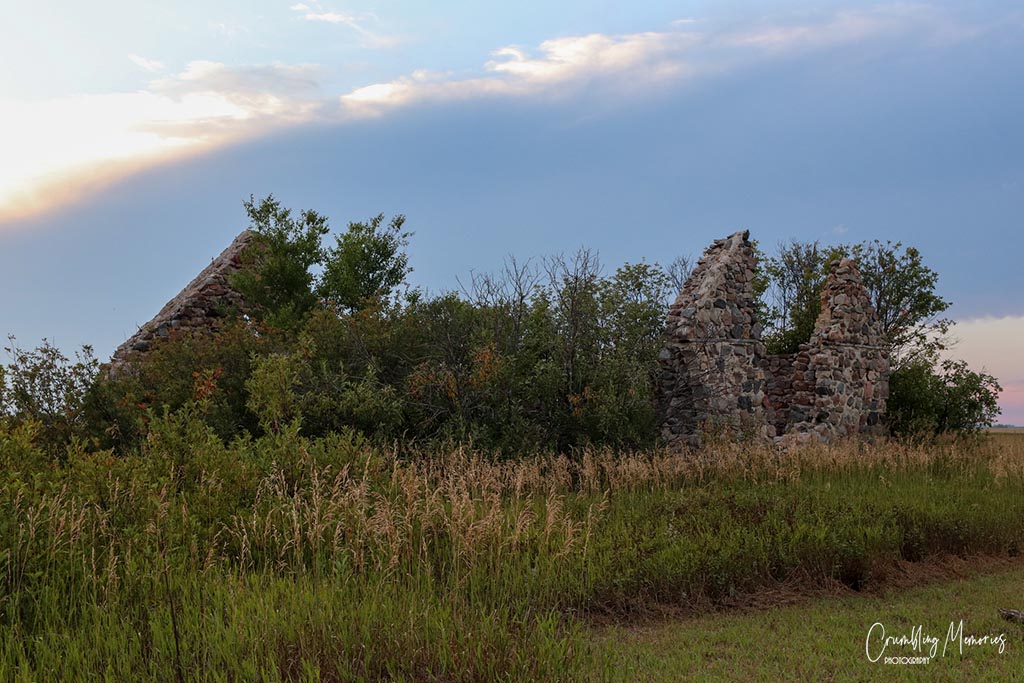
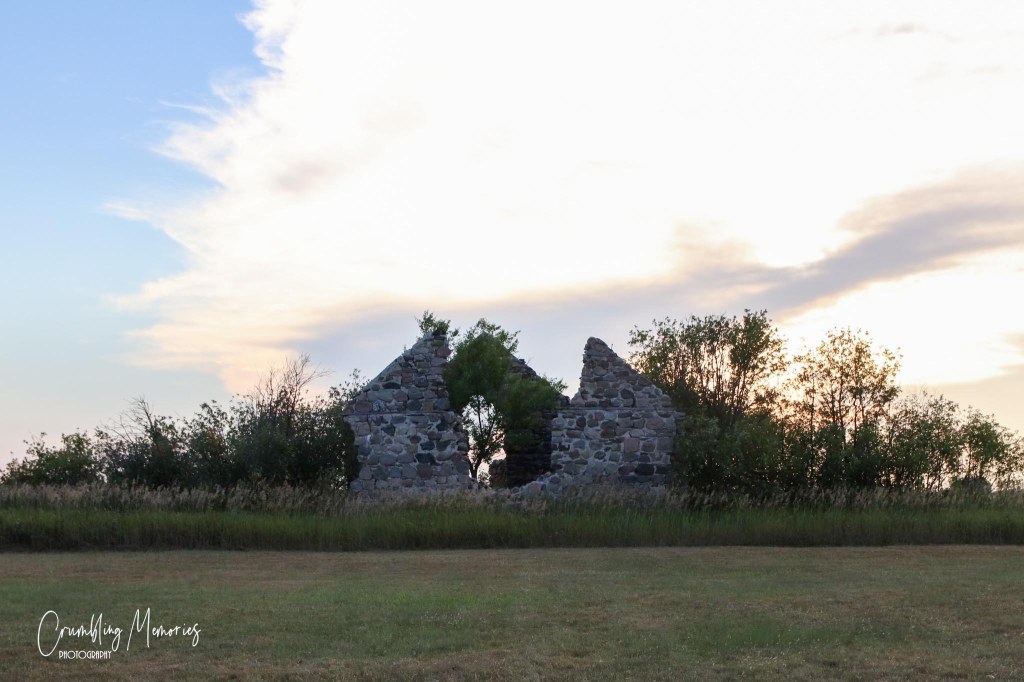
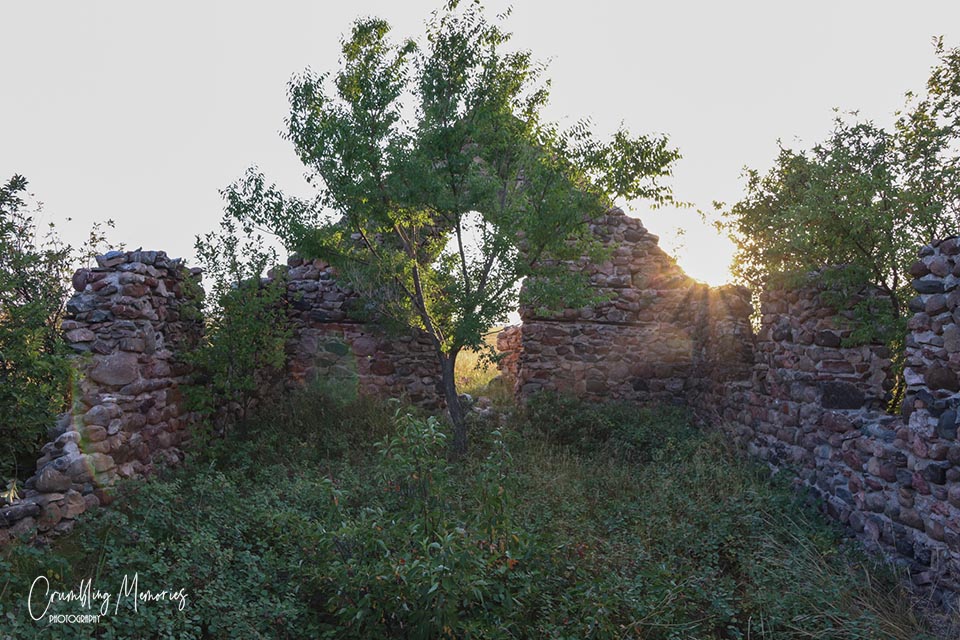
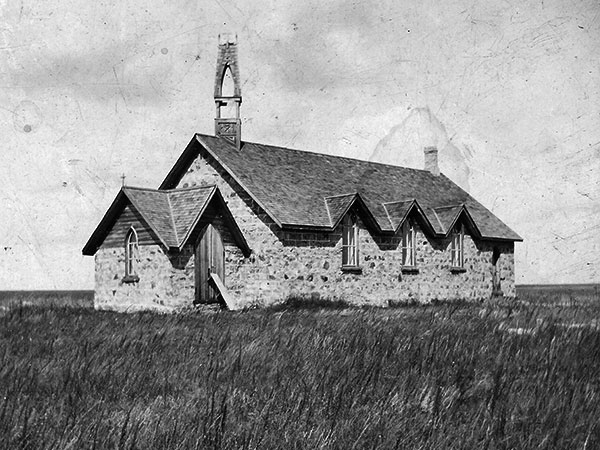
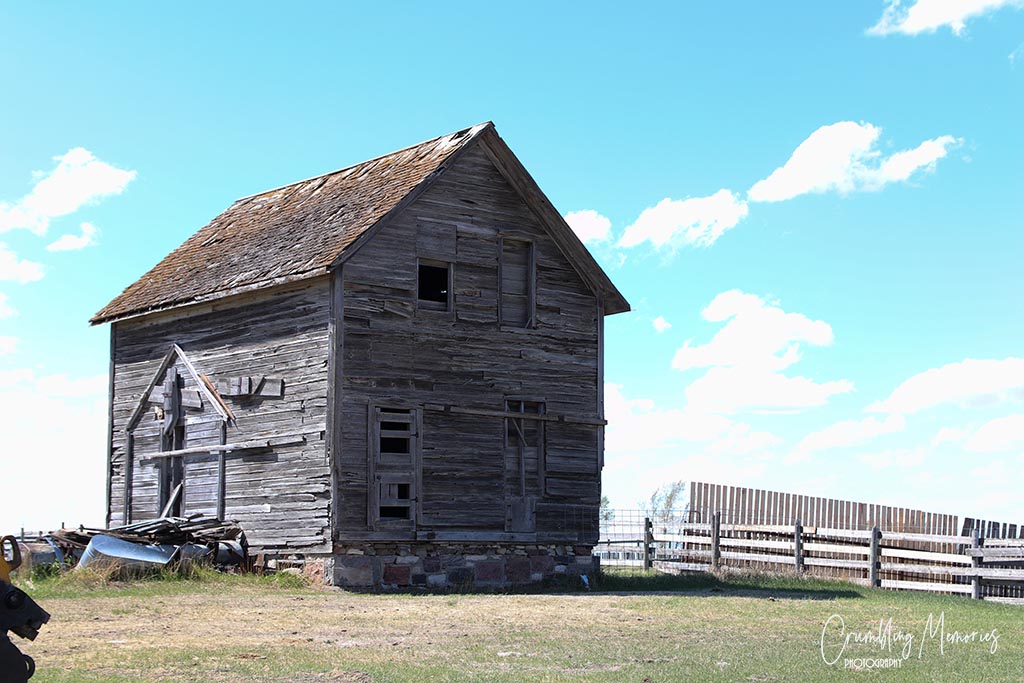
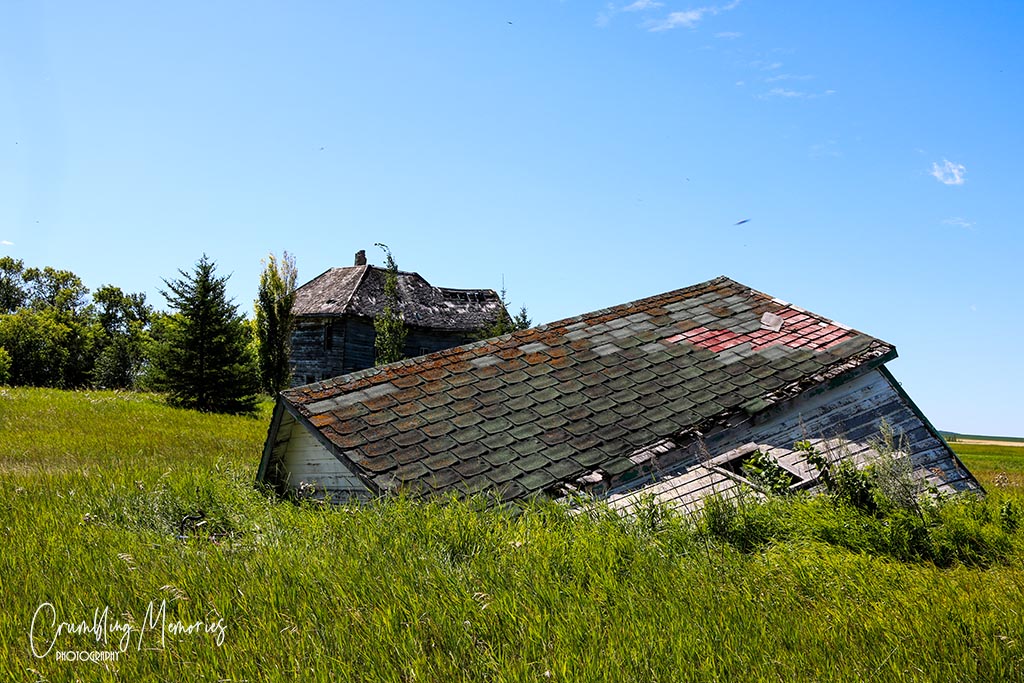
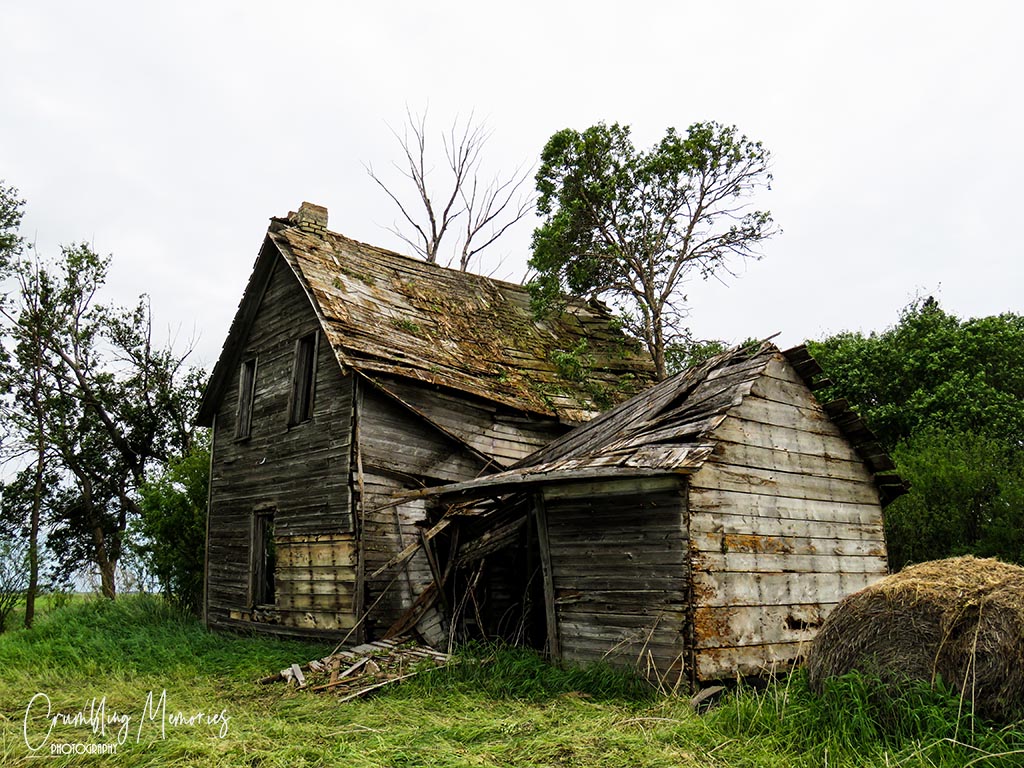
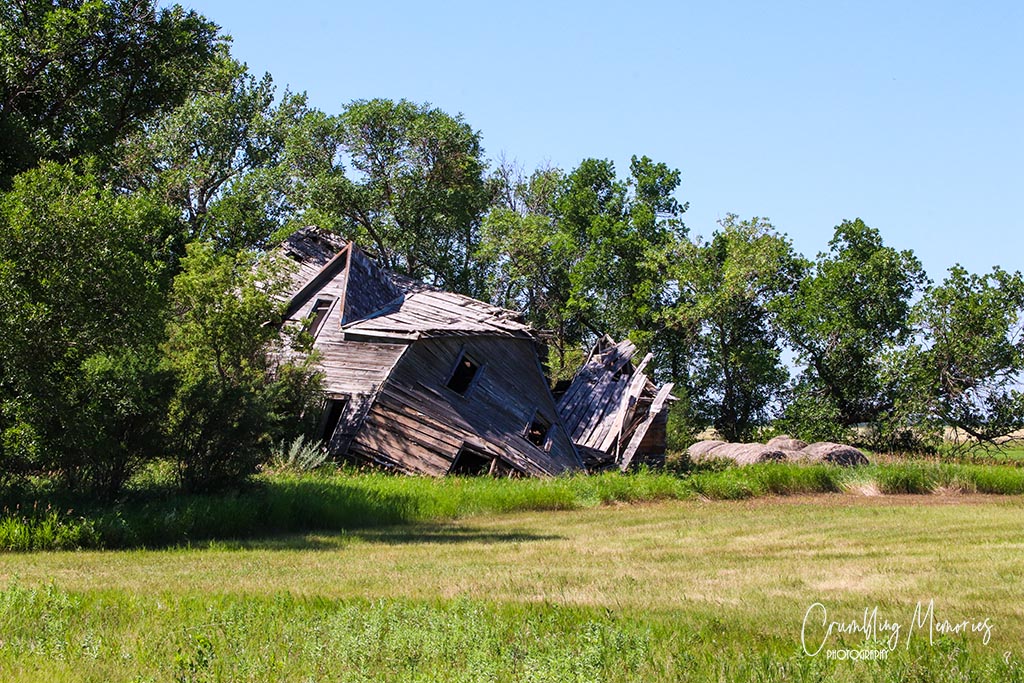
CROFTHEAD FARMS – 1881

This sign is one of the coolest things I’ve seen given that it actually states when the homestead came to be. I have removed some of the information from this sign which gives away its location. I love that this sign confirms when this homestead came to be.

John & Mary, both born in Scotland in 1847 and 1845 immigrated to Ayr, Ontario in 1868 where they lived for 9 years. In 1877 they made their way to Manitoba by Red River cart and arrived in Portage la Prairie, Manitoba where they remained for 4 years.

In 1880 Mr. filed for this homestead and was one of the homesteaders in this district. That summer he built a soddy and the following year he moved his family here. Mr. & Mrs. raised 9 children on this land. For several years that soddy was a stop-over or half-way house for other farmers moving grained from Deloraine to Brandon. It was here that they would replenish their supplies and rest.

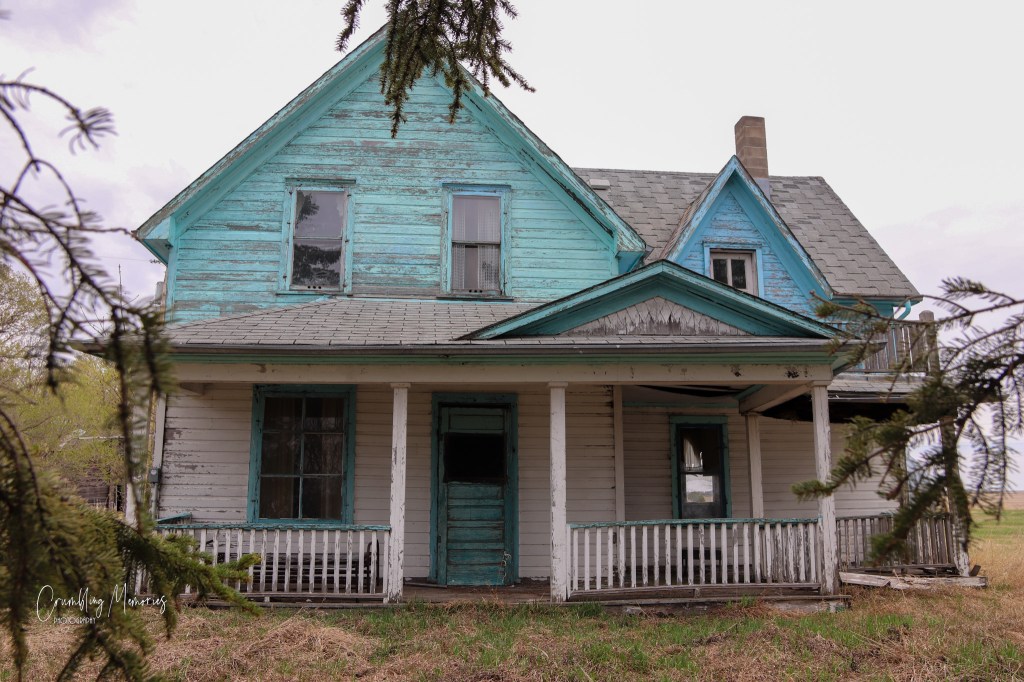
This house was built in 1885 and was last recorded to be owned by Mr. & Mrs. grandson, W. Jack.

Mr. & Mrs. retired to Victoria, B.C. in 1912.

All 9 of their children attended Millerway School which was built in 1884.

The couple had a happy life together and celebrated their golden wedding anniversary in 1919 (50 years) and their diamond wedding anniversary in 1929 (60 years).

Mr. passed away in March of 1931.

Mrs. passed away in August, 1935.

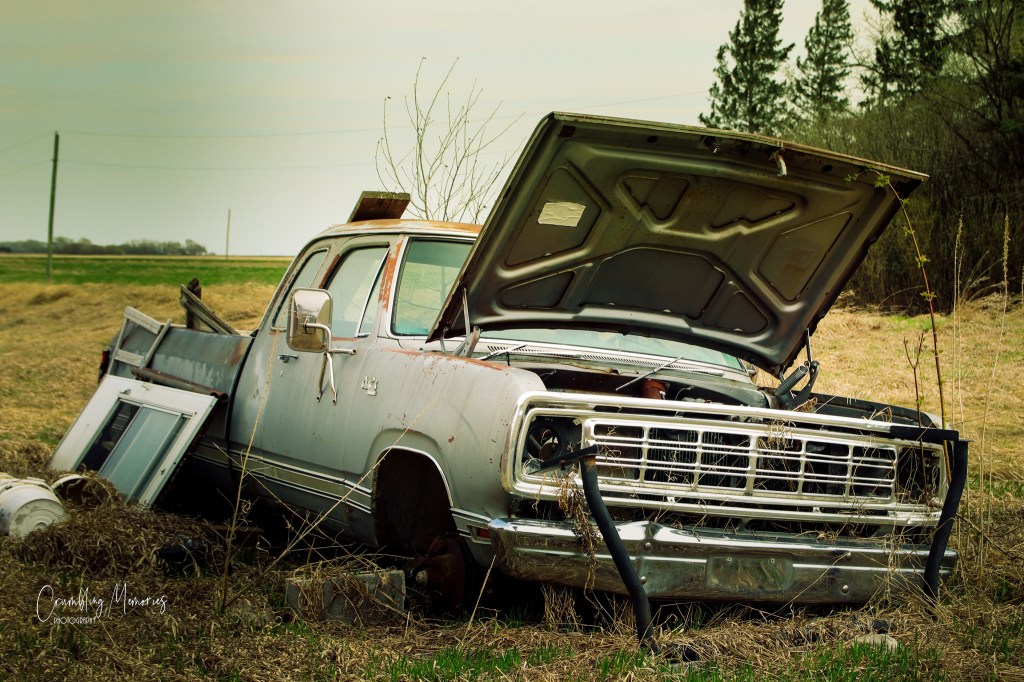
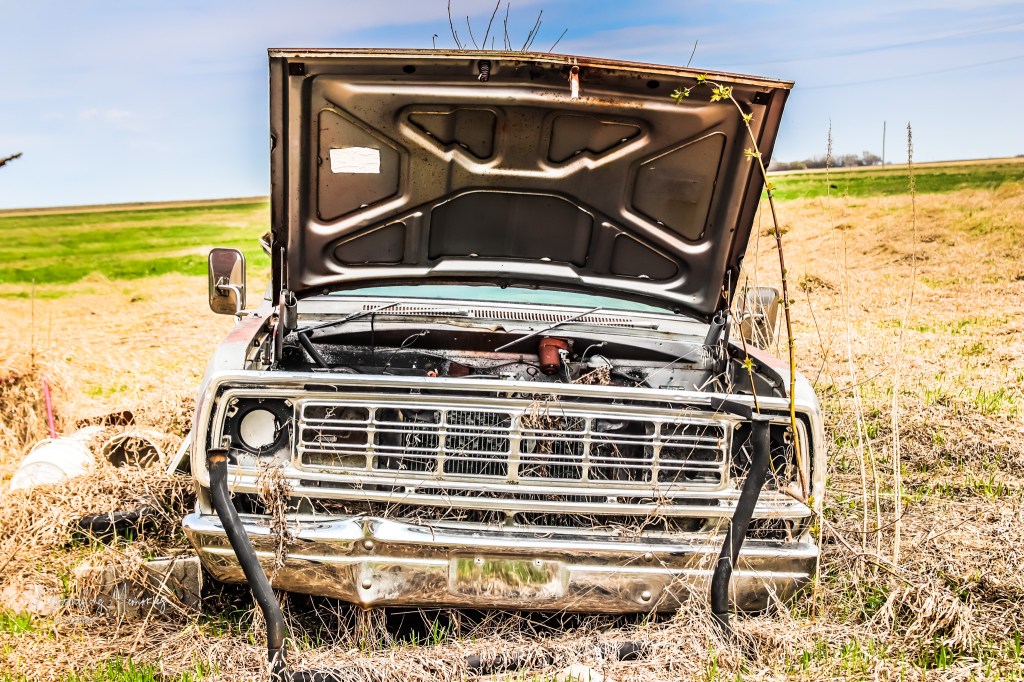
The best thing about a bando house hunt is when I find old cars there.

THE WILLOW ROW FARM

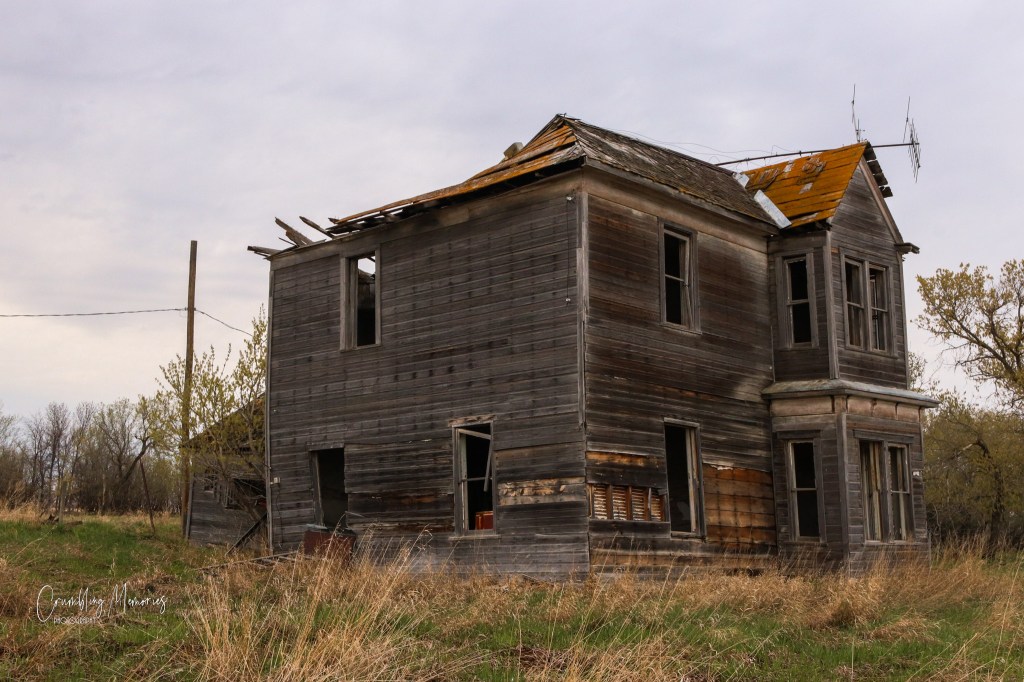
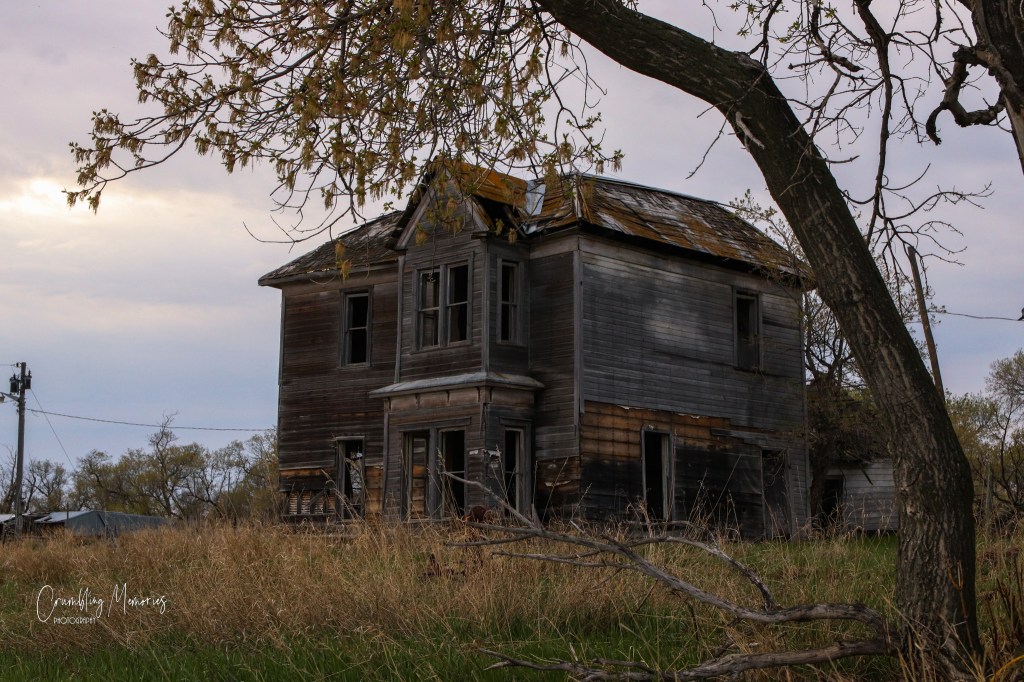
The original homesteaders of this property came to this land at the turn of the 19th century. The first official recording that they were the landowners is dated 1901. Owned originally by one of the brothers of this family, the first brother to own this land, William, turned the sod making it ready for farming and construction of a forever home.

In 1904 William sold the land to his brother James who lived here until he retired. At that time he son, namesake of his uncle and his dad, took over.

This property has a long drive and is beautifully treed. This is also the spot where Christian and I got most of our wood ticks that day. I’m sure that we picked off at least 50 at the end of this driveway before we got back in the vehicle.

In 1920 this land was sold Mr. Taylor but then repurchased it. James later sold the land again, this time moving to a different district to farm, but again bought the land back. It does not state why the land was sold but it does say it was purchased back due to adverse conditions.

James and his wife Bessie raised three children, mostly on this homestead. In 1930 they retired from active farming and moved to the closest town. Mr. died in September, 1953 and Mrs. not long after in April, 1954.

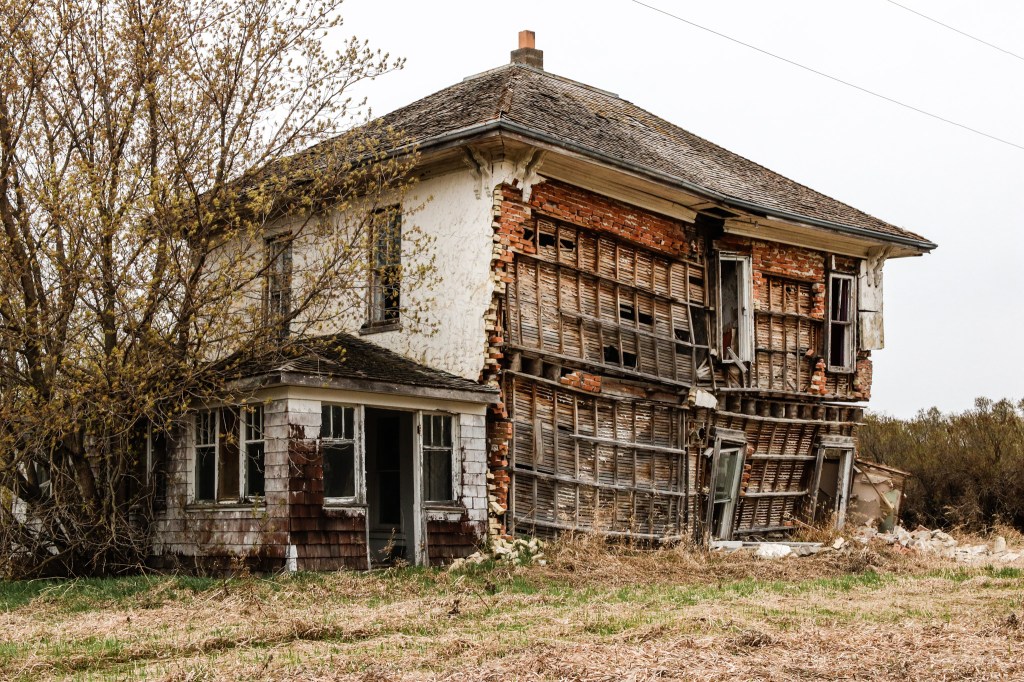
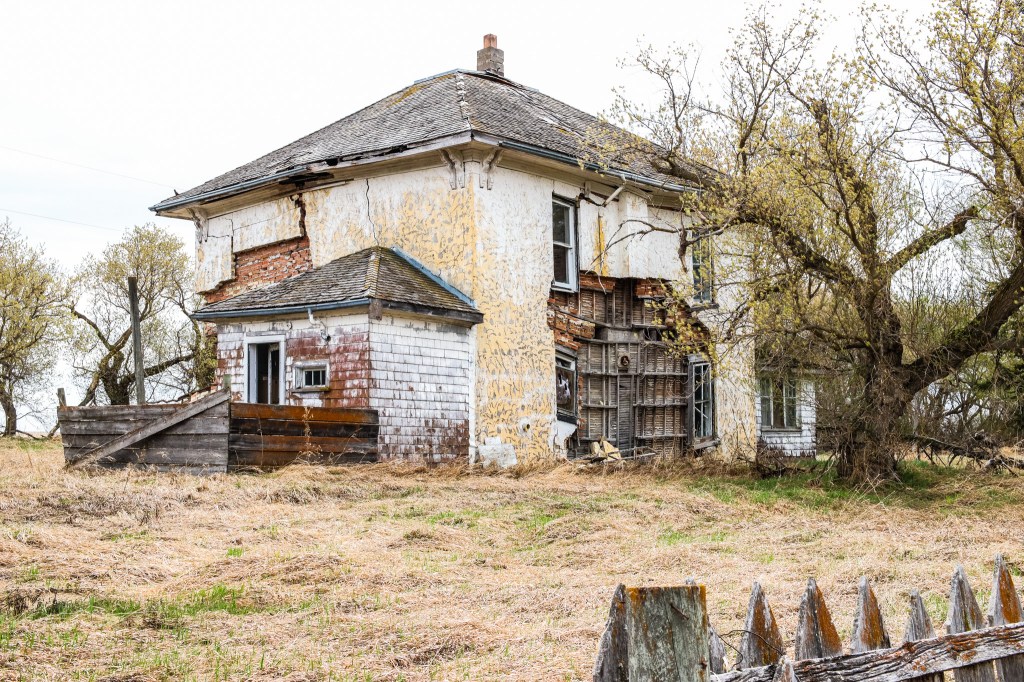
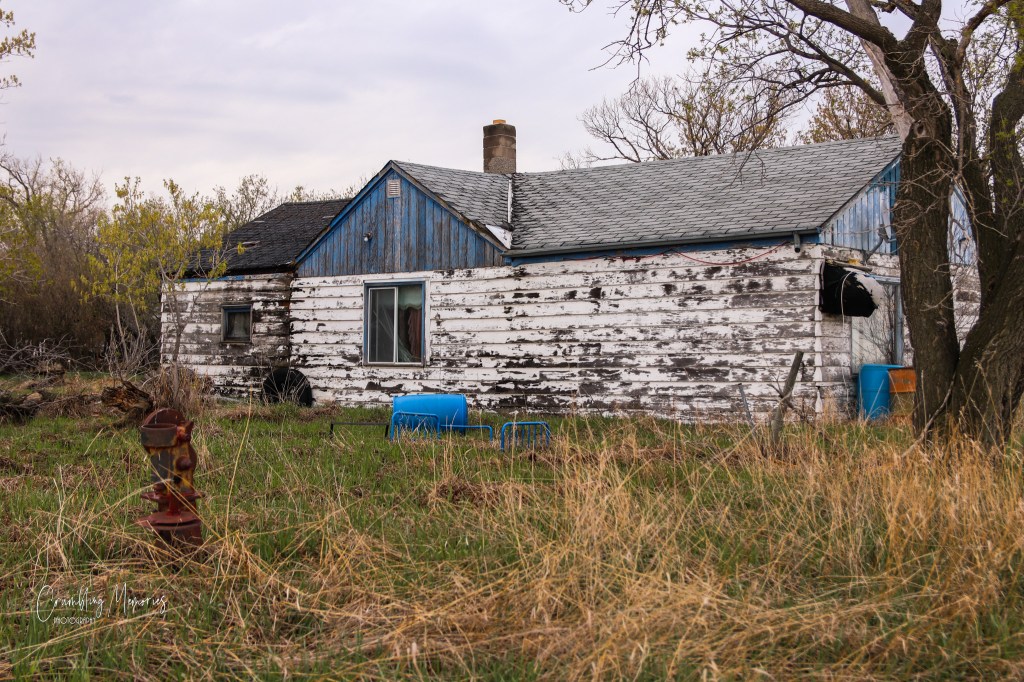
This was not the first house we went to on this day that was suffering from the same sort of decay. I am going to make the assumption that at one time, these were brick homes. In an effort to modernize them, stucco was applied over the brick. With time, the roof began to leak and the water ran between the two layers causing this deterioration to happen.

Inside the house we could see the remains of furniture and a bookshelf with puzzles and games.

IT WAS ONCE THE MITCHELL’S

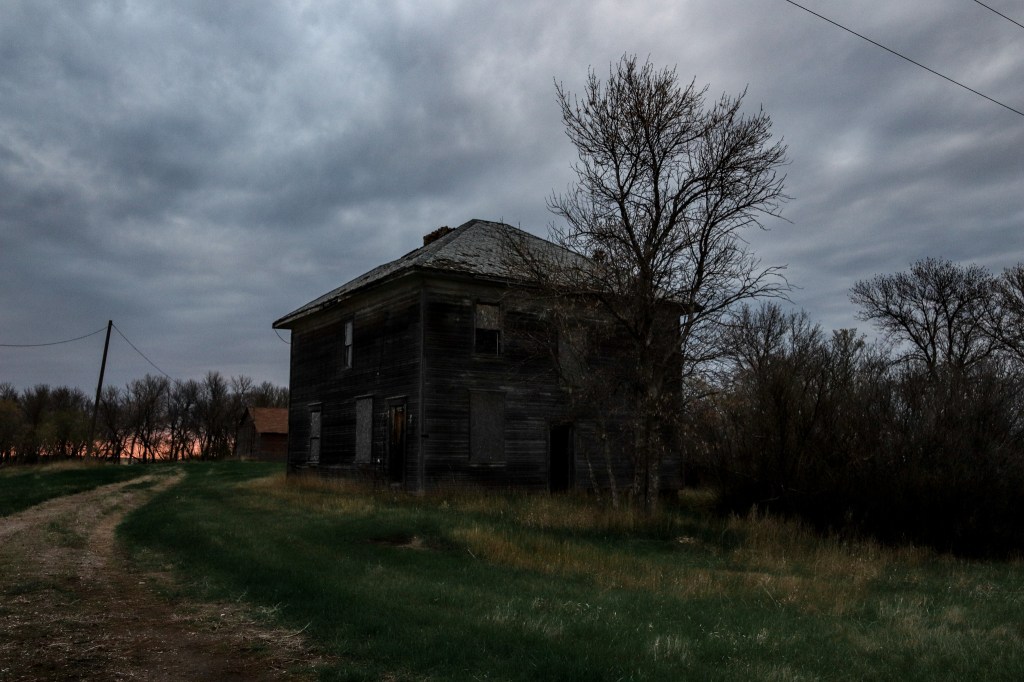
Back to that day when Christian and I went out, one of the first houses we stopped at on our venture was this one.

Visible from the road, this was an easy stop. After fiddling around with my camera for a bit we got ourselves on the other side of the trees.

This big old two story house with the missing door upstairs wouldn’t want to be something I came across at night time. I wasn’t at all freaked out here but with the dead trees in the front, I could see how one would be.

The history I found on this homestead is not of the original homesteaders. That is of course somewhat disappointing to me but its better than nothing. That being said, here we go. The second homesteader of this land immigrated to Canada in 1903. Born in 1881 in Country Cork, Ireland, he moved to the area and married in 1908. Having worked for many farmers in the area and renting land to farm, he moved from the land he originally lived on and in 1921 eventually moved to Neepawa. In 1927, Mrs. passed away and he came back to the area.

In April, 1928 to be exact, the family moved back to Elgin, Manitoba but he again rented land. It wasn’t until 1942 that him and his children moved to this homestead.

Mr. retired from farming in 1951 at the age of 70 and moved to Brandon where he lived until he passed away in 1964. Mr. and his wife raised 6 children on various farms in the area as well as in Neepawa. Upon Mr.’s retirement, his youngest son and his wife took over this farm and raised their family here.

NOT ONE BUT TWO

The first recorded landowner recorded for this section of land is 1889 but there is no family history. So, I don’t know who built this house. Regardless, she’s a beauty.

In 1906 Mr. quit his job at the chair factory in Orangeville, Ontario to move to the area. He boarded a freight train with the machinery, furniture and household effects of the Anderson Family. Upon his arrival to the area he was hired as a farm hand on another farm. In 1911 he rented this land from the previous landowner.

In January, 1912 he married Helen, the daughter of the family whom he traveled with to the area with their belongings. They bought the land and lived there until 1954.

When they left the land they retired to Melita. During his active years Mr. was on the school board in the area and was a counsellor for 13 years. Their youngest son took over the farm and raised his family here.

Before marrying Mr., Helen was a school teacher at Brown’s School from 1909 to 1911. She began teaching at 16 years of age.

While walking up to this property we discovered that the Souris River runs through it. The water was full of ducks and small birds. In the distance I could hear an owl taunting me but I could not spot it.

There were two houses on this property . This newer house must have been what the family moved into when the original farm house was no longer livable. I love that the house was preserved to some extent.

Mr. & Helen raised 9 children on this farm, 4 boys and 5 girls. Mr. passed away in 1963 and the history that I found for this family was written on May 26, 1982 by Helen who was in her 90th year. I visited this house on May 13, 2023.

At the time that Helen wrote her family’s history, there were 25 grandchildren, 30 great-grandchildren and 5 great-great-grandchildren.

Then the 30’s rolled around and the family faced the depression, the dust bowl and the grasshoppers. At the time the family had a car, a piano and a telephone. Mr. sat down with his family and said something had to go. Helen said that the telephone had to stay, in case of an emergency. The children all wanted to piano for entertainment. So, Mr. put the car up on blocks and parked it. The family relied on a Bennett Buggy for transportation.

I did find this one strange piece of equipment in the yard. I took a photo of it with the hopes that my husband could identify what it might be but he wasn’t sure.

Now I’m wondering if the old car is somewhere on this property. Maybe the owl was trying to lure me further into the yard in the tall grass and treed area so I would see it!

EMPIRE LOYALISTS

TJB was born in 1872 to Empire Loyalist parents in DeCewsville, Ontario. TJB moved to Canada in 1892 in what was referred to as a “harvest excursion”.

What is an Empire Loyalist? Due to the American Revolution, approximately 8,000 Brits came to Canada and migrated to an area in Southern Ontario. Those people were among the first white settlers of the province and were instrumental to creating the Province of Upper Canada 1791.

Christian and I were on our way home for the day after an almost 11 hour day hunt and shoot. We had just finished up and the well groomed yard when he remembered this place which had some old cars which he knows I also enjoy photographing. It was getting pretty dark so we weren’t sure what we were going to get. Again, I wasn’t sure what I was going to get in this lighting and I also underestimate what I can do. That am I’m not much of a risk taker because don’t want to miss a shot.

In 1894 TJB married Emma in Deloraine. Emma was the first woman to live in Medora. The first home they built was where the Medora Service parking lot is now and they lived there until 1903.

TJB played for the local baseball team and was a goalie for a football team. He was the secretary for the Sunday School and the Literary Society. As well, he was a member of the Orange Lodge. The Orange Lodge is a group of Protestants who were committed to the protection of the principals of the Protestant Reformation and the Glorious Revolution of 1698 which enshrined civil and religious liberty for all. The Orange Lodge has existed in Canada since at least 1812.

Emma was a very involved in working with the church and was a life-member of the Women’s Institute. Emma was also a well known dress-maker.

From what I have read or found about this property, I can’t tell you anything about these old trucks nor can I link them to this family.

During my old car photo shoot, Christian was wandering around the house so I thought I had better get over there and take some photos before it was way too dark.

Here is where I get a confused by what history I have found. It says that TJB built the house in 1903 which is now owned by another farmer in the area. “This old house was moved to the farm.” So is this the house that was built on the service lot in Medora and moved here or was the house built on the service lot sold to the other farmer and he moved it to his own farm? Regardless, she is a big old beauty.

TJB and Emma raised 5 children on the homestead. Their oldest son George who was born in 1897 later left this property to his only son when he retired and moved to Medora in 1974.

TJB passed away on June 8, 1930 and Emma passed away on August 14, 1962.

JACK & DIANE – WELL, NOT QUITE

The furthest I can go back on this property is 1922 when this property was bought by Jack & his wife. Married in 1908 the couple lived six miles south of Medora where they raised four children. In 1922 they moved to this property but I cannot confirm whether or not they built this house or if it was there when they bought the land.

Jack was born in Shropshire, England on February 5, 1879. He came to Canada in April, 1906 and met and fell in love with his wife. She was born in Montgomershire, Wales and also immigrated to Canada in 1906. Jack passed away in 1962 and his wife in 1965. Their only son took over this land.

Born in January 1913, C.S. received all of his school in the area. Fond of sports, he was active in hockey, curling and baseball. He farmed his parents land until he sold same in the Spring of 1969 when his nephew took it over.

A few years later, C.S’s nephew’s Grandson took over the land and I believe he still owns it today.

After a day of wood ticks, this stop was a blessing. The ride in was easy and the grass all around the house was cut. It was a nice change for the day. The dreary, cloudless, grey sky we had shot all day wrapped up with this beautiful sunset. This house had been on my to-do list for a long time and I’m happy that I finally got to it.

RED BARN

Located just off the road heading into Deloraine, MB, I have passed this barn many times over the years while going to hockey.

On this particular day, the kids and I were headed there for baseball and I was itching to take a photograph of anything. And this is what I did.

HOMESTEAD #3136

Referred to as Homestead #3136, A.J.W was born on September 28, 1840 near Picton, Prince Edward County, Ontario. A.J.W graduated from a military school and later became a Captain of the 16th Battalion during the Fenian Raids. When he wasn’t serving he was a woodworker who specialized in making cases for organs and pianos.

It is said that A.J.W married his wife in Ontario in 1863 or 1864.

A.J.W and his wife raised four sons in Ontario and then decided to move to Manitoba through Emerson. They settled first in Rapid City.

In 1885 after snowshoeing to the area, he found this property. A.J.W moved his family to the land and there, they wintered, in a tent, on the property. The following summer, this house was built.

A.J.W passed away in 1909. His wife died in 1933.

While we were able to get right up to this home, I didn’t go inside or even look inside.

This house for me will always be known as the Coyote House. While making our trek down the road, along the field line, there was a dead coyote.

HARTLEPOOL, ENGLAND

George was born in Hartlepool, England in 1837. On December 9th, 1859, he married Isabella and together they raised seven children.

In 1880 they arrived in Barrie, Ontario with the Hunt family. They stayed there for 6 years where they worked at a saw mill.

On April 1, 1886 the entire family moved to Manitoba. They considered stopping in the Red River Valley but worried about clearing all the trees and stopped for a short time in the Hernfield District before settling on this property.

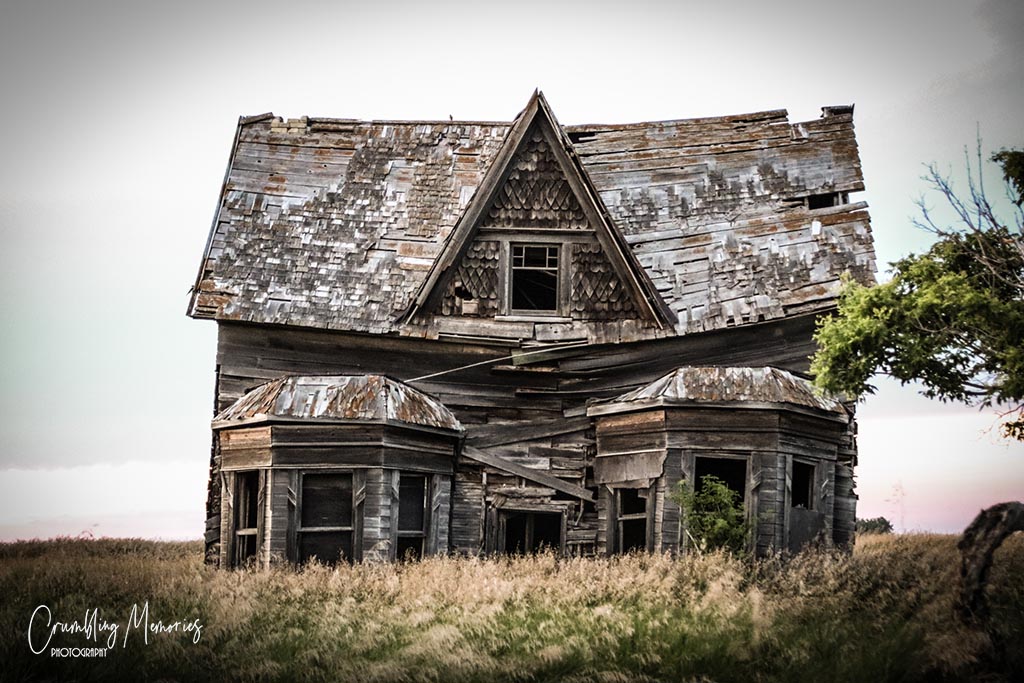
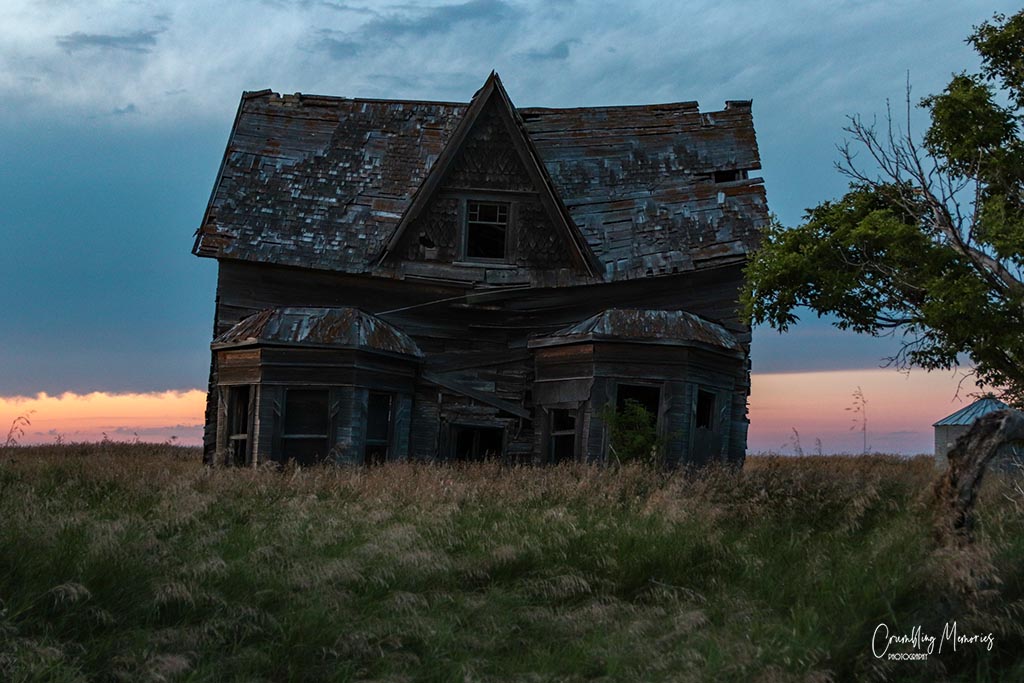
This photograph! Its a total fluke. It was close to dark when we arrived, as you will see from the other photos I post. I had been struggling with camera settings all evening but got this. Cade would like me to blow up and frame this for the living room. Not really my thing, to have my own art on display but I do really like this photo. Cade tells me that its one of his favourites that I have done. I am pleased that this turned out because I actually got a good idea of what this beautiful house looked like. This is by no means close to where I live but I do plan on going back.

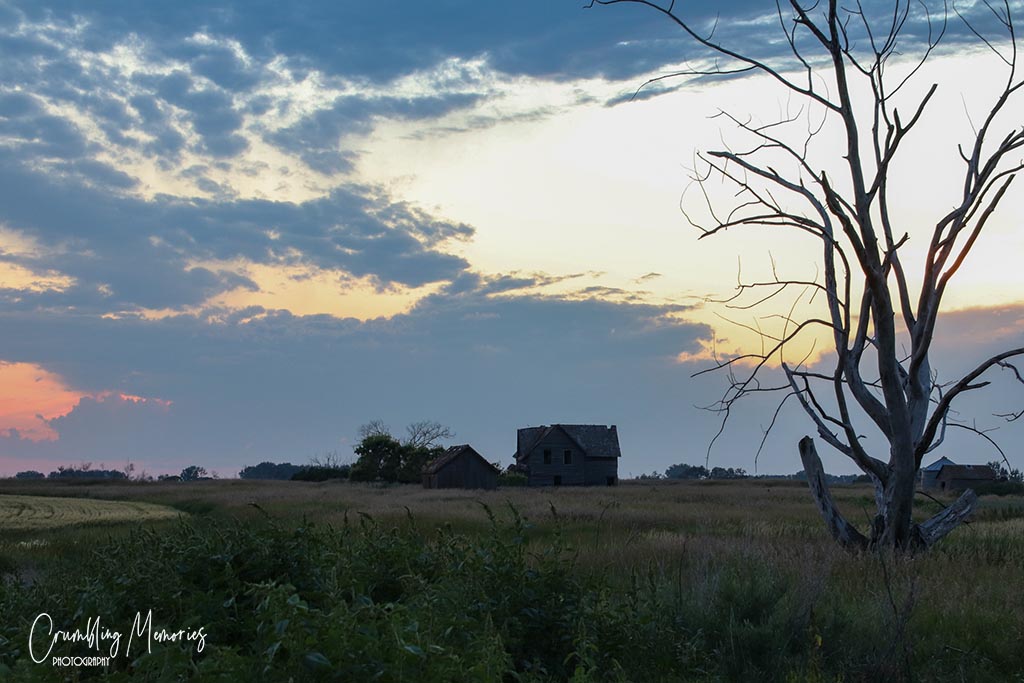
Anyways, back to the history. Upon arrival to this area, the family needed to set up a homestead. There were few trees in the area but lots of uncultivated prairie grass. The family set up tents and got to work building a sod house, sod barn and even a sod grainary. I do not know when this house was built. But when they built it, they built it well. There is no shelter belt around the home and stands out in the wide open prairie.

Farmers in this area were said to make a week long round-trip trek to Brandon to sell their grain. They welcomed the arrival of the train to nearby districts which shortened their trip to sell their crops.
The entire family homesteaded in this area. George passed away from cancer in 1894 and Isabella died on February, 1909.

My companion on this trip was adamant that we get to this house and another to capture the sunset. We stood here for awhile as the sun quickly faded below the horizon. The sky changed quickly from the time we left Prohibition Church, made a pit stop at another house and then made our way into this one. Even for the 10 or so minutes that we stood in front of this house, it changed a lot.

I have to admit, I did not enjoy my walk into this property. Lots of badger holes, grass up to my waist in some areas. My exploring buddy led the way, which I am grateful for.

This is near the start of our walk in. I thought I’d like to stay along with field but that didn’t work for us getting back out. God I hate tall grass. I hate when I cannot see where my feet are landing.

I do believe that this is one of the oldest histories that I have found. When I was able to connect a family to this property I was really excited. From the map I am convinced that the other side of this house is just a amazing as this side and I have every intention of making the trek back to see it.

BOOTLEGGER’S CHURCH – COPLEY ANGLICAN CHURCH

This stone church, formerly known as St. George’s Anglican Church was fifty-six feet long, twenty wide and twenty tall is located approximately 5 miles from the Saskatchewan border and 2 miles from North Dakota. The organization and fundraising efforts to build this church were headed by Goddard Gale and construction of same began in 1890 by Mr. William Cornwallis. Two years later in September 4th, 1892 the church was consecrated by Bishop Robert Machray.

Goddard Gale was an artist from London and the son of a well-known barrister and a cricket player. Goddard is also rumored to be the first “white man” to set eyes on Lake Louise. Mr. Gale was a surveyor and engineer for the Canadian Pacific Railway and a staunch Anglican. When he took up residence is what was once known as Butterfield, he became a community leader and a council member for the RM of Arthur. Arthur is what this area of the province was before it was split into three smaller municipalities. In 2015 it was then reunified into one large RM known now as Two Borders.

When Mr. Gale started fundraising for the church on this 4.6 acres of land, stones were gathered as he wrote letters back home to his friends where he told them this would be the first Anglican church west of the Souris River.

As settlement started dwindling, church attendance also waned. In June, 1913 the church was deconsecrated. Some of the contents of the church were taken to a new building in Pierson but the organ and photos were taken to Eunola School.

Locals from the area told stories about Prohibition and how given the location close to the American border and the very isolated location of the now vacant church, it became an attractive hideout to bootleggers. I certainly didn’t get any Al Capone vibes while here.

Upon our arrival at the church, the sun was blaring, there were no clouds in the sky. I was a tad bit disappointed. Back at the start of Covid, Cade, Makenna and I drove out this way with the intention of visiting this location. We ended up heading North after a stop in Elva and I didn’t think I would ever make my way down here again. Yesterday a fellow bando hunter took me down here to do some touring. I’m glad he did. And I’m glad the sunset improved. Within fifteen or so minutes after our arrival, the infamous “golden hour” revealed itself.

After years of abandonment and vandalism, in 1932 the windows and doors of the church were boarded up in an effort to save the building. Inside the structure are obvious signs of a fire. I would have loved to have seen this place before Mother Nature and vandalism took hold.

In 1967 it was recorded that the building was still intact.

Driving around this area, there are very few cars and people. In the late 19th and 20th centuries, it is said that the government did all they could to entice people to this area. It is said that people from Britain and Northern Europe were heavily recruited. During the recruiting process no one took into consideration the climate these people would endure here on the wide open prairies nor did they consider if farming on this land would prove successful before they made their way to Canada from abroad.

And then there is this old truck. I will admit, at first I was a bit more excited about this old truck than I was the old church. What role this old truck plays to this historical site is beyond anyone’s knowledge. I googled it, but not to thoroughly, so I’m just going to pretend that a bootlegger parked his truck here to hide out in the church and then had to escape by foot and never came back for it. Its perfect right where it is and has been subject to many photographs in its time, as this old field stone church as its backdrop.

CONCEALED

Here is another house I photographed back in the late summer of 2020. It is another one that I cannot find any concrete history on so, I’m just going to leave it here and if that ever changes, I’ll re-write my post and share its story.

This home is well hidden. It was rented out for a time but once the last tenants moved it was quickly taken over by Mother Nature. I did not get close as the vegetation was quite high and I was alone. Better to be safe than sorry. I know that Cade’s aunt worries about me alone on these excurisons and the possibility of there being a well, so I err on the side of caution.

A PLACE FOR HORSES

This place is right outside my door. Well, not really but its a stone’s throw.

Its been on my to-do list for a very long time and I just sorta took advantage of it being there and something I could get to at any time. So last spring I wandered over there and the current owners were there and said come any time. The only stipulation was that I close the gate and don’t let the horses out.

If you know me you know that I am afraid of dogs. And to me, horses are big dogs. So when I went I decided I would not go inside the gate if I didn’t have to.

It was windy as heck out but the clouds were amazing. To me the sky looks painted. Believe me when I say that there is not filter on this photograph, this is straight out of the camera. The sky is almost too good to be true.

I have tried to get more information on this property and cannot. And given that its been some time since I’ve been out and posted, I’ve given up on the idea that I will be able to solidify any further information so, I’m posting.

I can tell you that the property has been rumored to be owned by a couple of different families whose ancestors still live in the area. I can also tell you that the house was last occupied in 1920.

BLUE ROOF

I seen a photo of this house a few years ago and wondered if one day I would spot it given its in my territory. I was thrilled when a fellow bando friend posted a photo of it and shared its location with me.

Even better, its on land owned by a friend. So Cade took me out to check it out. I would have walked in closer but the thistles were waist high and thick. This was close enough for me, although the other side and a peak inside would be cool. Maybe in the fall.

Downfall, no history. Can’t have everything, right?

ROADSIDE TREASURES

On the way home from a shoot last August, I found this along the way.

Why its taken me so long to blog, I do not know.

At the end of the day,difference because I cannot find any good history about this big, old beauty.

I never really know what I will find when I photograph an old property. I go and shoot everyything that catches my eye and sometimes I am lucky enough to make a connection to what I read. That is really why I keep doing this.

And sometimes I’ll be working on a history and find a connection to a property that I blogged months before. Its exciting to go back and add those interesting tidbits. Maybe, as I start to explore this area more, I’ll find something.

Regardless, I really liked this old house and the surrounding out buildings and I’m happy I took a detour home that day.

JOHN & LENA, CARL & RETA AND SO ON

John, from Beauharnois Country, Quebec and Lena from Emerson, Manitoba married in Killarney on December 29, 1899 and raised 10 children together on this land which John acquired in 1898. John earned an income to support his family by farming and running a hardware store in Neelin. He was also a carpenter. Lena was known to be a stern mother who instilled good values and principals. John passed away in 1937 and Lena in 1973.

In November of 1923, newly married Reta & Carl made their home on this land where they lived and raised their family. In 1966 the semi-retired to Killarney. The frugal couple raised two children on this homestead. Reta & Carl were the second family to own this homestead.

Carl & Reta, determined to make a living and “owe no man nothing”, worked from dusk till dawn to make a living and raise their children. It is said that Reta would do the work of a man and did things such as driving fence posts with a maul as heavy as herself. She broke horses, milked cows and raised chickens. She would support her family by trading milk, butter, chicken and eggs for food. If her grocery bill was more than she had in cash or trade, Reta would put the unneeded items away until next time. Reta & John would not hold a charge account. They prospered and made a good life for themselves and their children.

Upon Carl and Reta’s retirement, their son Glenn stayed on the farm and raised Aberdeen Angus cattle. He then raised four children on his own on this farm with his wife whom he married in June of 1955.

In 1982 Glenn and his wife purchased a family restaurant in Killarney while living on the home farm which he purchased from his parents in 1974.

This is a beautiful homestead. The house and outbuildings are very nicely treed in and its not far from your basic needs like food and gas. The homestead is no longer owned by one of the two original families.

BEING STRONG DOESN’T MEAN YOU WILL NEVER FALL DOWN

Back in June, 2018 (yes, 2018) I went out to this house. It was one of the first I got permission to photograph and I have gone back a few times since.

Back to that 2018 thing. I cannot believe that I have been doing this since 2018. Wow!

Anyways, here it is back then. The floor was giving out, the roof was caving in and the stairway was a mess. I did not step inside the home but I could get up to the windows and doors and see inside.

Today I went back. Mother Nature has had her way with this place.

DEVIL’S GATE AND CAPOTE

Remember this place? And the guy with the gun?

Back in February I received an email through my blog from the Granddaughter of the Baleja family, the second last owner of this property.

I learned that there was a second movie filmed on this property by the name of Capote which came out to the public in 2005. I haven’t looked it up but I will, one day. I was told by the Granddaughter that when Capote was filmed, film crews laid limestone on the roads in the area to make it easier to get their equipment down the roads. This is why the road is made up of nice black dirt.

She also told me that her Grandfather bought the property in 1947 from a local man. A search of the name by both of us came up empty handed. I have made a request to my local library to see what sorts of material they might be able to borrow from another location for me.

There is apparently a drainage ditch near the house (which I did not notice) which was enchanced by the RM and the City of Winnipeg, I’m assuming and is called Z dike. The purpose of the dike was to protect Winnipeg from the infamous Flood of the Century.

The house is actually two houses. One of the houses was brought in by the movie company in 2015. The orginal house in the tangle of houses was moved from the other side of the road and you can see that there is an old yardsite there. The purpose of bringing the two houses together was to give the house a creepy appearance. The current owner advised the Granddaughter that the inside of the house had cable supports inside to support the joining of the homes and/or set.

And the barn. What a sight. This house, when I first seen photos of it, were taken by my Winnipeg Bando friend, Lee. She loves this old barn. Well, the structures on the roof were added by Grandfather Baleja as was the granary on the front.

The Granddaughter also shared with me that when the old house was moved across the road to create the movie set, the current owner from an old bible. I never did hear back from her to see if she received a photograph of an inscription that was in the bible.

PELICAN TOWN

I have driven by these vehicles hundreds of times. The kids at the colony have asked me to stop and take some photos. So finally I did.

Given that they are right out in the open and have some buildings beside them and behind them, I didn’t think I’d get any decent shots. Sometimes the best photos come from the opportunities you doubt most.

When I posted these photos on my Instagram account, Cade had no idea where I had found these as he is usually with me when I venture out now because I’m scared to go alone.

I am happy that the kids talked me in to it because I think they turned out pretty good.

When I texted them to one of the kids to see if they could identify them, they knew right away.

ST. PAUL’S ANGLICAN CHURCH

I seen this little church online and thought I’d stop by on one of our roadtrips. There wasn’t a whole lot to see here and I couldn’t find any info on it. I do not know when it was built or when the last service was held here.

The new resident pigeons didn’t seem to mind me taking some photos.