After visiting the Scallion House, we headed over to the town of Lenore. It was getting dark. I fiddled a lot with settings to try and capture just the right light. The setting sun and cloud cover added to the challenge. If my memory serves me correctly, there was also a dog barking in the distance. Of course, I was worried about that.
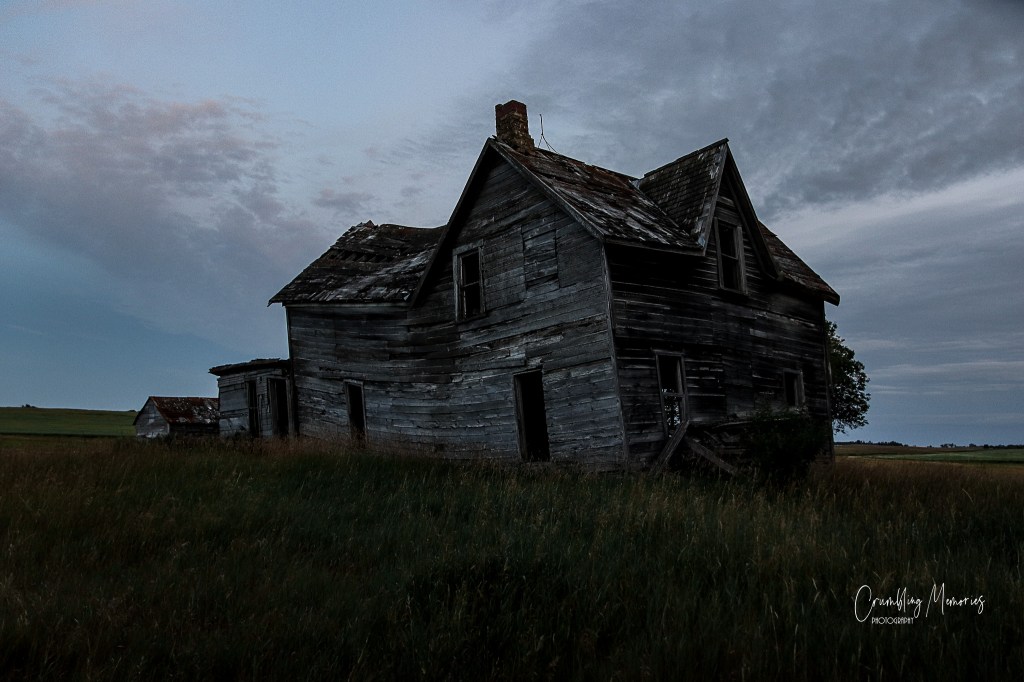
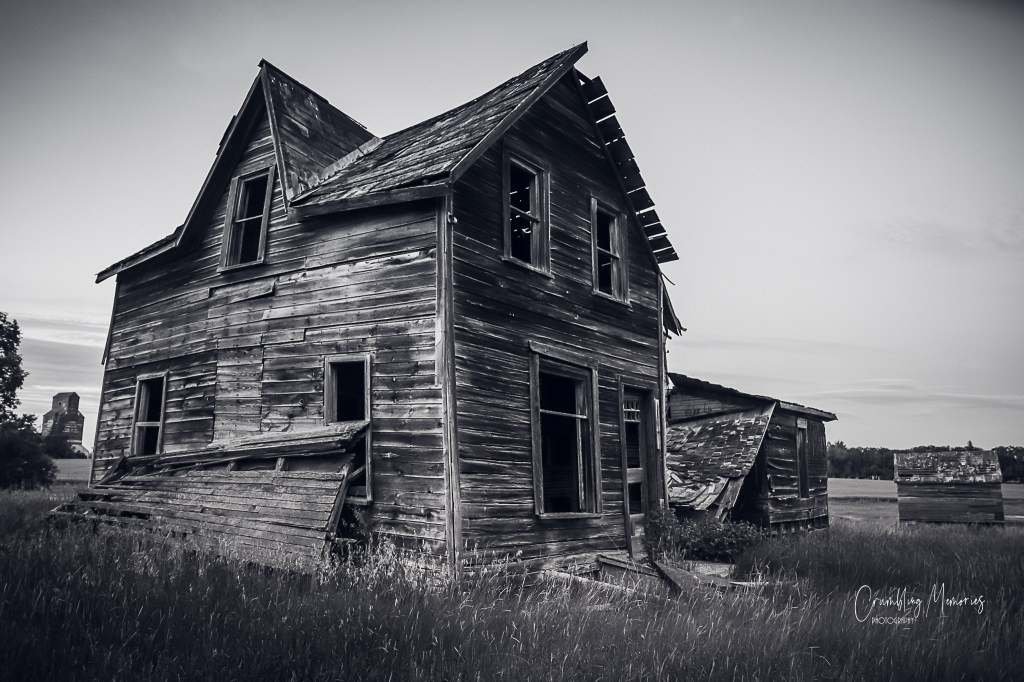
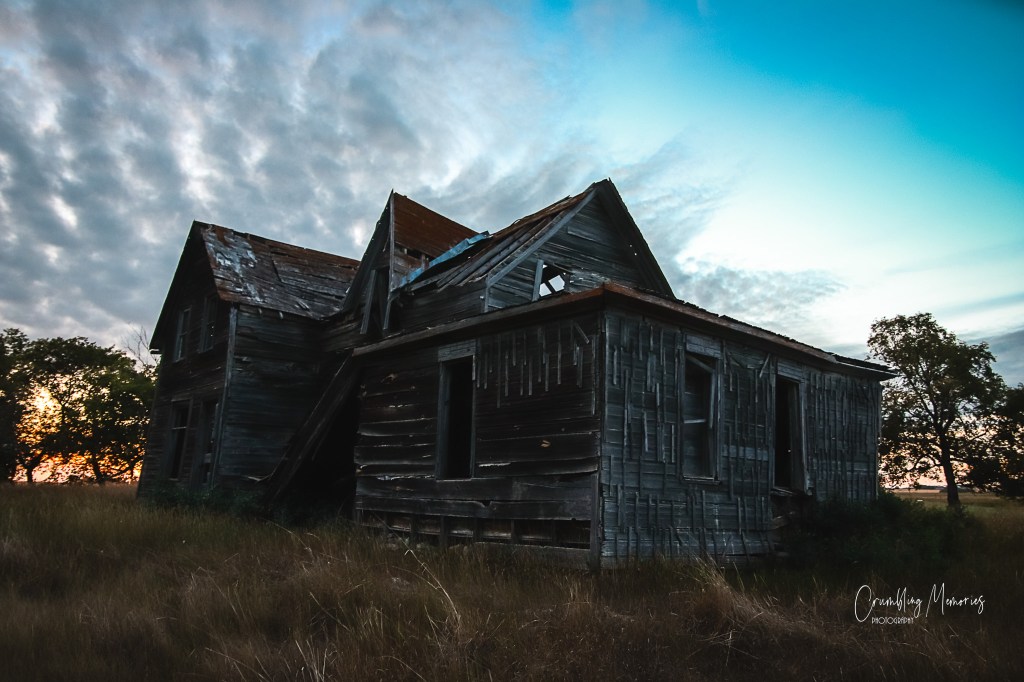
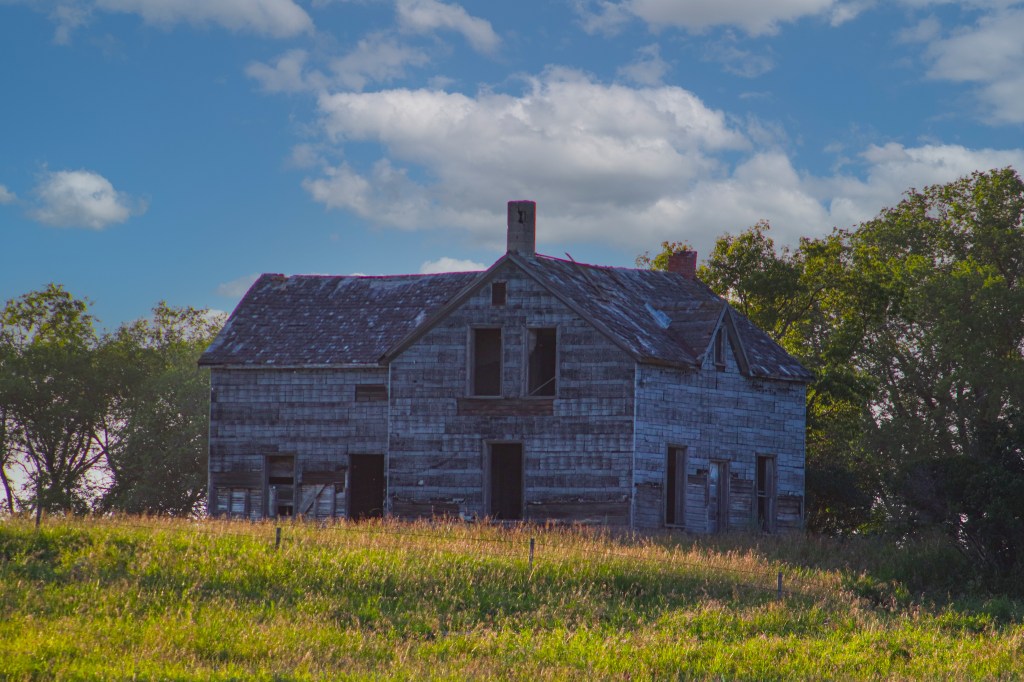
I did try to find some history on this house but came up empty handed.
Off in the distance I managed to get the elevator in the shot. Not planned but I think Christian will be pleased with this shot.
I recently saw a photo of this house posted online. It appears that the middle section has given away more so than it has in these photos. It won’t be long before the two sides collapse into the center of the house.
Its been a while. And to make matters worse, I shot this house in 2023! I need to get it together.
That being said, let’s start with a house that I can’t tell you a whole lot about, mainly because the archives are sparse and the details are shrouded in mystery. The first family I could find any history about was the third owner of the land, who purchased the estate in the early 1900s.
Born in Northern Ireland in 1893, he spent his early years surrounded by the lush green hills and rich culture of his homeland. In 1912, seeking new opportunities, he moved to Canada, where he initially farmed for a local landowner, experiencing the challenges and rewards of rural life in a foreign land. However, in 1915, with a strong sense of duty and patriotism, he enlisted to serve in the war, joining the Field Ambulance Militia, where he played a crucial role in providing medical support to soldiers in France amidst the chaos of battle. After several grueling years of service, he returned to his home area in 1923, bringing with him not only memories of his experiences but also a renewed perspective on life. It was during his time overseas that he met Beatrice, whom he married soon after settling back in Canada, eager to start a new chapter together.
DK and Beatrice raised two daughters, both of whom were born in this home, and retired from farming in 1949, after many years of hard work and dedication to their land. The home was filled with laughter and love, as the family created cherished memories together, celebrating milestones such as birthdays and holidays in the warmth of their rural setting. Their daughters grew up immersed in the values of hard work, perseverance, and the importance of family, which were instilled in them by their parents through countless lessons learned on the farm. As their farming days came to an end, DK and Beatrice looked forward to new adventures in retirement, reflecting on a life well-lived while maintaining connections with their community and the land they had nurtured for so long.
On this day we had a little friend out with us. The neighbouring farm dog joined us on our walk out to the house. Honestly, given my fear of dogs, I was more concerned about the bull that was watching us from across the pasture! We survived.
Leaving a roadside stop, we came across this house tucked away in the trees. Taken across the field with my unsteady hand and 300mm I managed to get an okay photo.
I wasn’t too terribly disappointed when I got home and noticed the poor quailty of the shot and made the discovery that there was little to no info on this homestead.
A young couple moved to this property around 1918 and here they raised 5 sons and 1 daughter. They dubbed the property the Graves Estate after the original homesteader who claimed this land in 1882.
John, originally from England, came to Canada as a young boy. First settling in Cannington, Ontario and then moving west to Southwestern, Manitoba.
In 1882 John married Elizabeth and settled on another homestead. There they raised two boys, Sidney and William. As a young man Sidney purchased a 1/4 section of this same parcel of land and raised two sons of his own.
When Sidney’s son Cecil got married and needed a place of his own to farm and raise a family, he bought the southwest section of this land, close to his parents and started a family of his own.
Now this house has been in my to shoot binder for some time but Christian then discovered this old car behind the house and as much as I love old abandoned houses, when you add an old car to the mix, it makes it WAY better.
This was one of many locations we shot on this particular afternoon and thankfully since Christian had already been here, he was gracious enough to come back with me and take a few more shots of his own.
I did not post a photograph but this is another one of those old brick houses where the brick is now starting to fall off. I am going to assume that when the roof goes, the water leaks down between the wood structure and the brick which then causes the brick to fall off. There are a few of these red brick houses in the area and recall that there was a family that owned a company that made these bricks.
The other night while hunting for houses, we came across this old house from many moons ago. Easily shot from the road, we stopped for a couple shots to add to our list of houses photographed. I wish I had kept better stats since the start of this hobby.
This is the house where I stepped on the board suspended over a hole. I was content on the road. I had been here many years ago and had investigated inside during that visit.
The sun was starting to set which was giving off that golden hour glow which I love.
I have a new system for keeping track of houses I want to shoot and houses I have shot. Its a work in progress and it appears to be a lot simpiler than the big old binder that Christian teases me about. I will hold on to the binder because when I search for the history, I do use the original page to record notes and the name of the blog post, date and contact information for permission.
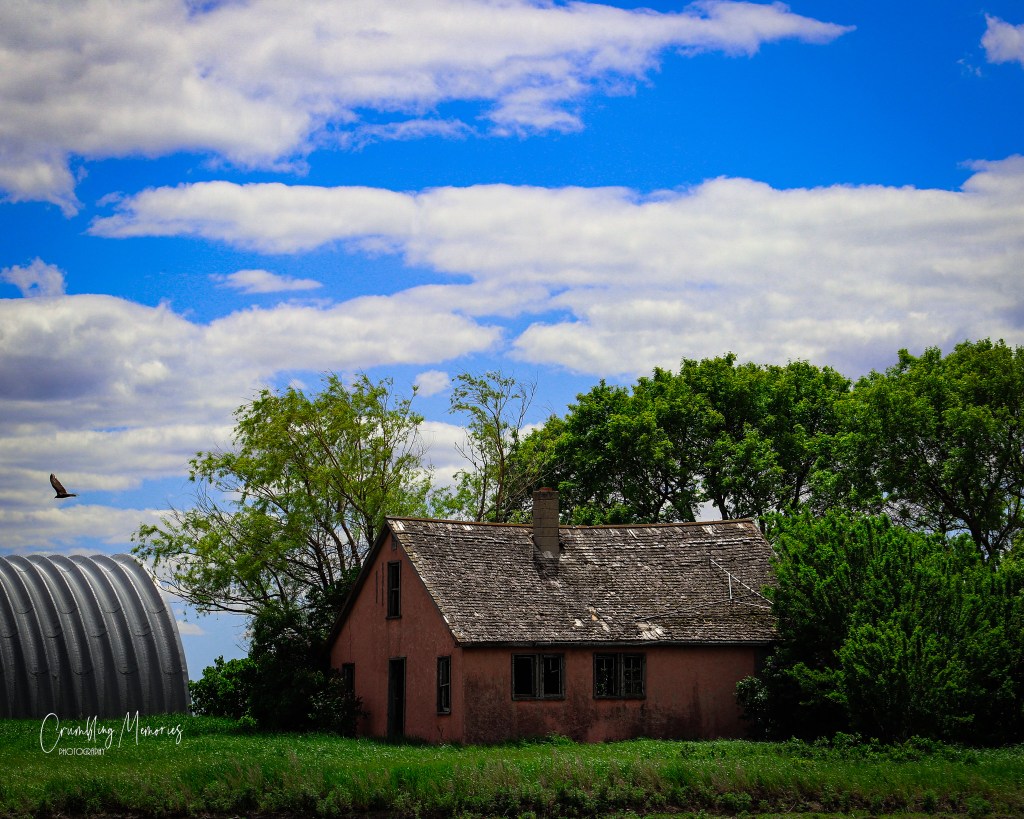
The first recorded landowner for this property is listed in 1891. I can find no history for that family or the 3 families after them which allegedly lived and farmed on this section of land before Mr. Laidlaw settled here. I can also tell you that the current residents are not so welcoming. While I only saw one who decided to photo bomb my roadside stop, there is two vultures who now reside at this house.
I can tell you about Walter though. Walter came to Canada when he was 28 years old. He left Scotland by steamship in 1904 and landed in Halifax. He carried on to Brandon and from wagon headed to Newdale, Manitoba where he worked for a few months. He worked for a few years firing a steam engine for a local man and then was a stooker for other farmers in the area. Walter and his wife settled here sometime around 1918.
In 1918 Walter married Jeanne from Switzerland. Jeanne immigrated from Switzerland to the Cartwright area and ran the millner shop. Two years later she married and the couple went on to raise 5 children of their own. All but one of their children served in the miltary except the eldest who as a child was kicked in the forehead but a horse. The boy was stitched up at the kitchen table but as a result of the accident, the injury left him with muscle damage to his eye which caused his eye to turn inward. Because of this, he was unable to serve like his siblings so he farmed with his Dad. It is said that the injury to his eye didn’t prevent him from being an excellent shot during hunting season.
In January, 1946, upon his return from serving with the Queen’s Own Cameron’s, in France, Belgium and Holland, the second eldest son, Herman, returned to the area and started farming his parents land. Herman later married but did not have children of his own. Herman passed away at the age of 82 years.
What is the Queen’s Own Cameron’s? Well I had to google it. Given that the family was of Scottish decent, it makes perfect sense as to why and how Herman ended up serving with them. Winnipeg has always had a strong Scottish tradition so after years of intense pressure from the local Scottish community, the government finally authorized the raising of a highland regiment in Winnipeg. Gazetted in 1910, the Queen’s Own Cameron Highlanders of Canada are the oldest highland regiment in Western Canada.
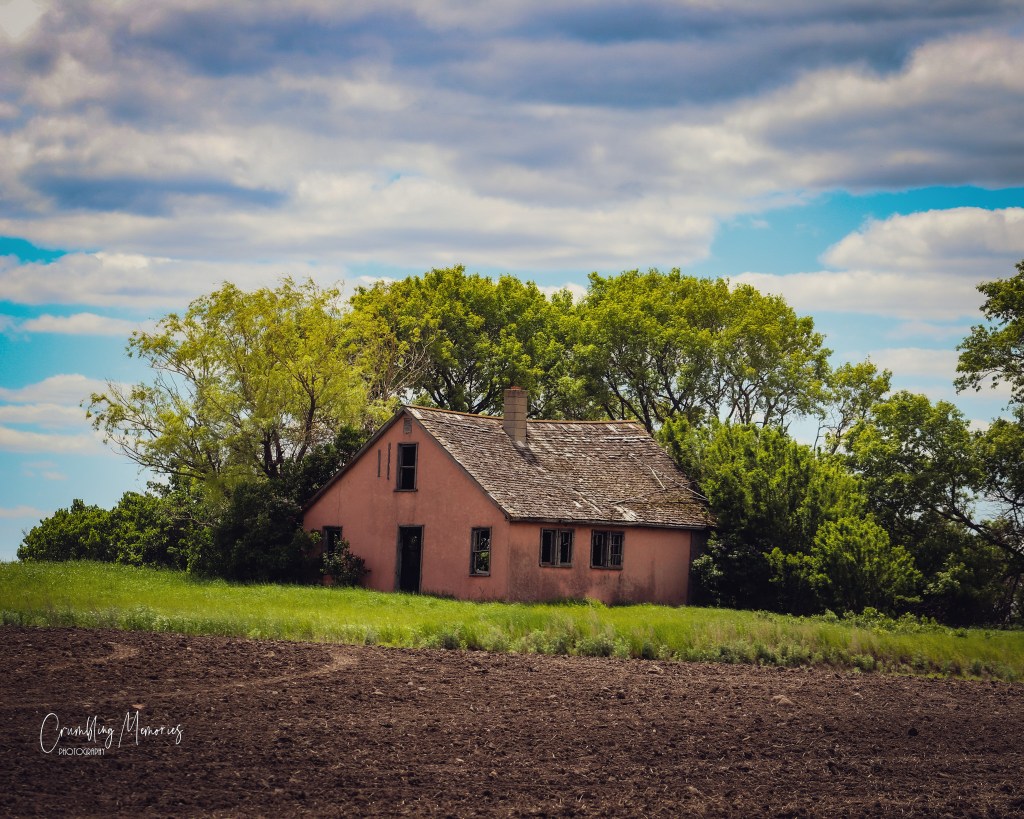
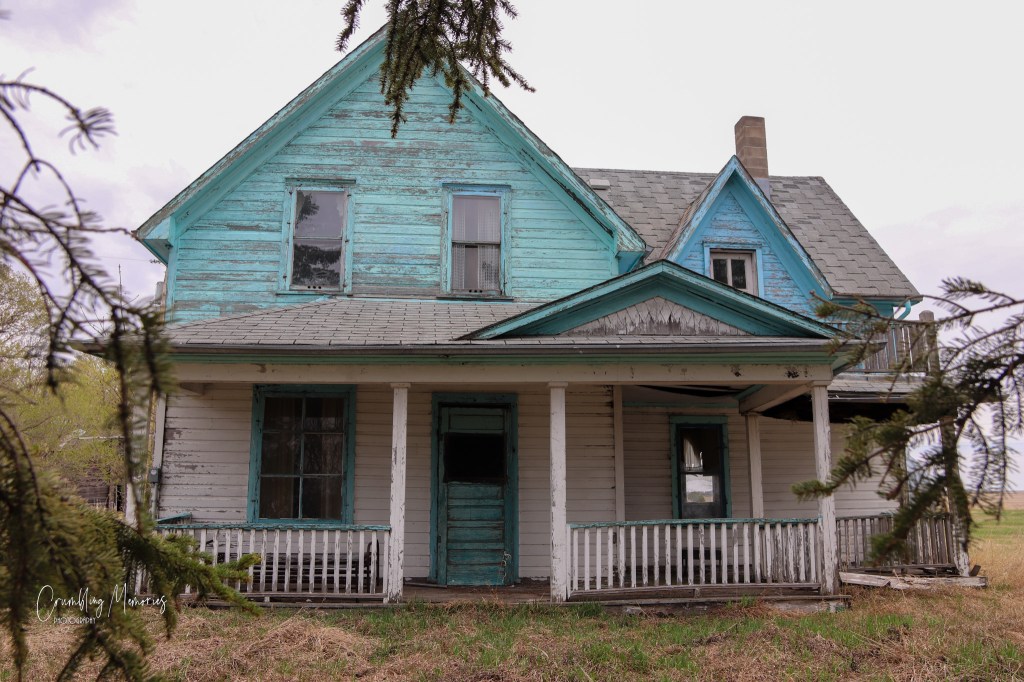
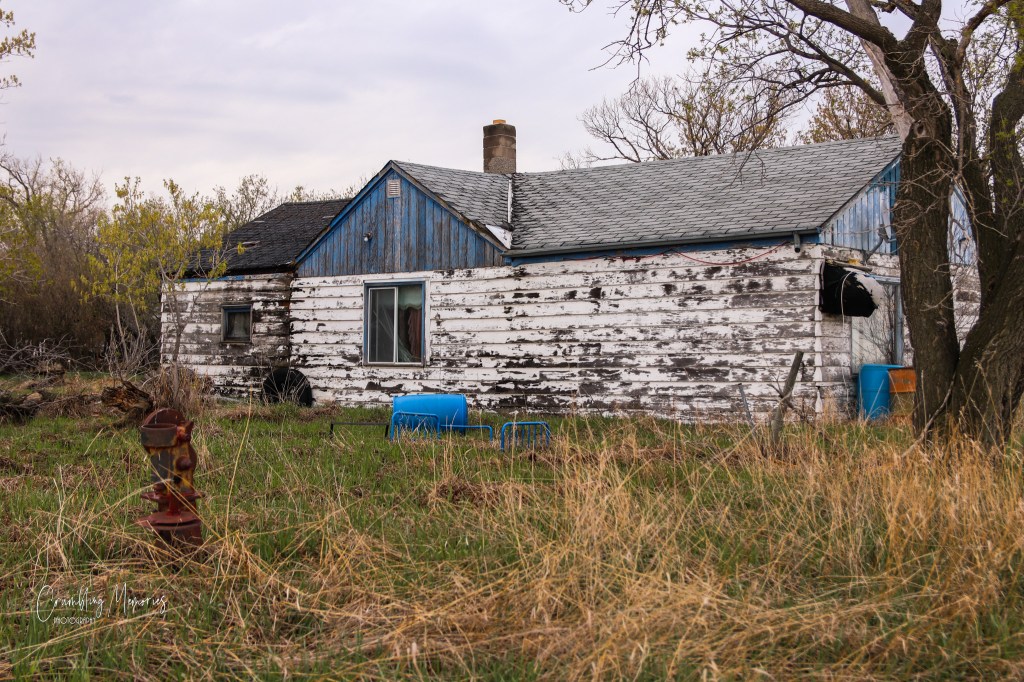
I love the color of this house! These were roadside shots so I don’t know how well the inside is holding up but one day I would love to get a closer look.
Over the last few weeks I have spent some time going through my “to photograph” binder. This binder is what I’ve been told is old school and have been teased about numerous times. If you reading this, you know who you are!!!
Anyways, I finally got out after searching maps and satelittes and I have, suprisingly, found three houses in locations I thought may have bando on them. And all three were close by. So I spoke to my bando buddy and he said, yes, go, I think you’ve got something there. I did.
Now I can’t find any history on this small house so I’m just going to just post the photos I took with my iPhone. I do beleive that one of the families that owned this land built this small home and lived in it during the farming season and then moved back to their home in the Fall. It would make sense as it is quite small.
After retreating back to my vehicle, I pulled off 6 woodticks! That time of year is here and I supposed 6 is far better than the 50 some I picked off on another excursion where I just stopped counting. Good thing they don’t freak me out.
On my way out I did notice that there was a lot of moose droppings in the area around the house, I was watching fro them on my way back to the car but didn’t see any. I would assume that they are all safely tucked away awaiting for the arrival of ilittle ones.
My first find was far more exciting. Stay tuned and I’ll post that when I have a chance.
Long before the first registered homesteader came to this property, many indigenous people lived off this land. Many studies have been conducted and many different artifacts from different periods of time have been recovered in different layers of the land here but there is still not a lot know about the very first settlers, the Blackduck people who are recorded to have lived on this land between A.D. 700 and A.D. 1300.
What we do know is that Mr. William Thomas Brockinton, a graduate of Oxford University in England, and his wife and two children who were 5 and 3 years old left England and William’s job as an auditor for The Birmington Railway and arrived in Woodstock, Ontario in the fall of 1881 with zero farming experience.
They remained in Woodstock that first winter and met a group of young men who were on their way to Manitoba. The men picked their homesteads from a Homestead Map and headed to Brandon in the Spring of 1882. Brandon was a far as they could travel by train as that was where the track ended at that time. The group organized their supplies and William bought himself what was said to be the best team of oxen ever seen. The cart was loaded with lumber which would build the Brockinton’s house. Mrs. drove a pony, hitched to a buggy with the children inside and a cow attached behind. Remember, the Brockinton’s had zero farm experience and it is said they relied heavily on the young men they travelled to Manitoba with.
On their first night, the cow got loose and William spent a good part of the night trying to get it back. This resulted in William missing the ferry at Plum Creek. The young men were not happy as they had already gotten their supplies across and were annoyed that William was likely going to delay things trying to get his oxen and load of lumber across the creek. This didn’t stop William. He came down the bank, oxen pulling his lumber and entered the water. It wasn’t long before the oxen were completely submerged underwater for about 10 feet or so. The force of the load was so heavy that the oxen were able to get their footing on the bottom of the creek and carry on across the creek bottom and up the other side of the bank. It is said that all the while, William stood on the top of the load, smoking his pipe like this was a normal thing.
That first winter, the Brockinton’s lived in their small, cold, wood house. The young men decided to head back to Woodstock for the winter leaving William all alone to figure out his first winter on the prairies. A Manitoba winter was not something William and his family was used to. In February, the family started to get short on food so William set out for food and nearly froze to death on his way back with a bag of potatoes which were also frozen by the time he barely made it back to his family.
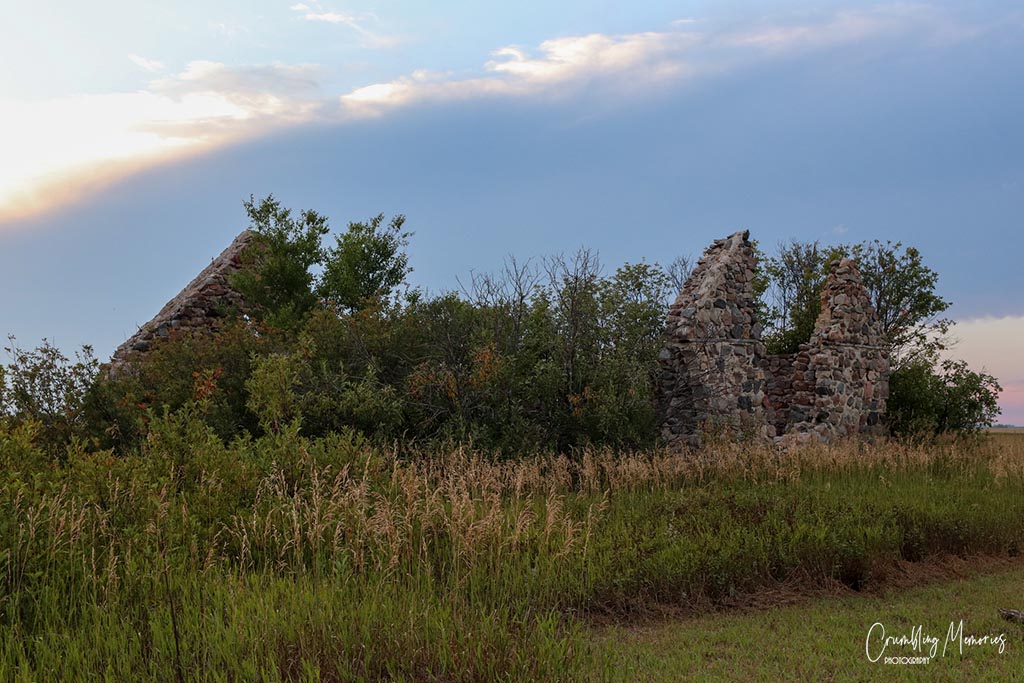
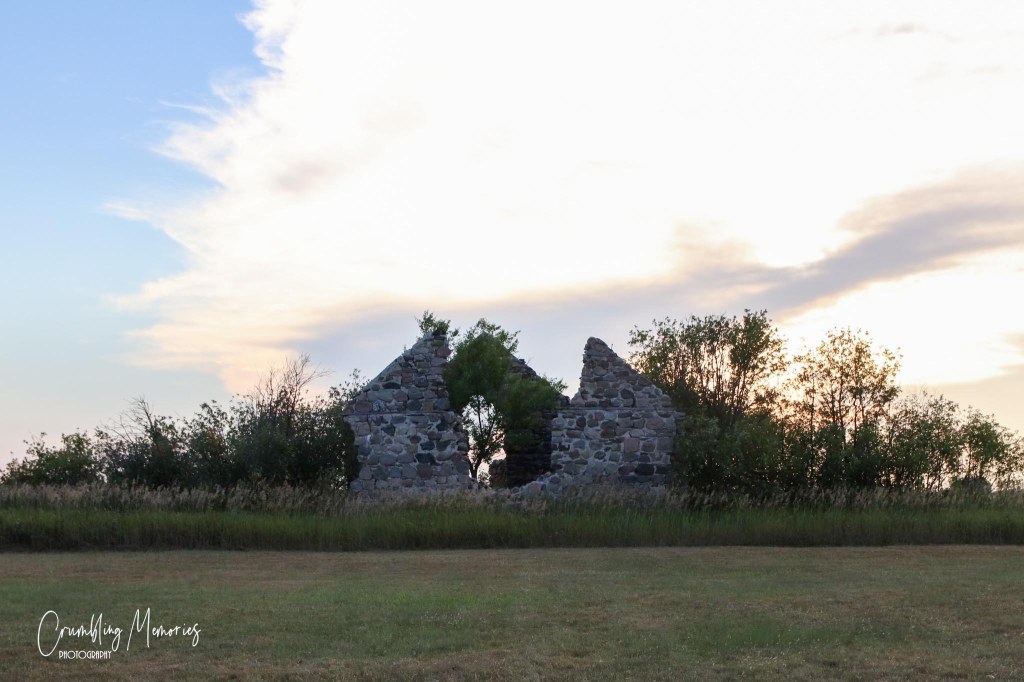
During the second summer in Manitoba, William acquired a second homestead on the river flats where there was plenty of wood. That first winter William built a soddy to live in. William now spent his time between his two homesteads and in 1895 he built this beautiful stone home which still stands today.
After moving to Manitoba, the Brockinton family had two more children. As there were no schools nearby, William home schooled his children until a school was built nearby in 1901.
William was an exceptional violinist and was more than willing to teach anyone who was willing to learn.
Mr. and Mrs. Brockinton continued to live on their farm until their deaths. Mrs. Brockinton died in November of 1924 and Mr. Brockinton died in September of 1933 at 83 years of age.
It is said that William continued to purchase land in the area and at one point paid $4.80 an acre. I cannot tell you exactly where this couple retired.
This land is also recognized as a Manitoba Grassland Birding Trail.
This old homestead is recognized as a National Historical Site. One day I hope to find out more about the Blackduck People who inhabited this land many, many moons ago.
This house has been on my radar for a very long time. The day we finally went to see it, which was the first time for both Christian and I, my anxiety was through the roof. In my mind I was thinking of reasons why we shouldn’t go. Long walk in, getting stuck, tall grass, uncovered well. All ridiculous.
More often than not, we go to a house because we’ve seen it photographed by someone else and decide we must see it too. More often than not, I know nothing about the house, that always comes afterwards. While I knew a couple things, what I found out after was a story of a man who changed farming in the early 1900’s. Those practices carried on into today’s time. I had no idea when I started to dig into it how significant this man would be to this area and to Manitoba.
There is a lot of history here and I’m not sure where to start or how much to write about so lets start with the house in its prime.
When I look at this photo its very hard for me to picture the house like this given the state it is in now. To get to this property, which is located about 1/4 mile off the municipal road, we drove up a long drive, ruts visible and large maple trees which enclose the laneway. I can imagine that this was a beautiful drive in its time. Likely not so good in a Manitoba winter but I would imagine these trees would be a pretty good shelterbelt.
Until 1954 the CPR had a line which was ran to the Rocanville Substation. I do not know if station still exists today and if it is, what it is called or if it is operational and for what. I do know that this railway is what makes this landowner and this house as popular as it is.
James William Scallion born February 14, 1847 in Wexford, Ireland immigrated to Canada and in particular Thorold, Upper Canada which is known today as Hamilton, Ontario. Arriving in Canada with his parents, brother and two sisters at the age of 10, James did all his schooling there and later became a teacher at the Toronto Normal School for a few years. Then himself and his brother Thomas, ran a store in Thorold. It is said that they became intrigued by the possibilities in Western Canada and in 1882 moved to Stonewall, Manitoba. The foll0wing year they headed to the Virden area and purchased 640 of land and chose this spot as the homestead.
Dubbed “The Grange”, the brothers built the house and granary from field stone found on the land. One of the first homesteaders in the area, the brothers built a lavish field stone home which even had electricity in the house and the barn. In a short time they upgraded their acreage to 960 and included livestock to their farm. This required the brothers to hire two farmhands.
The granary which is in great shape was above standard for its time. Not only did they have electricity but it held 12,000 bushels and had electricity to run the machinery to help load and unload the grain. That railway I was telling you about, was within 500 yards of this granary and because of this the Scallion brothers were able to load their grain onto the passing boxcars, therefore eliminating the commercial elevator in the area. This put more money into the pockets of the Scallions and not the elevators and railways.
Back to the family. I really wasn’t sure what I was expecting when I got here. For a while I just stood here and looked around. In the NE section there were combines going. It was peaceful and the sky was amazing but starting to set so I knew I didn’t have a lot of time because I did not have my tripod with me. Behind me were multiple bee hives but of course they were not at all interested in what I was doing.
It is said that after the death of their parents in Ontario, James’ two sisters Hannah and Catherine joined their two brothers in approximately 1887. The four of them lived unmarried and happy in this house. Said to be known for their hospitality, the Scallions had plenty of visitors to their farm. People wanted to see how they prospered.
James Scallion was known as a successful farmer in the area but he should be better known as the man who pursued and was successful in assuring that the farmers who worked hard for their crops got a fair price for their grain. James believed that all farmers should be able to ship their grain directly to the market and not be undercut by the middle man. James believed that farmers should be able to sell their grain to whomever they wanted be it in Canada or the United States.
In 1903 James formed the Virden Grain Growers’ Association and then travelled around the province to encourage other communities to do the same. James told them that the money they received for their grain should go to them and not to the grain dealers and railway promoters. James was named the President of the VGGA but stepped down within the year due to health issues.
MGGA chapters formed all over the province. In an unprecedented move, in 1912 James also allowed women to be associate members and in 1914 women were recognized as full voting members.
James was also a founding member of the Grain Grower Grain Company which later became the United Grain Growers. It was later one of the biggest grain companies in Canada with hundreds of elevators in prairie towns whose profits were shared by its members. James was a very successful man with a big history in this province. He had many more accomplishments in his life.
1n 1918 after dealing with years of illness, James and his sister travelled to California. Upon their returned they settled into a house in Virden where he lived until James passed away on April 24, 1926. Upon James retirement from farming he sold the farm to a young man from Scotland who then sold the farm to a member of the family that currently owns the land. That man died at the farm in 1948 in a farming accident.
The railway was removed in 1954.
James improved the lives of many farmers, ensuring that they, like himself were paid fairly for their hard work. In one final contribution James donated $10,000 (said to be valued into today’s currency at more than $140,000) toward Virden town development and $5,000 towards the Virden Hospital.
Believe it or not, it is said that James is barely remembered in the Virden area.
Years ago I found this house while visiting something else in the area. I put it on my to-do list but never went back. The front was overgrown with caragana and I don’t like tall grass when I can’t see where my feet are going!
Christian and I were cruising around this area a few weeks ago and he spotted it from the road. I had forgotten about it but was glad he seen it and pulled in for a couple shots of it.
Unfortunately, I have not been able to find anything about the first homesteaders or anyone who has come after that.
I wonder if they planned to come back for this boat.
When I first saw this house posted online by another bando hunter, I immediately put it on my list to see. Back in May, a fellow bando hunter and I went there. One thing I did notice was the two lightning rods that were once attached to the house are now gone and the swinging door has one again closed itself, or maybe it had help.
Mr., born in England, immigrated to the United States and then ended up here in 1894. Upon his arrival he purchased this section of land. He met his wife when he got to Manitoba and they married in Brandon. From this union 3 girls were born. In 1902 he sold the farm to his brother-in-law and moved to town and purchased shares within the local flour mill and worked for many years in the community.
The history of the brother-in-law’s family is far more in depth but doesn’t really confirm anything about this house. Their earliest recorded history is 1196. In 1756 the family changed the spelling of their name, which really wasn’t that uncommon back then. The family are said to be the equivalent of English Feudal Lords and were the Lords of Duersen and Lissel in the Province of Brabant which is in the Netherlands. The earliest record of an ancestor coming to America was 1630. The earliest record on one coming to Canada was 1756 when they immigrated to Ontario. It is said that one of the children, at a young age, was lost in the woods and never found.
Now this is where it gets tricky. This family farmed on the NW corner of this section which would explain how this family is connected and how the original landowner met and married his wife. When they moved from the land to town to operate the flour mill, he sold the land to his brother-in-law. It is recorded that a farm on this land burnt down in 1916 when the family was away in Ontario. They lost everything in that fire.
I cannot confirm if this is a rebuild of the original home or if the house that burnt down was on another quarter of this section. Regardless this is quite the house. Unfortunately, it was not easy to photograph from the front given the tree line. And honestly, I didn’t even look at it from the back.
This is a neat old house which I thought would have been quite fancy for its time with its porch and upstairs deck. It certainly wasn’t your typical style home. The floors were caving in so we just peeked through the windows but inside there was plenty of old things to see.
It definitely goes up there on one of the neatest houses I’ve been to.
The original homesteaders of this property came to this land at the turn of the 19th century. The first official recording that they were the landowners is dated 1901. Owned originally by one of the brothers of this family, the first brother to own this land, William, turned the sod making it ready for farming and construction of a forever home.
In 1904 William sold the land to his brother James who lived here until he retired. At that time he son, namesake of his uncle and his dad, took over.
This property has a long drive and is beautifully treed. This is also the spot where Christian and I got most of our wood ticks that day. I’m sure that we picked off at least 50 at the end of this driveway before we got back in the vehicle.
In 1920 this land was sold Mr. Taylor but then repurchased it. James later sold the land again, this time moving to a different district to farm, but again bought the land back. It does not state why the land was sold but it does say it was purchased back due to adverse conditions.
James and his wife Bessie raised three children, mostly on this homestead. In 1930 they retired from active farming and moved to the closest town. Mr. died in September, 1953 and Mrs. not long after in April, 1954.
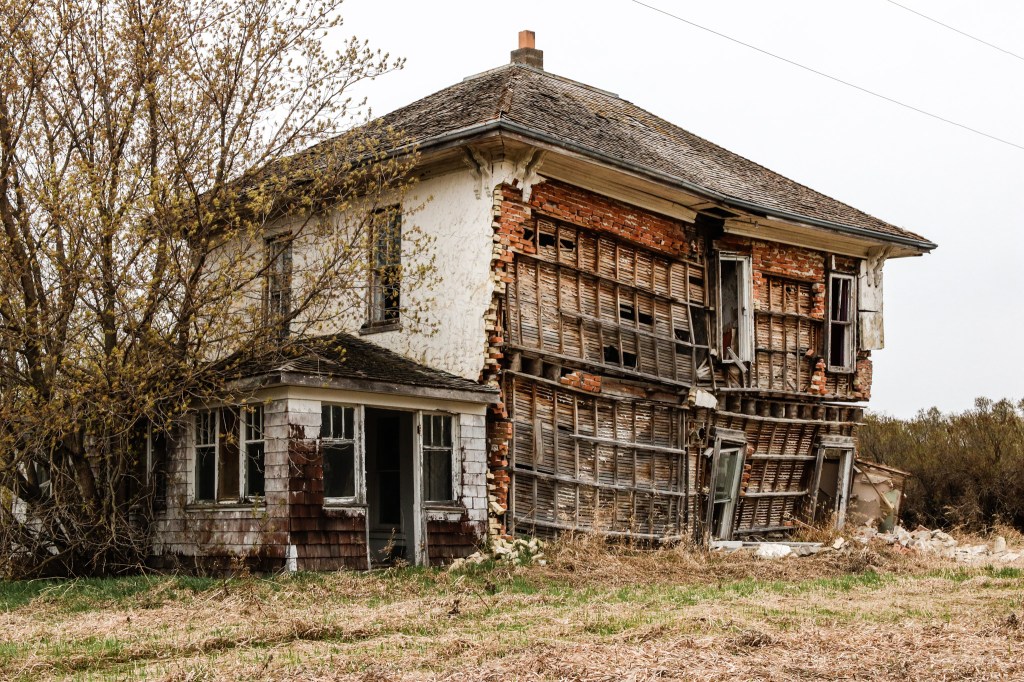
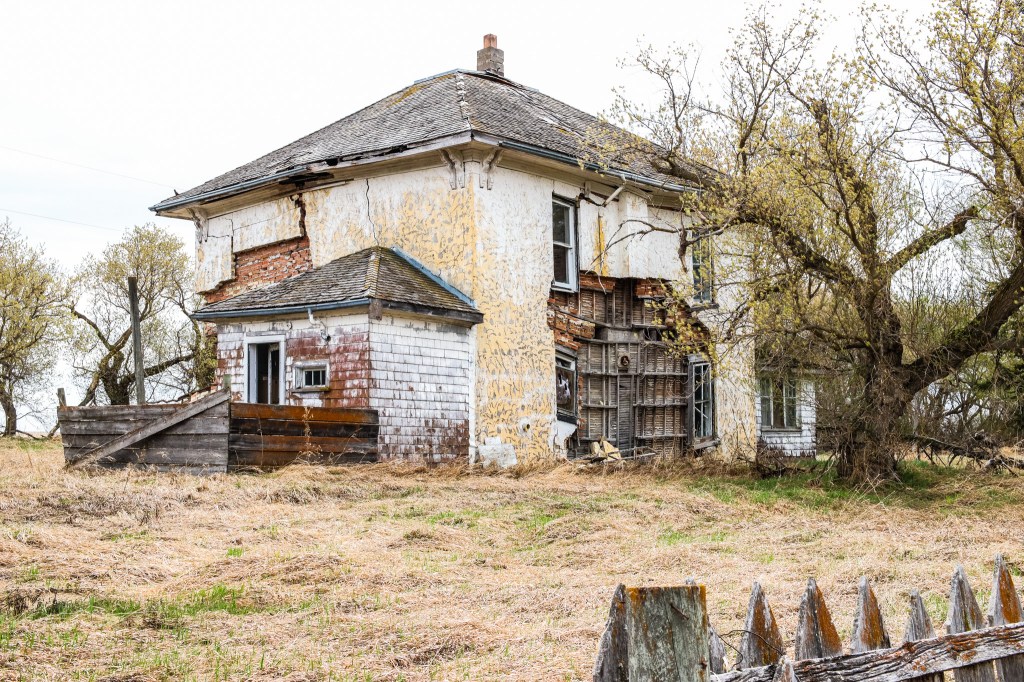
This was not the first house we went to on this day that was suffering from the same sort of decay. I am going to make the assumption that at one time, these were brick homes. In an effort to modernize them, stucco was applied over the brick. With time, the roof began to leak and the water ran between the two layers causing this deterioration to happen.
Inside the house we could see the remains of furniture and a bookshelf with puzzles and games.
Back to that day when Christian and I went out, one of the first houses we stopped at on our venture was this one.
Visible from the road, this was an easy stop. After fiddling around with my camera for a bit we got ourselves on the other side of the trees.
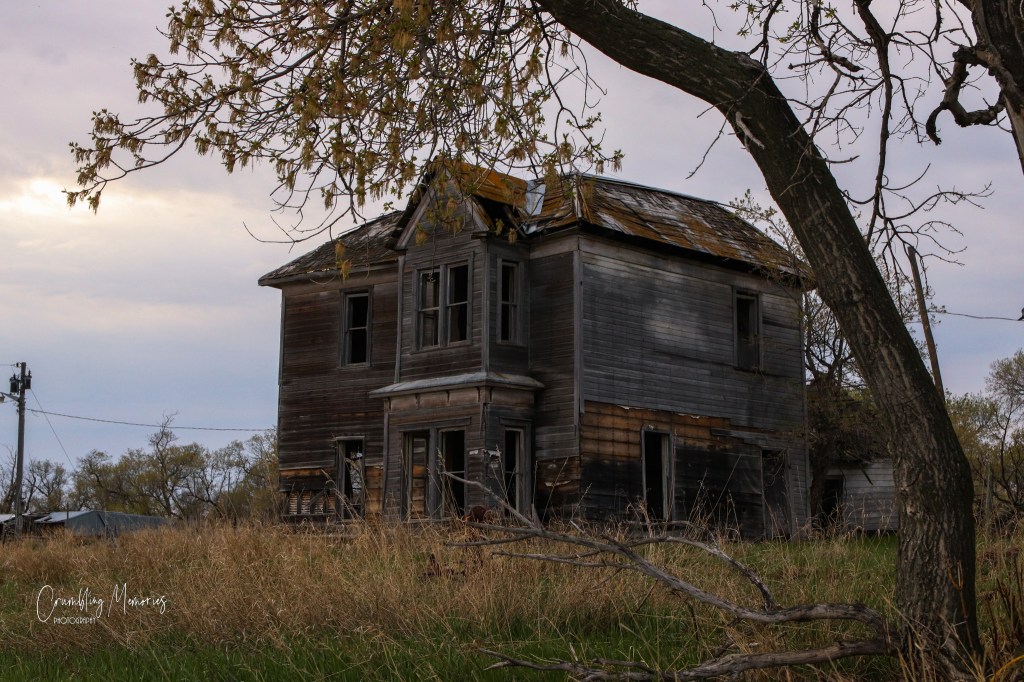
This big old two story house with the missing door upstairs wouldn’t want to be something I came across at night time. I wasn’t at all freaked out here but with the dead trees in the front, I could see how one would be.
The history I found on this homestead is not of the original homesteaders. That is of course somewhat disappointing to me but its better than nothing. That being said, here we go. The second homesteader of this land immigrated to Canada in 1903. Born in 1881 in Country Cork, Ireland, he moved to the area and married in 1908. Having worked for many farmers in the area and renting land to farm, he moved from the land he originally lived on and in 1921 eventually moved to Neepawa. In 1927, Mrs. passed away and he came back to the area.
In April, 1928 to be exact, the family moved back to Elgin, Manitoba but he again rented land. It wasn’t until 1942 that him and his children moved to this homestead.
Mr. retired from farming in 1951 at the age of 70 and moved to Brandon where he lived until he passed away in 1964. Mr. and his wife raised 6 children on various farms in the area as well as in Neepawa. Upon Mr.’s retirement, his youngest son and his wife took over this farm and raised their family here.
The first recorded landowner recorded for this section of land is 1889 but there is no family history. So, I don’t know who built this house. Regardless, she’s a beauty.
In 1906 Mr. quit his job at the chair factory in Orangeville, Ontario to move to the area. He boarded a freight train with the machinery, furniture and household effects of the Anderson Family. Upon his arrival to the area he was hired as a farm hand on another farm. In 1911 he rented this land from the previous landowner.
In January, 1912 he married Helen, the daughter of the family whom he traveled with to the area with their belongings. They bought the land and lived there until 1954.
When they left the land they retired to Melita. During his active years Mr. was on the school board in the area and was a counsellor for 13 years. Their youngest son took over the farm and raised his family here.
Before marrying Mr., Helen was a school teacher at Brown’s School from 1909 to 1911. She began teaching at 16 years of age.
While walking up to this property we discovered that the Souris River runs through it. The water was full of ducks and small birds. In the distance I could hear an owl taunting me but I could not spot it.
There were two houses on this property . This newer house must have been what the family moved into when the original farm house was no longer livable. I love that the house was preserved to some extent.
Mr. & Helen raised 9 children on this farm, 4 boys and 5 girls. Mr. passed away in 1963 and the history that I found for this family was written on May 26, 1982 by Helen who was in her 90th year. I visited this house on May 13, 2023.
At the time that Helen wrote her family’s history, there were 25 grandchildren, 30 great-grandchildren and 5 great-great-grandchildren.
Then the 30’s rolled around and the family faced the depression, the dust bowl and the grasshoppers. At the time the family had a car, a piano and a telephone. Mr. sat down with his family and said something had to go. Helen said that the telephone had to stay, in case of an emergency. The children all wanted to piano for entertainment. So, Mr. put the car up on blocks and parked it. The family relied on a Bennett Buggy for transportation.
I did find this one strange piece of equipment in the yard. I took a photo of it with the hopes that my husband could identify what it might be but he wasn’t sure.
Now I’m wondering if the old car is somewhere on this property. Maybe the owl was trying to lure me further into the yard in the tall grass and treed area so I would see it!
This is another property I have driven by a million times and have never stopped at. I did two properties in one day and guess what? No history on this one either.
So here is a photo dump of this little property that kept on giving. I thought I was going for this house.
We passed by an old ice cream sign and some old bottles.
At this point Cade has already taken off to check out an old Mac truck.
It don’t think I’ve ever found one in such nice condition and it was even more shocking that the dog was still attached.
To my surprise I had stumbled upon a little old truck/tractor resting spot. Wahoo, old cars and bando houses. Why didn’t I stop here sooner.
Not sure what happened here but it made a good photo.
Then I found this. I am sure that this is some sort of old store. When I asked the current owners, they didn’t have a whole lot of information to provide.
And then I found this. This made my day. So enjoy this photo dump. If I ever find more info about this location and the little “store” I’ll be sure to update.
Have I ever mentioned before how much I hate hydro lines at a bando site?
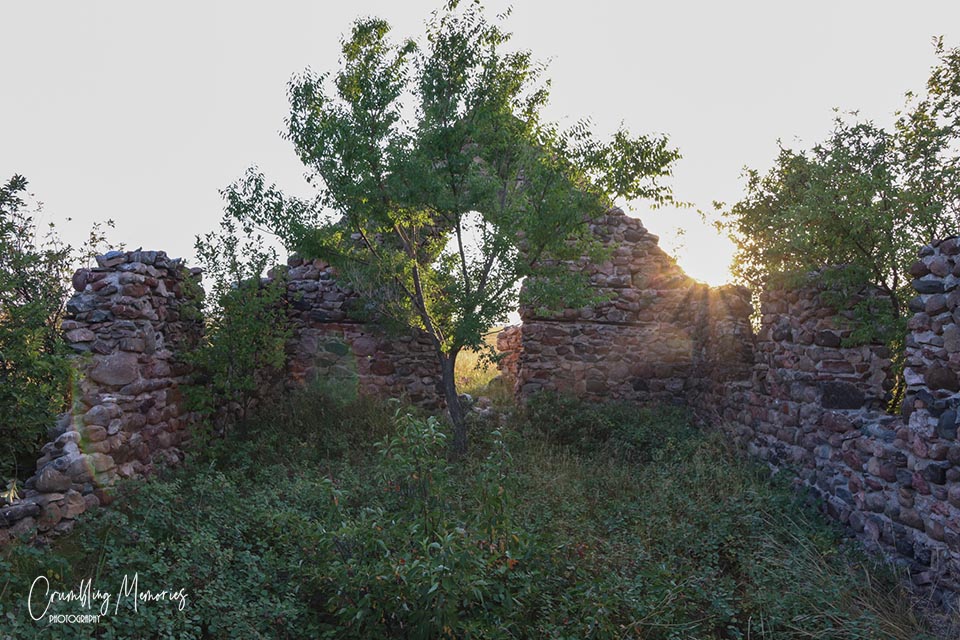
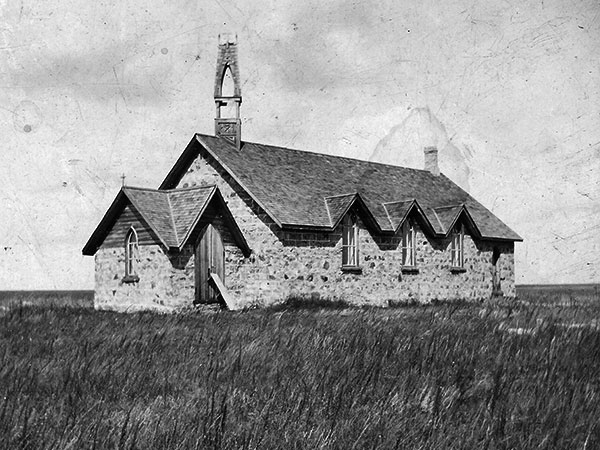
This stone church, formerly known as St. George’s Anglican Church was fifty-six feet long, twenty wide and twenty tall is located approximately 5 miles from the Saskatchewan border and 2 miles from North Dakota. The organization and fundraising efforts to build this church were headed by Goddard Gale and construction of same began in 1890 by Mr. William Cornwallis. Two years later in September 4th, 1892 the church was consecrated by Bishop Robert Machray.
Goddard Gale was an artist from London and the son of a well-known barrister and a cricket player. Goddard is also rumored to be the first “white man” to set eyes on Lake Louise. Mr. Gale was a surveyor and engineer for the Canadian Pacific Railway and a staunch Anglican. When he took up residence is what was once known as Butterfield, he became a community leader and a council member for the RM of Arthur. Arthur is what this area of the province was before it was split into three smaller municipalities. In 2015 it was then reunified into one large RM known now as Two Borders.
When Mr. Gale started fundraising for the church on this 4.6 acres of land, stones were gathered as he wrote letters back home to his friends where he told them this would be the first Anglican church west of the Souris River.
As settlement started dwindling, church attendance also waned. In June, 1913 the church was deconsecrated. Some of the contents of the church were taken to a new building in Pierson but the organ and photos were taken to Eunola School.
Locals from the area told stories about Prohibition and how given the location close to the American border and the very isolated location of the now vacant church, it became an attractive hideout to bootleggers. I certainly didn’t get any Al Capone vibes while here.
Upon our arrival at the church, the sun was blaring, there were no clouds in the sky. I was a tad bit disappointed. Back at the start of Covid, Cade, Makenna and I drove out this way with the intention of visiting this location. We ended up heading North after a stop in Elva and I didn’t think I would ever make my way down here again. Yesterday a fellow bando hunter took me down here to do some touring. I’m glad he did. And I’m glad the sunset improved. Within fifteen or so minutes after our arrival, the infamous “golden hour” revealed itself.
After years of abandonment and vandalism, in 1932 the windows and doors of the church were boarded up in an effort to save the building. Inside the structure are obvious signs of a fire. I would have loved to have seen this place before Mother Nature and vandalism took hold.
In 1967 it was recorded that the building was still intact.
Driving around this area, there are very few cars and people. In the late 19th and 20th centuries, it is said that the government did all they could to entice people to this area. It is said that people from Britain and Northern Europe were heavily recruited. During the recruiting process no one took into consideration the climate these people would endure here on the wide open prairies nor did they consider if farming on this land would prove successful before they made their way to Canada from abroad.
And then there is this old truck. I will admit, at first I was a bit more excited about this old truck than I was the old church. What role this old truck plays to this historical site is beyond anyone’s knowledge. I googled it, but not to thoroughly, so I’m just going to pretend that a bootlegger parked his truck here to hide out in the church and then had to escape by foot and never came back for it. Its perfect right where it is and has been subject to many photographs in its time, as this old field stone church as its backdrop.
This place is right outside my door. Well, not really but its a stone’s throw.
Its been on my to-do list for a very long time and I just sorta took advantage of it being there and something I could get to at any time. So last spring I wandered over there and the current owners were there and said come any time. The only stipulation was that I close the gate and don’t let the horses out.
If you know me you know that I am afraid of dogs. And to me, horses are big dogs. So when I went I decided I would not go inside the gate if I didn’t have to.
It was windy as heck out but the clouds were amazing. To me the sky looks painted. Believe me when I say that there is not filter on this photograph, this is straight out of the camera. The sky is almost too good to be true.
I have tried to get more information on this property and cannot. And given that its been some time since I’ve been out and posted, I’ve given up on the idea that I will be able to solidify any further information so, I’m posting.
I can tell you that the property has been rumored to be owned by a couple of different families whose ancestors still live in the area. I can also tell you that the house was last occupied in 1920.
I seen a photo of this house a few years ago and wondered if one day I would spot it given its in my territory. I was thrilled when a fellow bando friend posted a photo of it and shared its location with me.
Even better, its on land owned by a friend. So Cade took me out to check it out. I would have walked in closer but the thistles were waist high and thick. This was close enough for me, although the other side and a peak inside would be cool. Maybe in the fall.
Downfall, no history. Can’t have everything, right?
Back in February I received an email through my blog from the Granddaughter of the Baleja family, the second last owner of this property.
I learned that there was a second movie filmed on this property by the name of Capote which came out to the public in 2005. I haven’t looked it up but I will, one day. I was told by the Granddaughter that when Capote was filmed, film crews laid limestone on the roads in the area to make it easier to get their equipment down the roads. This is why the road is made up of nice black dirt.
She also told me that her Grandfather bought the property in 1947 from a local man. A search of the name by both of us came up empty handed. I have made a request to my local library to see what sorts of material they might be able to borrow from another location for me.
There is apparently a drainage ditch near the house (which I did not notice) which was enchanced by the RM and the City of Winnipeg, I’m assuming and is called Z dike. The purpose of the dike was to protect Winnipeg from the infamous Flood of the Century.
The house is actually two houses. One of the houses was brought in by the movie company in 2015. The orginal house in the tangle of houses was moved from the other side of the road and you can see that there is an old yardsite there. The purpose of bringing the two houses together was to give the house a creepy appearance. The current owner advised the Granddaughter that the inside of the house had cable supports inside to support the joining of the homes and/or set.
And the barn. What a sight. This house, when I first seen photos of it, were taken by my Winnipeg Bando friend, Lee. She loves this old barn. Well, the structures on the roof were added by Grandfather Baleja as was the granary on the front.
The Granddaughter also shared with me that when the old house was moved across the road to create the movie set, the current owner from an old bible. I never did hear back from her to see if she received a photograph of an inscription that was in the bible.
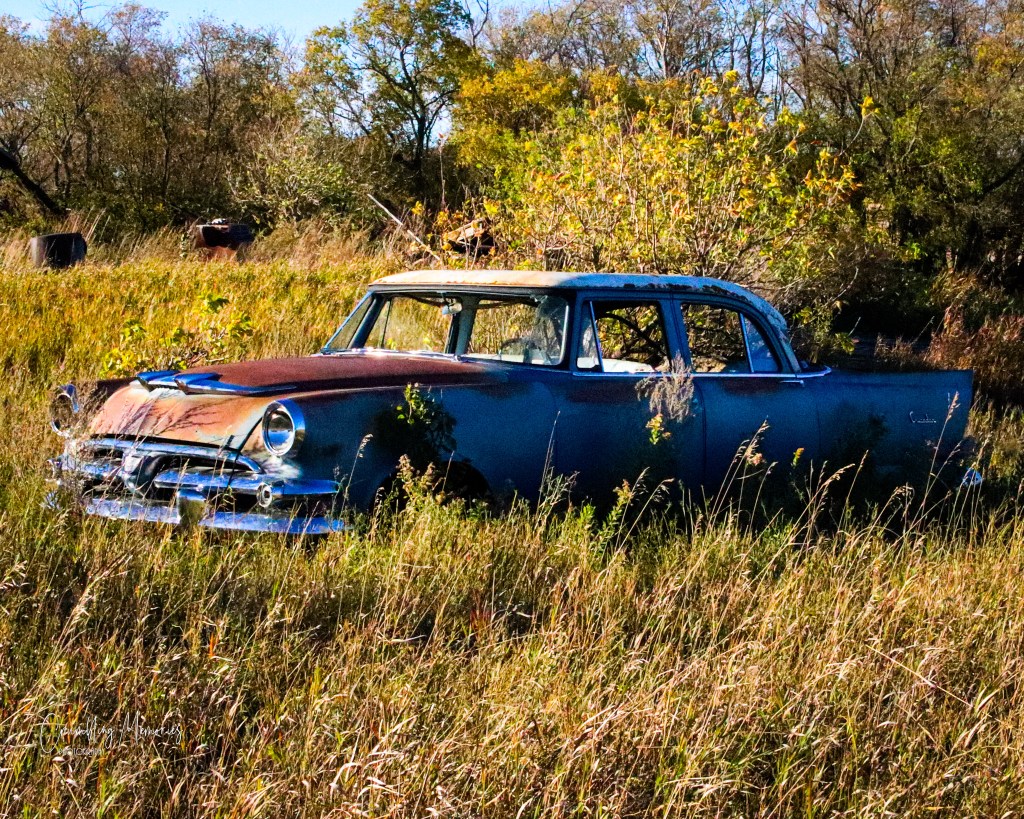
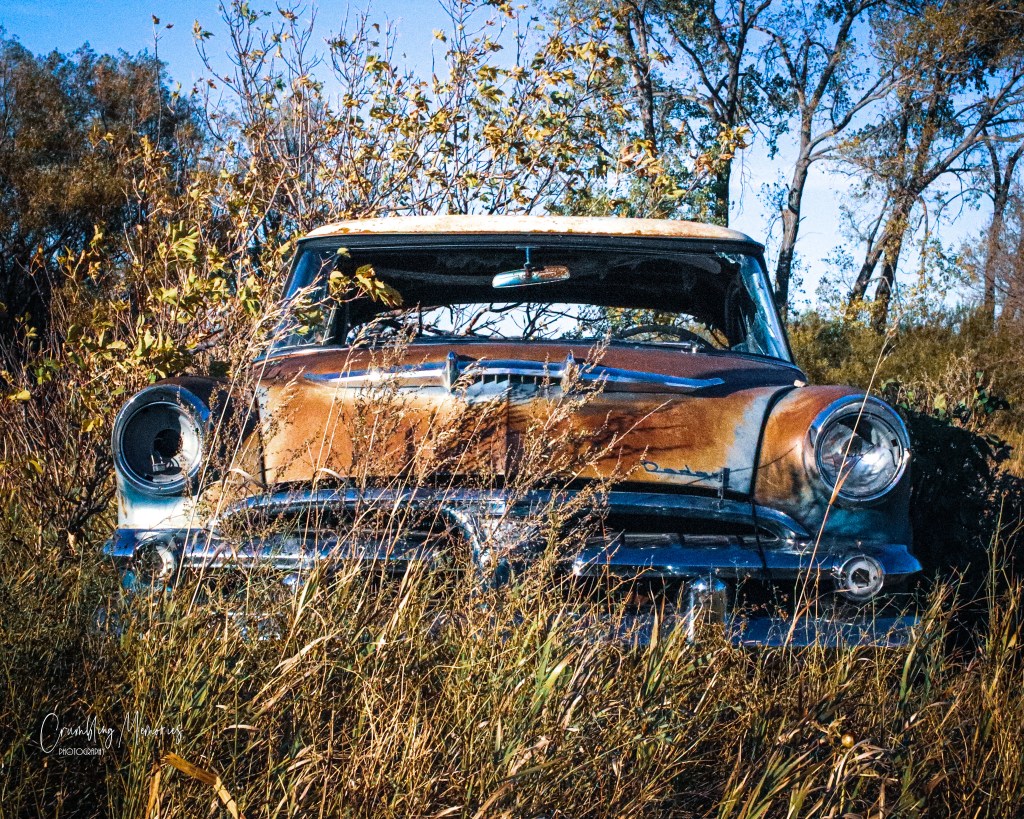
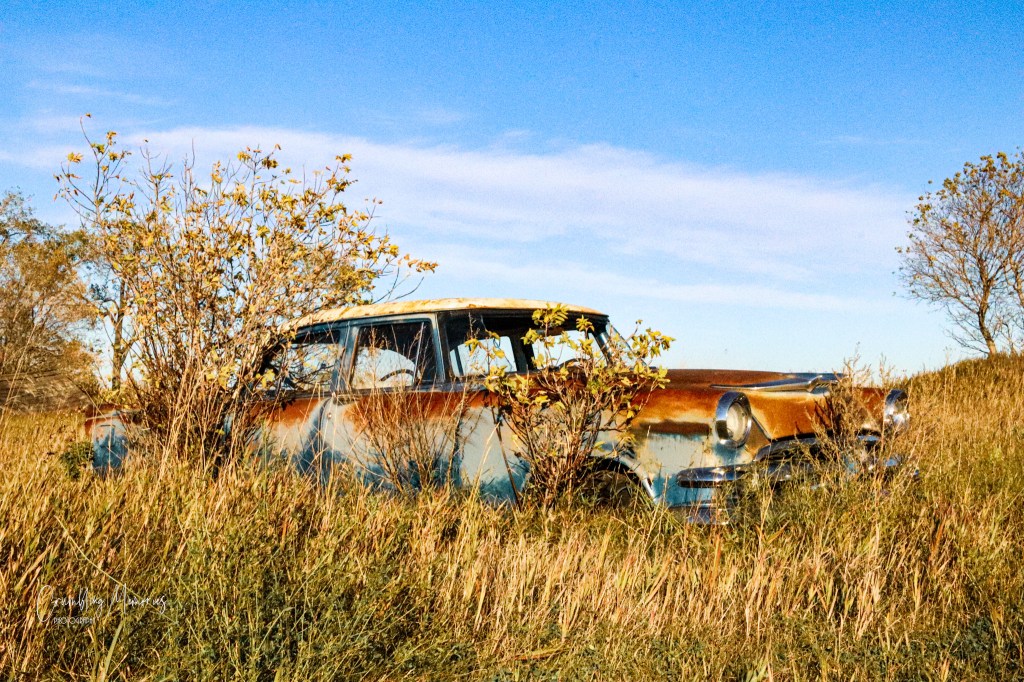
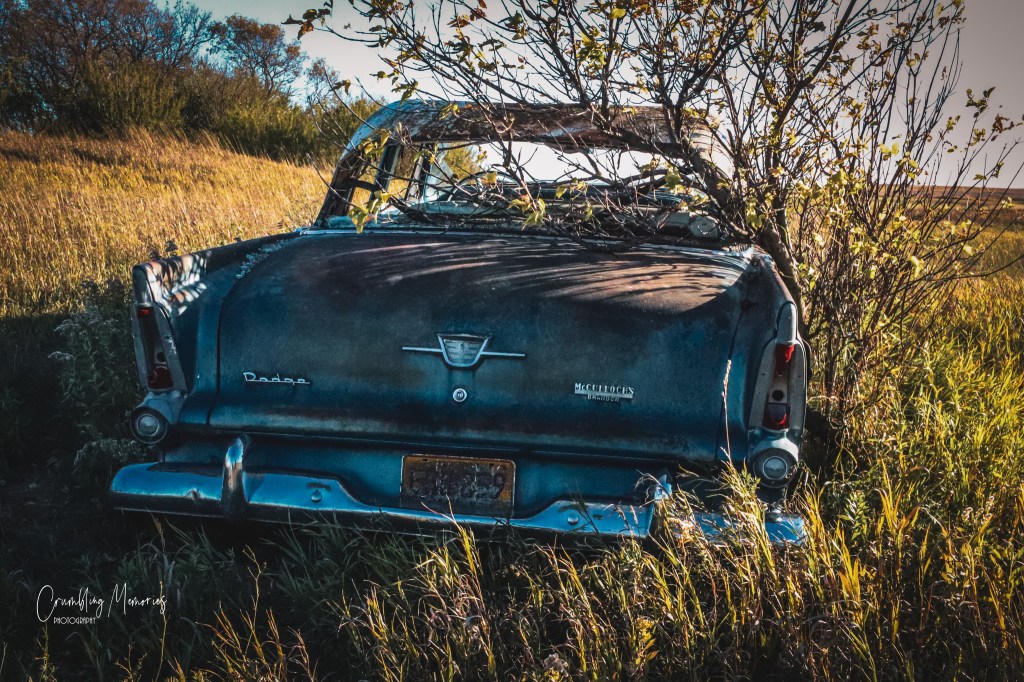
I have driven by these vehicles hundreds of times. The kids at the colony have asked me to stop and take some photos. So finally I did.
Given that they are right out in the open and have some buildings beside them and behind them, I didn’t think I’d get any decent shots. Sometimes the best photos come from the opportunities you doubt most.
When I posted these photos on my Instagram account, Cade had no idea where I had found these as he is usually with me when I venture out now because I’m scared to go alone.
I am happy that the kids talked me in to it because I think they turned out pretty good.
When I texted them to one of the kids to see if they could identify them, they knew right away.






























 CRUMBLING MEMORIES