PELICANS

You may recall a couple years ago when I got “the” pelican shot and figured my pelican photography days were over.  The photograph was a hit with my family and ended up getting blown up quite large and is in my front entrance.

Last summer before our BC trip I bought myself a lens that was going to force me to photograph a new, not so dangerous and easier to find subject, birds and wildlife.  While I have taken a couple photos with that lens, namely the owls and the blue heron, I am not overly happy with the lens and just posted it for sale a couple days ago.  I am on the fence about this because everything I read and everyone I talk to tells me to give it more time, read more, watch more videos.  So I’ll try but patience is not my virtue.

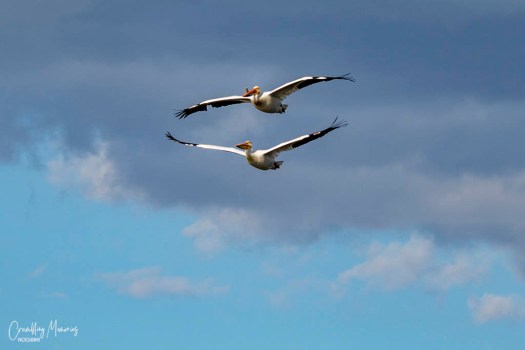
Anyways, I wanted to share this photograph I took the other night while fishing with Colton down at the beach.  I took the lens with to play with, without having done any reading or watching.  While its not a great photo, its different and okay.  I certainly like the colors it picked up in the sky.
flying pelicans for email

PELECANIFORMES

img_0258 email

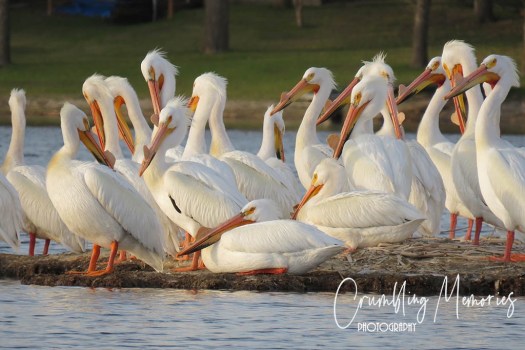
To me, pelican’s arriving back on the small lake in my community is a sign that warmer weather is truly on its way.  After our cold winter, they were certainly a welcome sight.  During the winter they are typically found in warm, coastal marine habitats.

They breed in large, dense colonies.  Flocks forage cooperatively by circiling around fish or driving them toward the shore where they are easier to catch.  During breeding season, adults often forage at night.  They eat mainly small, “rough” fish with little commercial value.  They will also eat salamanders and crayfish.

New pairs will nest close to another pair who are at the same stage of the breeding cycle.  Nests are typically located on open, bare soil.  Both sexes build the nest which consists of shallow depression surrounded by a low rim of gravel, soil or plant material.  Both sexes incubate two eggs.  The chicks are dependant on their parents for warmth and food.  Unfortunately, the second-hatched chick usually dies.  When the chick leaves the nest they gather in groups called “creches”.  Chicks are fed by the parents until the leave the colony at 10-11 weeks of age.  In the breeding season, there is a laterally flattened “horn” on the upper bill. The horn is shed after the birds have mated and laid their eggs.

The typical life span of a wild pelican is 10-15 years.

In Ontario, the species is listed as “threatened”.