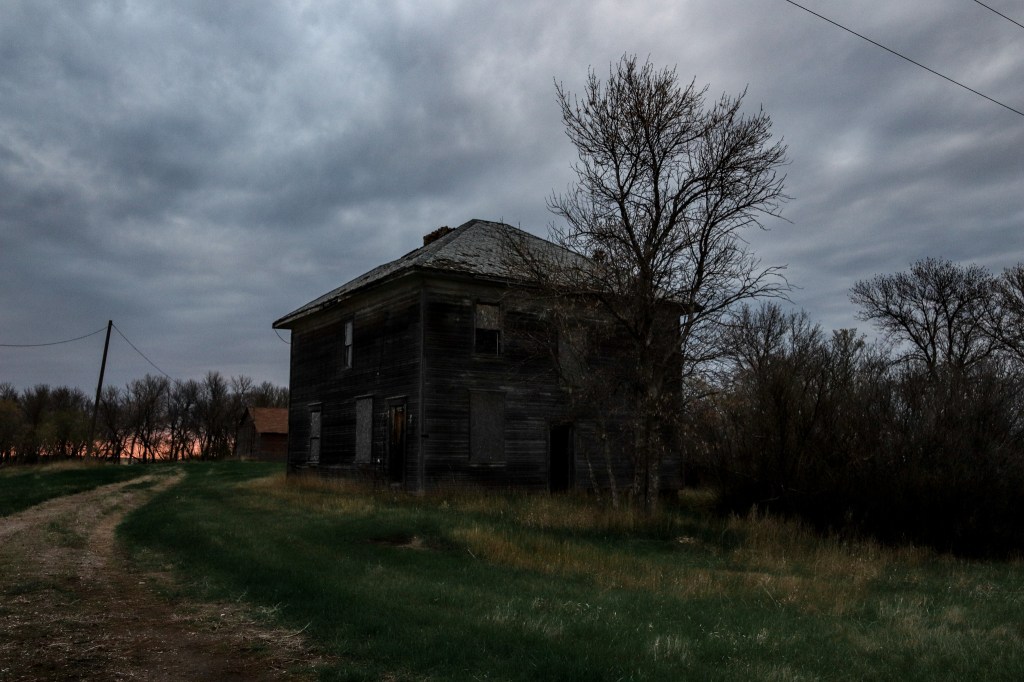
After visiting the Scallion House, we headed over to the town of Lenore. It was getting dark. I fiddled a lot with settings to try and capture just the right light. The setting sun and cloud cover added to the challenge. If my memory serves me correctly, there was also a dog barking in the distance. Of course, I was worried about that.
I did try to find some history on this house but came up empty handed.
Off in the distance I managed to get the elevator in the shot. Not planned but I think Christian will be pleased with this shot.
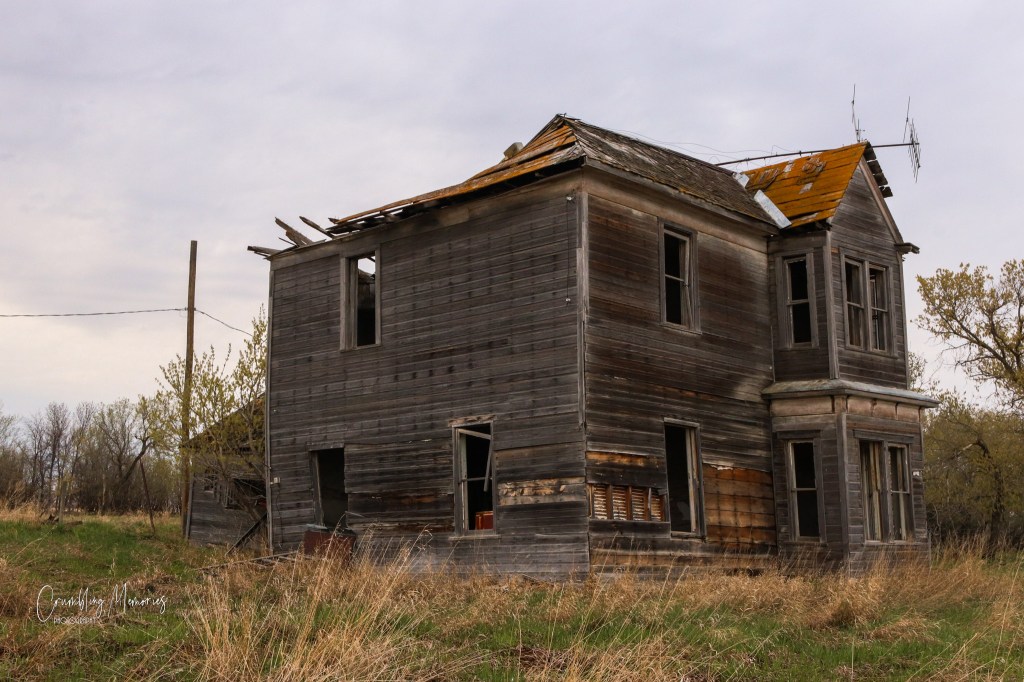
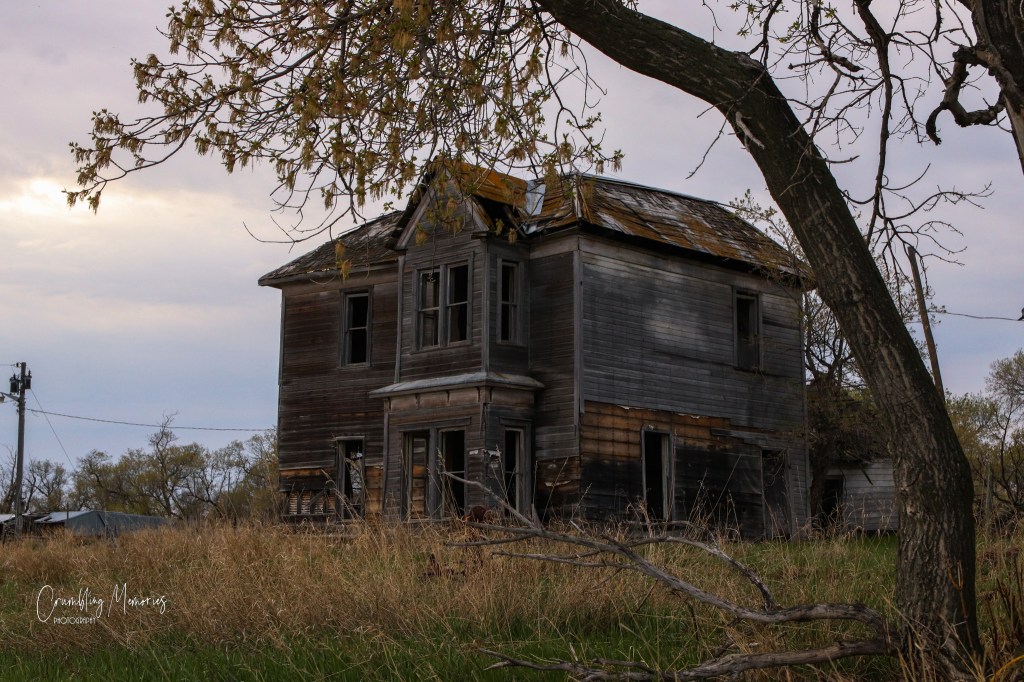
I recently saw a photo of this house posted online. It appears that the middle section has given away more so than it has in these photos. It won’t be long before the two sides collapse into the center of the house.
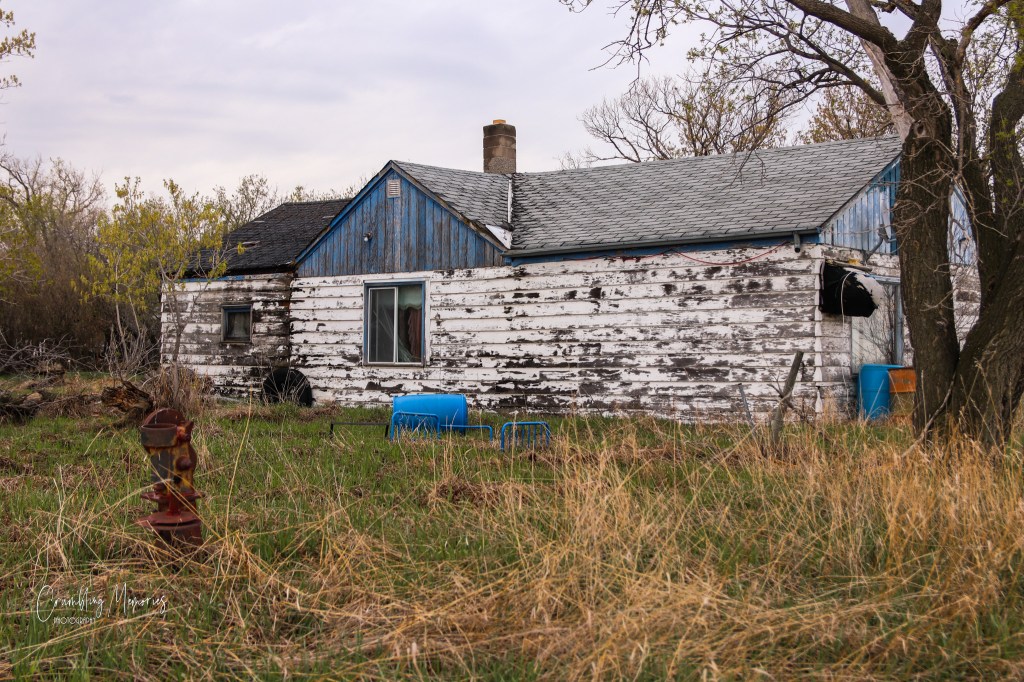
Yet another home I found nothing about. This was a long walk in. When we approached the house, it appeared a little too “new” for our liking. Sounds silly but…
Note the newer windows and the chimney stack. We will mark it down to revisit in a few years.
The barn and house are situated on this section of land. I am not sure that they go together. It might just be a coincidence.
There is no history on the first homesteaders of this land even though they owned the property for 14 years. From what I have gathered, they owned this land but did not live on it.
In the 1900’s Mr Fraser acquired this land but raised his family on another section close by. They had a large family and when their son married, he moved his new wife here. Together they farmed this land and raised a family of their own.
When the couple were too old to farm the land anymore, their daughter and her husband took over the land. They did not live on the land either and eventually one of their two sons took over the land.
This does not look like a home to me but a school. There was a school on the section of land next to this one. Unfortunately I cannot find any mention of it being moved here.
I will admit that it does look like some of the other schools in the area. It has a different entrance, but that is speculation and I cannot confirm.
I’d be lying if I said I wasn’t disappointed when my search of this old place came up empty handed.
I thought I hit the jackpot when I started looking for history on this one. Yet it turns out that what I found contradicted itself. So, I’m going to consider this one another one that left me empty handed.
But, it was not all for nothing. While trying to make sense of the stories, I found another old abandonded house that I have put on my to do list this coming summer.
I don’t recall how many photos I took, I should count.
Years ago I remember stopping at an old car lot in Saskatchewan along the number one highway. Not nearly as many cars and most were somewhat intact. And I do not recall seeing an area with parts like this lot.
I love this old car and what is was used for.
Imagine firefighters hauling ass down the highway in this?
This one reminds me of one of those old ice cream trucks. They would circle around the residential streets on the nice evenings in the summer.
Richard Wilson moved with his father, step-mother, siblings and step-siblings to the Marringhurst Plains in the RM of Argyle. Richard’s parents were originally from York, England where theiy married but then moved to Ontario where Richard and his sister were born. Richard chose this property to homestead on. He then married his wife Annie in 1863 and together they would raise a family of 8 on this homestead.
The first house on the property was a log home built by Richard upon his arrival to the Marringhurst Plains. At that time he also erected buildings for his livestock. In 1909, the Wilson’s built this “stately” two-storey, red brick home to replace the original log farmhouse.
In 1898 at the tender age of 34 years, Annie died leaving Richard with many children to raise. Richard married Annie’s sister, Louisa and together they had 3 more children.
The children grew up and went off to operate their own farms and raise their own families and by 1970 the home stood empty.
The home has been restored to its original grandeur and renamed the Marringhurst House. The home now operates as a turn of the century farm house museum and is open upon request for tours.
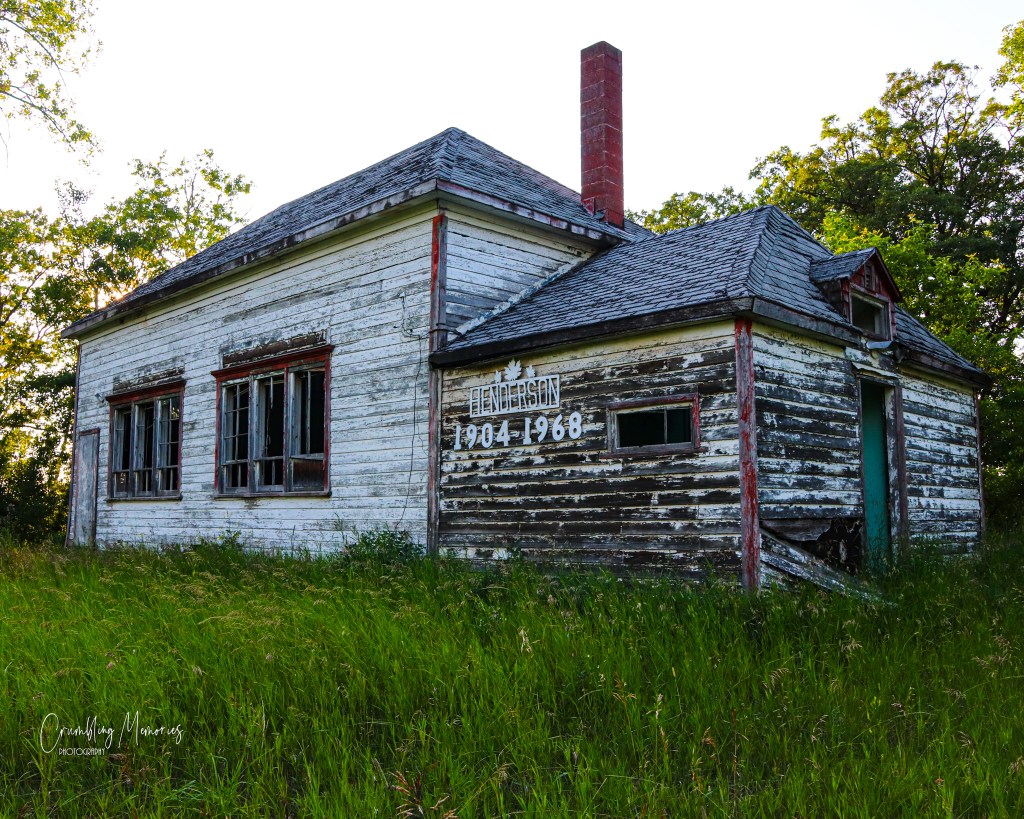
Its been some time since I’ve checked on this school and because we were in the area, we figured why not. It is not maintained like it was when I first visited.
And I do beleive that the school had far more windows intact when I was there last.
So if you are unfamiliar with the history, here is a quick recap. Built in 1904 this school operated until 1968 when it joined the current school division in the munincipality.
During the 1940s, the building was used for services of the Bannerman Church of Christ. It is my understanding, from a person who grew up and still farms in this area, that a local ladies group owned the school building for a while and held meetings here. Then the RM bought it back and has remained unused since then.
I had to go inside because I remember the inside of the school being in relatively good condition. The school desk and piano remains. And over the years, vistors have written on the chalkboard.
While school is out for summer for most, this place was pretty busy. Upon our arrival, a few birds took off out the windows. And, something was scurrying around in the ceiling. Given that we were blocking the main exit and the ceiling isn’t exactly stable, we left.
I’ll go back again in a few years and see how its making out.
Long before the first registered homesteader came to this property, many indigenous people lived off this land. Many studies have been conducted and many different artifacts from different periods of time have been recovered in different layers of the land here but there is still not a lot know about the very first settlers, the Blackduck people who are recorded to have lived on this land between A.D. 700 and A.D. 1300.
What we do know is that Mr. William Thomas Brockinton, a graduate of Oxford University in England, and his wife and two children who were 5 and 3 years old left England and William’s job as an auditor for The Birmington Railway and arrived in Woodstock, Ontario in the fall of 1881 with zero farming experience.
They remained in Woodstock that first winter and met a group of young men who were on their way to Manitoba. The men picked their homesteads from a Homestead Map and headed to Brandon in the Spring of 1882. Brandon was a far as they could travel by train as that was where the track ended at that time. The group organized their supplies and William bought himself what was said to be the best team of oxen ever seen. The cart was loaded with lumber which would build the Brockinton’s house. Mrs. drove a pony, hitched to a buggy with the children inside and a cow attached behind. Remember, the Brockinton’s had zero farm experience and it is said they relied heavily on the young men they travelled to Manitoba with.
On their first night, the cow got loose and William spent a good part of the night trying to get it back. This resulted in William missing the ferry at Plum Creek. The young men were not happy as they had already gotten their supplies across and were annoyed that William was likely going to delay things trying to get his oxen and load of lumber across the creek. This didn’t stop William. He came down the bank, oxen pulling his lumber and entered the water. It wasn’t long before the oxen were completely submerged underwater for about 10 feet or so. The force of the load was so heavy that the oxen were able to get their footing on the bottom of the creek and carry on across the creek bottom and up the other side of the bank. It is said that all the while, William stood on the top of the load, smoking his pipe like this was a normal thing.
That first winter, the Brockinton’s lived in their small, cold, wood house. The young men decided to head back to Woodstock for the winter leaving William all alone to figure out his first winter on the prairies. A Manitoba winter was not something William and his family was used to. In February, the family started to get short on food so William set out for food and nearly froze to death on his way back with a bag of potatoes which were also frozen by the time he barely made it back to his family.
During the second summer in Manitoba, William acquired a second homestead on the river flats where there was plenty of wood. That first winter William built a soddy to live in. William now spent his time between his two homesteads and in 1895 he built this beautiful stone home which still stands today.
After moving to Manitoba, the Brockinton family had two more children. As there were no schools nearby, William home schooled his children until a school was built nearby in 1901.
William was an exceptional violinist and was more than willing to teach anyone who was willing to learn.
Mr. and Mrs. Brockinton continued to live on their farm until their deaths. Mrs. Brockinton died in November of 1924 and Mr. Brockinton died in September of 1933 at 83 years of age.
It is said that William continued to purchase land in the area and at one point paid $4.80 an acre. I cannot tell you exactly where this couple retired.
This land is also recognized as a Manitoba Grassland Birding Trail.
This old homestead is recognized as a National Historical Site. One day I hope to find out more about the Blackduck People who inhabited this land many, many moons ago.
Of course, this is one of those ones where I cannot find anything for the first recorded landowner of this property. Recorded to have acquired the land in 1885 and sell the next year, clearly nothing was done with this land and they carried on.
Then in 1898, WGM from Otter Lake, Quebec decided to homestead here. Born on August 6, 1874 he married Mary who was born in Scotland in 1884 and immigrated to the Virden area with her parents as a girl. We visited this house on August 9th.
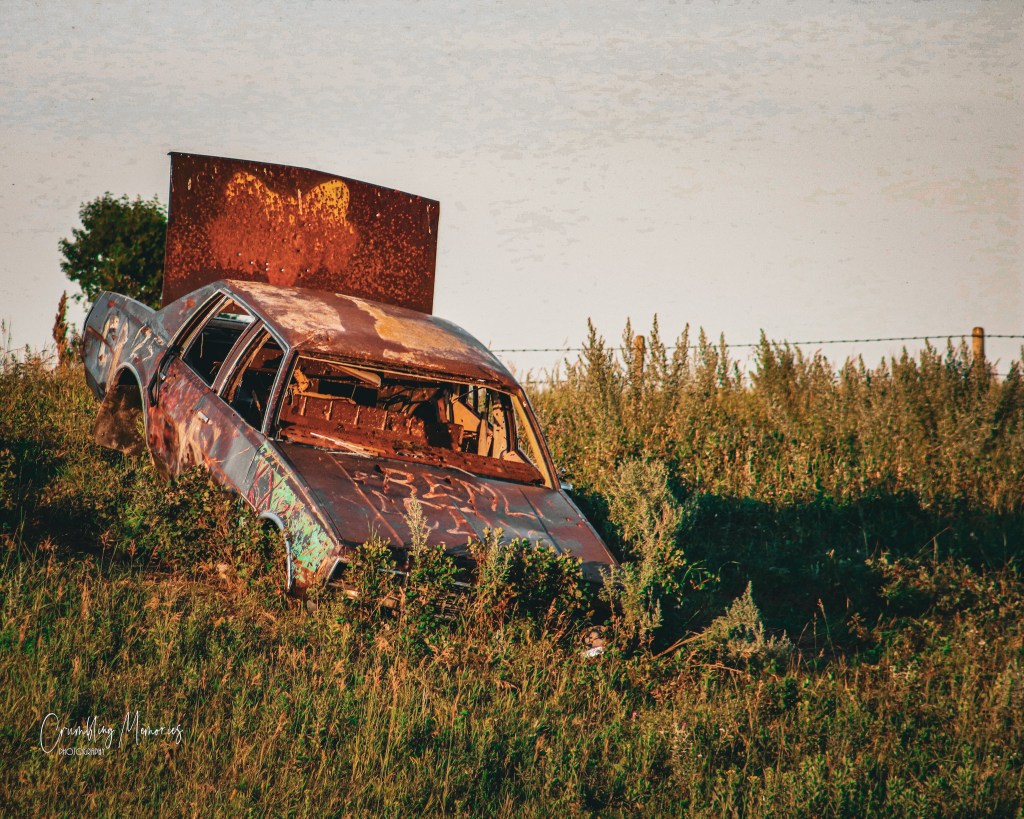
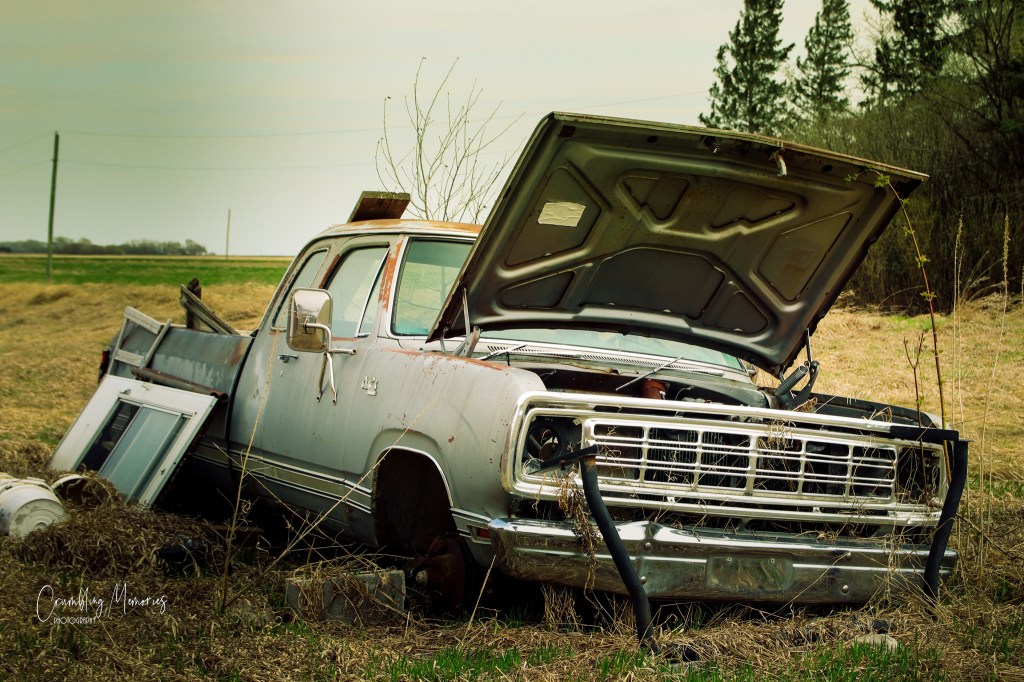
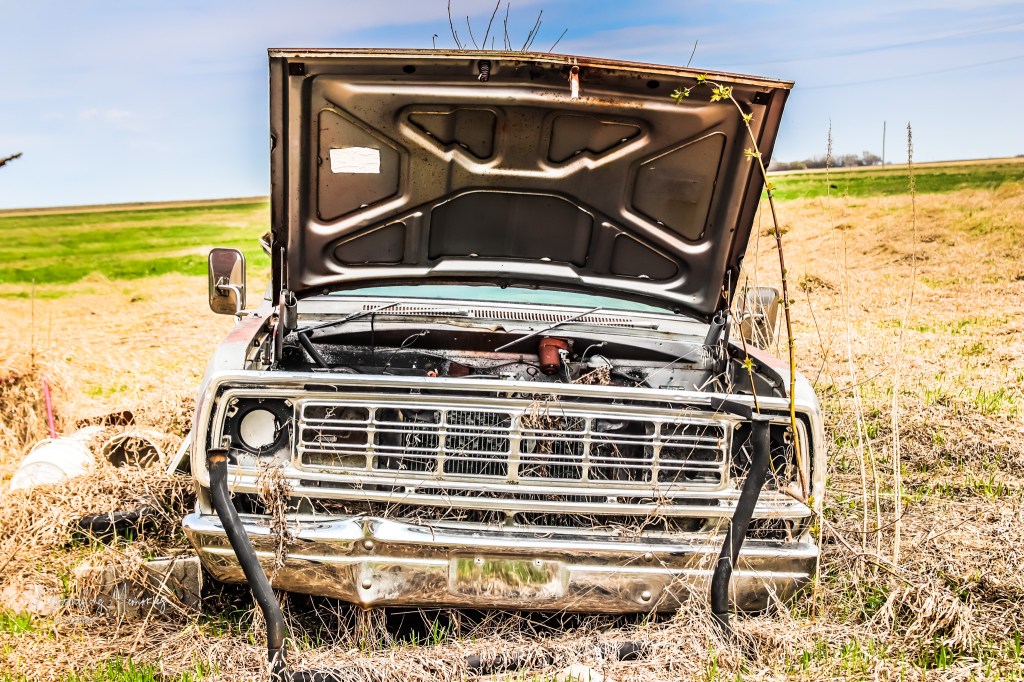
Christian told me about this house with an old car in front. This got me pretty excited until I realized that the car wasn’t really that old but was old looking to him. I appreciate he knows what I like though. He’s a great bando seeking friend.
Mr. & Mrs. were married in 1904 and together they had 4 children. Their youngest was only 8 years old when Mrs. passed away in 1922. Mr. lived until 1958.
In approximately 1947 this homestead changed ownership. The yard was surrounded by fruit trees and our fellow explorers identified them as plums.
This house has been on my radar for a very long time. The day we finally went to see it, which was the first time for both Christian and I, my anxiety was through the roof. In my mind I was thinking of reasons why we shouldn’t go. Long walk in, getting stuck, tall grass, uncovered well. All ridiculous.
More often than not, we go to a house because we’ve seen it photographed by someone else and decide we must see it too. More often than not, I know nothing about the house, that always comes afterwards. While I knew a couple things, what I found out after was a story of a man who changed farming in the early 1900’s. Those practices carried on into today’s time. I had no idea when I started to dig into it how significant this man would be to this area and to Manitoba.
There is a lot of history here and I’m not sure where to start or how much to write about so lets start with the house in its prime.
When I look at this photo its very hard for me to picture the house like this given the state it is in now. To get to this property, which is located about 1/4 mile off the municipal road, we drove up a long drive, ruts visible and large maple trees which enclose the laneway. I can imagine that this was a beautiful drive in its time. Likely not so good in a Manitoba winter but I would imagine these trees would be a pretty good shelterbelt.
Until 1954 the CPR had a line which was ran to the Rocanville Substation. I do not know if station still exists today and if it is, what it is called or if it is operational and for what. I do know that this railway is what makes this landowner and this house as popular as it is.
James William Scallion born February 14, 1847 in Wexford, Ireland immigrated to Canada and in particular Thorold, Upper Canada which is known today as Hamilton, Ontario. Arriving in Canada with his parents, brother and two sisters at the age of 10, James did all his schooling there and later became a teacher at the Toronto Normal School for a few years. Then himself and his brother Thomas, ran a store in Thorold. It is said that they became intrigued by the possibilities in Western Canada and in 1882 moved to Stonewall, Manitoba. The foll0wing year they headed to the Virden area and purchased 640 of land and chose this spot as the homestead.
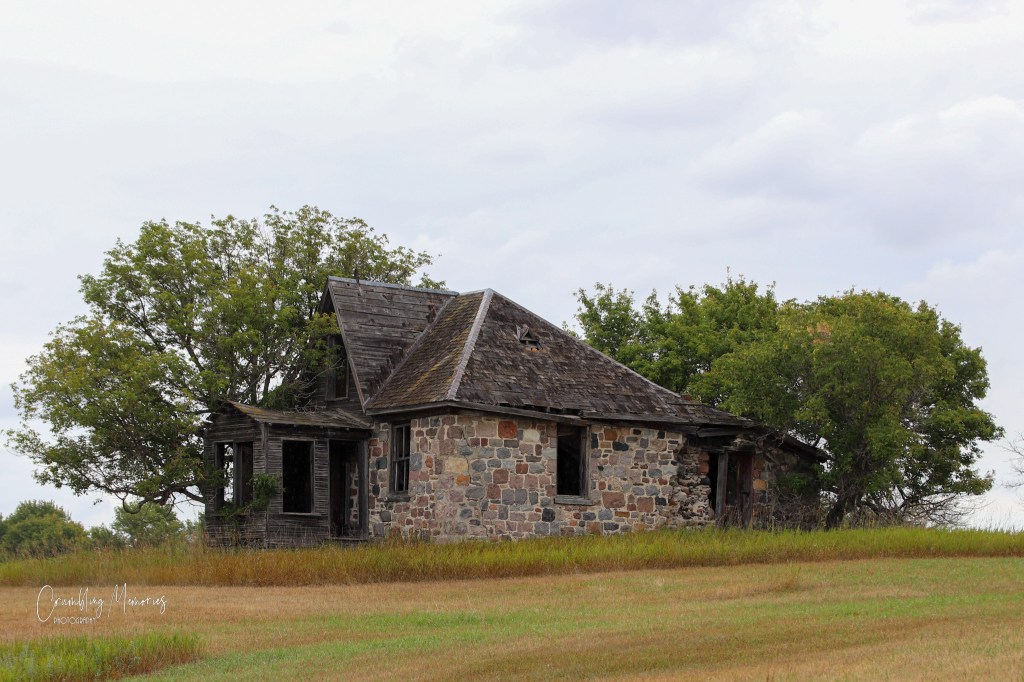
Dubbed “The Grange”, the brothers built the house and granary from field stone found on the land. One of the first homesteaders in the area, the brothers built a lavish field stone home which even had electricity in the house and the barn. In a short time they upgraded their acreage to 960 and included livestock to their farm. This required the brothers to hire two farmhands.
The granary which is in great shape was above standard for its time. Not only did they have electricity but it held 12,000 bushels and had electricity to run the machinery to help load and unload the grain. That railway I was telling you about, was within 500 yards of this granary and because of this the Scallion brothers were able to load their grain onto the passing boxcars, therefore eliminating the commercial elevator in the area. This put more money into the pockets of the Scallions and not the elevators and railways.
Back to the family. I really wasn’t sure what I was expecting when I got here. For a while I just stood here and looked around. In the NE section there were combines going. It was peaceful and the sky was amazing but starting to set so I knew I didn’t have a lot of time because I did not have my tripod with me. Behind me were multiple bee hives but of course they were not at all interested in what I was doing.
It is said that after the death of their parents in Ontario, James’ two sisters Hannah and Catherine joined their two brothers in approximately 1887. The four of them lived unmarried and happy in this house. Said to be known for their hospitality, the Scallions had plenty of visitors to their farm. People wanted to see how they prospered.
James Scallion was known as a successful farmer in the area but he should be better known as the man who pursued and was successful in assuring that the farmers who worked hard for their crops got a fair price for their grain. James believed that all farmers should be able to ship their grain directly to the market and not be undercut by the middle man. James believed that farmers should be able to sell their grain to whomever they wanted be it in Canada or the United States.
In 1903 James formed the Virden Grain Growers’ Association and then travelled around the province to encourage other communities to do the same. James told them that the money they received for their grain should go to them and not to the grain dealers and railway promoters. James was named the President of the VGGA but stepped down within the year due to health issues.
MGGA chapters formed all over the province. In an unprecedented move, in 1912 James also allowed women to be associate members and in 1914 women were recognized as full voting members.
James was also a founding member of the Grain Grower Grain Company which later became the United Grain Growers. It was later one of the biggest grain companies in Canada with hundreds of elevators in prairie towns whose profits were shared by its members. James was a very successful man with a big history in this province. He had many more accomplishments in his life.
1n 1918 after dealing with years of illness, James and his sister travelled to California. Upon their returned they settled into a house in Virden where he lived until James passed away on April 24, 1926. Upon James retirement from farming he sold the farm to a young man from Scotland who then sold the farm to a member of the family that currently owns the land. That man died at the farm in 1948 in a farming accident.
The railway was removed in 1954.
James improved the lives of many farmers, ensuring that they, like himself were paid fairly for their hard work. In one final contribution James donated $10,000 (said to be valued into today’s currency at more than $140,000) toward Virden town development and $5,000 towards the Virden Hospital.
Believe it or not, it is said that James is barely remembered in the Virden area.
Years ago I found this house while visiting something else in the area. I put it on my to-do list but never went back. The front was overgrown with caragana and I don’t like tall grass when I can’t see where my feet are going!
Christian and I were cruising around this area a few weeks ago and he spotted it from the road. I had forgotten about it but was glad he seen it and pulled in for a couple shots of it.
Unfortunately, I have not been able to find anything about the first homesteaders or anyone who has come after that.
I wonder if they planned to come back for this boat.
When I first saw this house posted online by another bando hunter, I immediately put it on my list to see. Back in May, a fellow bando hunter and I went there. One thing I did notice was the two lightning rods that were once attached to the house are now gone and the swinging door has one again closed itself, or maybe it had help.
Mr., born in England, immigrated to the United States and then ended up here in 1894. Upon his arrival he purchased this section of land. He met his wife when he got to Manitoba and they married in Brandon. From this union 3 girls were born. In 1902 he sold the farm to his brother-in-law and moved to town and purchased shares within the local flour mill and worked for many years in the community.
The history of the brother-in-law’s family is far more in depth but doesn’t really confirm anything about this house. Their earliest recorded history is 1196. In 1756 the family changed the spelling of their name, which really wasn’t that uncommon back then. The family are said to be the equivalent of English Feudal Lords and were the Lords of Duersen and Lissel in the Province of Brabant which is in the Netherlands. The earliest record of an ancestor coming to America was 1630. The earliest record on one coming to Canada was 1756 when they immigrated to Ontario. It is said that one of the children, at a young age, was lost in the woods and never found.
Now this is where it gets tricky. This family farmed on the NW corner of this section which would explain how this family is connected and how the original landowner met and married his wife. When they moved from the land to town to operate the flour mill, he sold the land to his brother-in-law. It is recorded that a farm on this land burnt down in 1916 when the family was away in Ontario. They lost everything in that fire.
I cannot confirm if this is a rebuild of the original home or if the house that burnt down was on another quarter of this section. Regardless this is quite the house. Unfortunately, it was not easy to photograph from the front given the tree line. And honestly, I didn’t even look at it from the back.
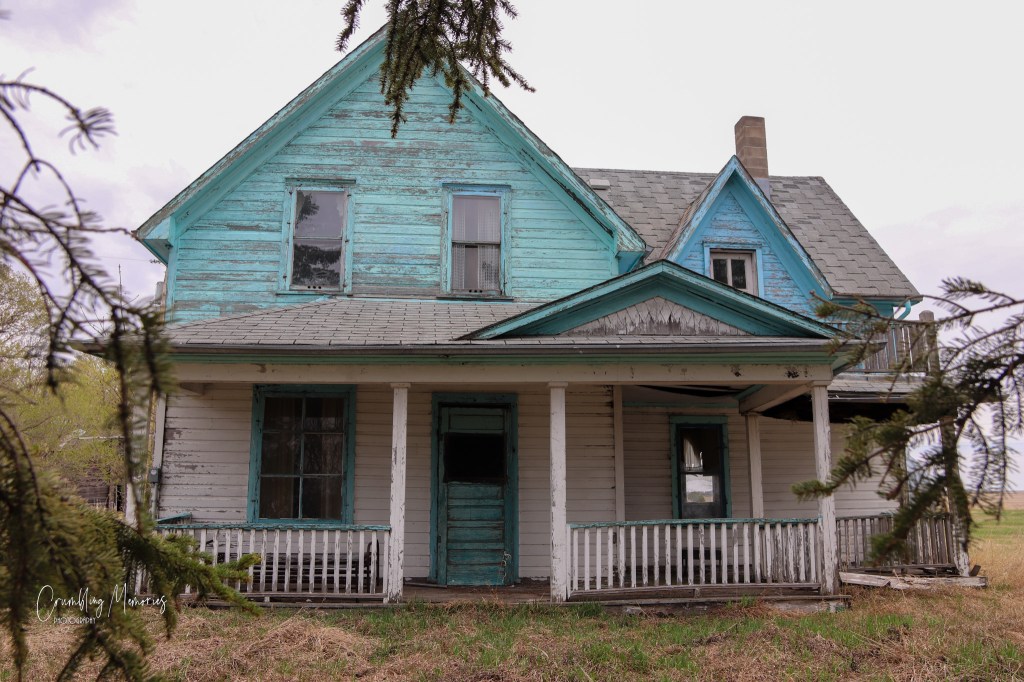
This is a neat old house which I thought would have been quite fancy for its time with its porch and upstairs deck. It certainly wasn’t your typical style home. The floors were caving in so we just peeked through the windows but inside there was plenty of old things to see.
It definitely goes up there on one of the neatest houses I’ve been to.
This sign is one of the coolest things I’ve seen given that it actually states when the homestead came to be. I have removed some of the information from this sign which gives away its location. I love that this sign confirms when this homestead came to be.
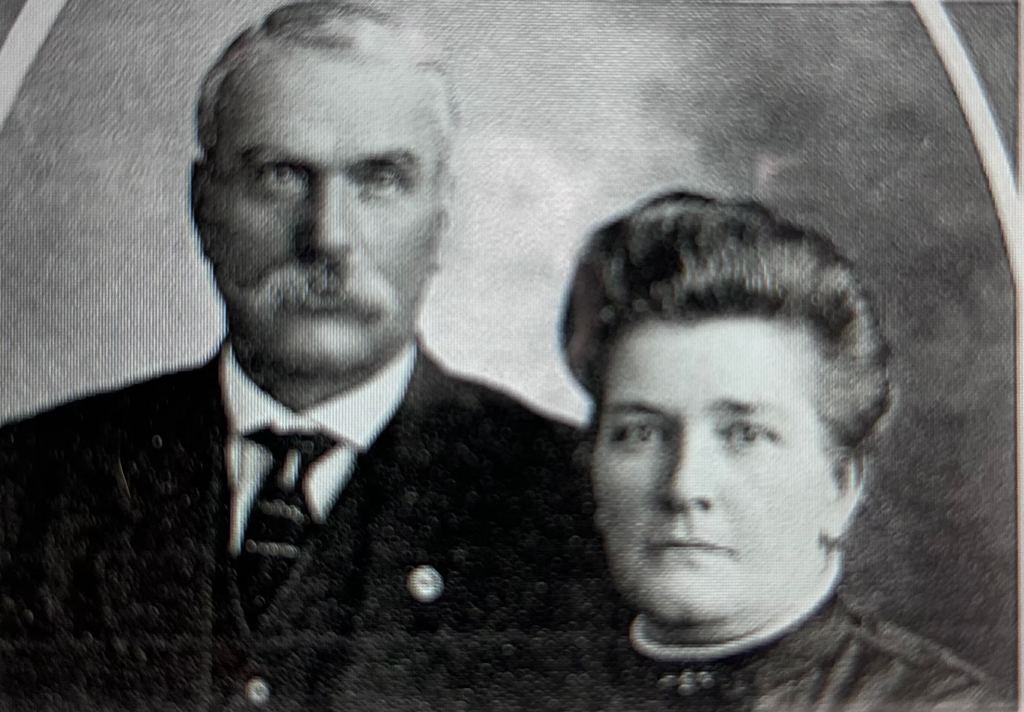
John & Mary, both born in Scotland in 1847 and 1845 immigrated to Ayr, Ontario in 1868 where they lived for 9 years. In 1877 they made their way to Manitoba by Red River cart and arrived in Portage la Prairie, Manitoba where they remained for 4 years.
In 1880 Mr. filed for this homestead and was one of the homesteaders in this district. That summer he built a soddy and the following year he moved his family here. Mr. & Mrs. raised 9 children on this land. For several years that soddy was a stop-over or half-way house for other farmers moving grained from Deloraine to Brandon. It was here that they would replenish their supplies and rest.
This house was built in 1885 and was last recorded to be owned by Mr. & Mrs. grandson, W. Jack.
Mr. & Mrs. retired to Victoria, B.C. in 1912.
All 9 of their children attended Millerway School which was built in 1884.
The couple had a happy life together and celebrated their golden wedding anniversary in 1919 (50 years) and their diamond wedding anniversary in 1929 (60 years).
Mr. passed away in March of 1931.
Mrs. passed away in August, 1935.
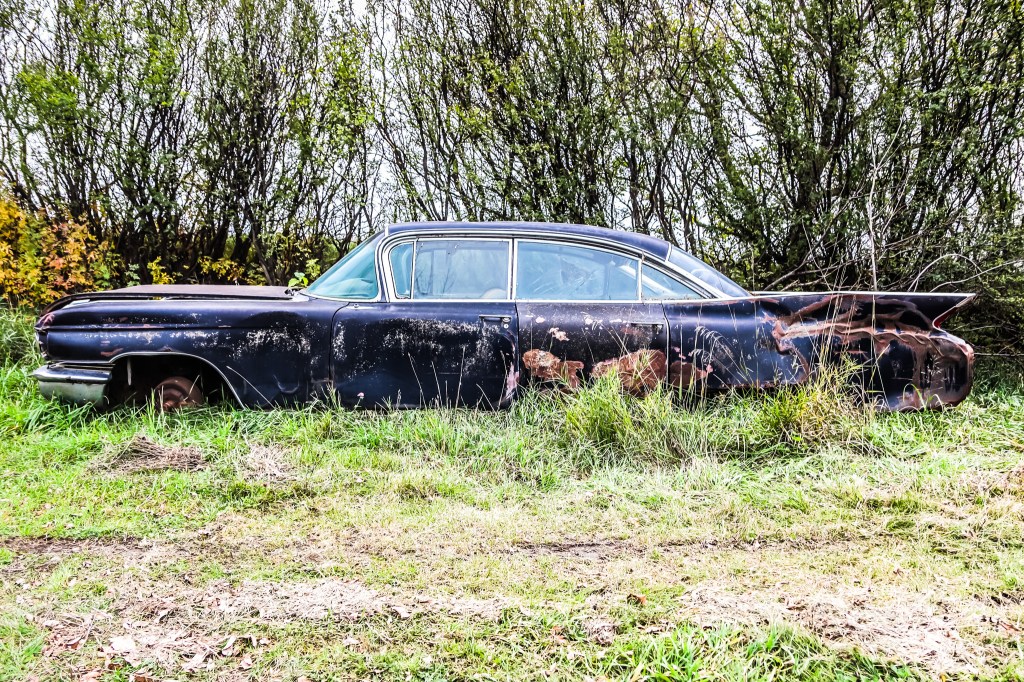
The best thing about a bando house hunt is when I find old cars there.
The original homesteaders of this property came to this land at the turn of the 19th century. The first official recording that they were the landowners is dated 1901. Owned originally by one of the brothers of this family, the first brother to own this land, William, turned the sod making it ready for farming and construction of a forever home.
In 1904 William sold the land to his brother James who lived here until he retired. At that time he son, namesake of his uncle and his dad, took over.
This property has a long drive and is beautifully treed. This is also the spot where Christian and I got most of our wood ticks that day. I’m sure that we picked off at least 50 at the end of this driveway before we got back in the vehicle.
In 1920 this land was sold Mr. Taylor but then repurchased it. James later sold the land again, this time moving to a different district to farm, but again bought the land back. It does not state why the land was sold but it does say it was purchased back due to adverse conditions.
James and his wife Bessie raised three children, mostly on this homestead. In 1930 they retired from active farming and moved to the closest town. Mr. died in September, 1953 and Mrs. not long after in April, 1954.
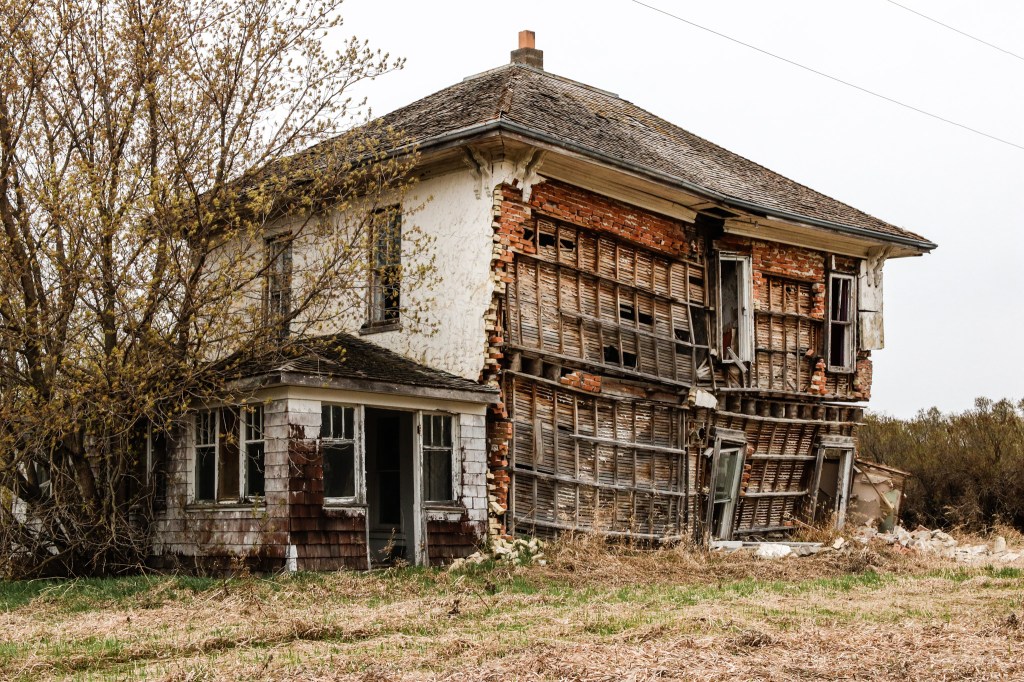
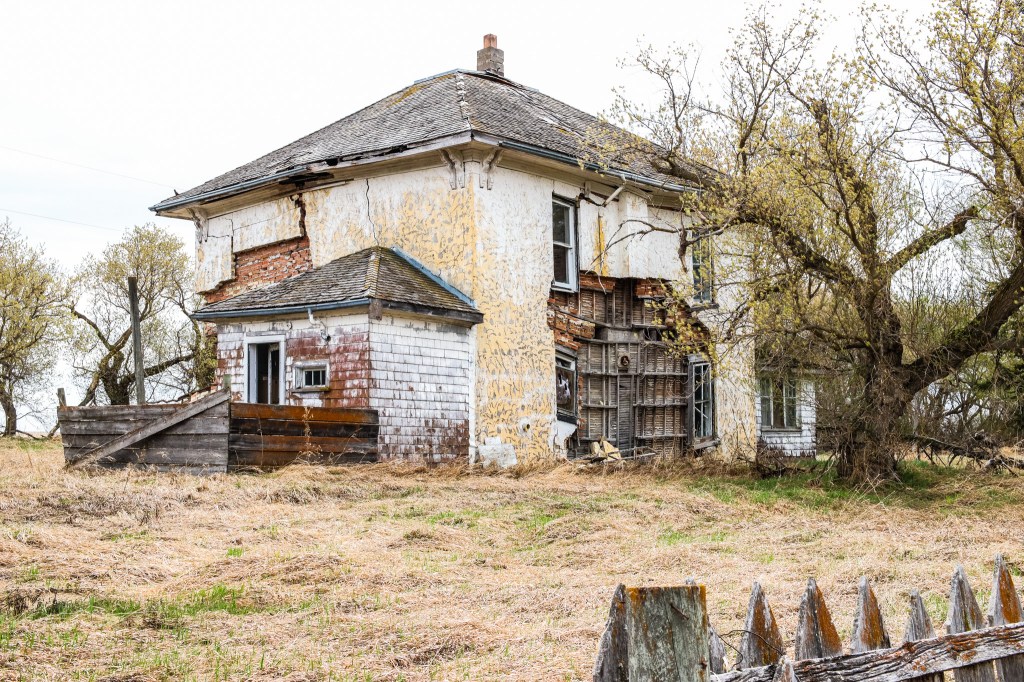
This was not the first house we went to on this day that was suffering from the same sort of decay. I am going to make the assumption that at one time, these were brick homes. In an effort to modernize them, stucco was applied over the brick. With time, the roof began to leak and the water ran between the two layers causing this deterioration to happen.
Inside the house we could see the remains of furniture and a bookshelf with puzzles and games.
The first recorded landowner recorded for this section of land is 1889 but there is no family history. So, I don’t know who built this house. Regardless, she’s a beauty.
In 1906 Mr. quit his job at the chair factory in Orangeville, Ontario to move to the area. He boarded a freight train with the machinery, furniture and household effects of the Anderson Family. Upon his arrival to the area he was hired as a farm hand on another farm. In 1911 he rented this land from the previous landowner.
In January, 1912 he married Helen, the daughter of the family whom he traveled with to the area with their belongings. They bought the land and lived there until 1954.
When they left the land they retired to Melita. During his active years Mr. was on the school board in the area and was a counsellor for 13 years. Their youngest son took over the farm and raised his family here.
Before marrying Mr., Helen was a school teacher at Brown’s School from 1909 to 1911. She began teaching at 16 years of age.
While walking up to this property we discovered that the Souris River runs through it. The water was full of ducks and small birds. In the distance I could hear an owl taunting me but I could not spot it.
There were two houses on this property . This newer house must have been what the family moved into when the original farm house was no longer livable. I love that the house was preserved to some extent.
Mr. & Helen raised 9 children on this farm, 4 boys and 5 girls. Mr. passed away in 1963 and the history that I found for this family was written on May 26, 1982 by Helen who was in her 90th year. I visited this house on May 13, 2023.
At the time that Helen wrote her family’s history, there were 25 grandchildren, 30 great-grandchildren and 5 great-great-grandchildren.
Then the 30’s rolled around and the family faced the depression, the dust bowl and the grasshoppers. At the time the family had a car, a piano and a telephone. Mr. sat down with his family and said something had to go. Helen said that the telephone had to stay, in case of an emergency. The children all wanted to piano for entertainment. So, Mr. put the car up on blocks and parked it. The family relied on a Bennett Buggy for transportation.
I did find this one strange piece of equipment in the yard. I took a photo of it with the hopes that my husband could identify what it might be but he wasn’t sure.
Now I’m wondering if the old car is somewhere on this property. Maybe the owl was trying to lure me further into the yard in the tall grass and treed area so I would see it!
TJB was born in 1872 to Empire Loyalist parents in DeCewsville, Ontario. TJB moved to Canada in 1892 in what was referred to as a “harvest excursion”.
What is an Empire Loyalist? Due to the American Revolution, approximately 8,000 Brits came to Canada and migrated to an area in Southern Ontario. Those people were among the first white settlers of the province and were instrumental to creating the Province of Upper Canada 1791.
Christian and I were on our way home for the day after an almost 11 hour day hunt and shoot. We had just finished up and the well groomed yard when he remembered this place which had some old cars which he knows I also enjoy photographing. It was getting pretty dark so we weren’t sure what we were going to get. Again, I wasn’t sure what I was going to get in this lighting and I also underestimate what I can do. That am I’m not much of a risk taker because don’t want to miss a shot.
In 1894 TJB married Emma in Deloraine. Emma was the first woman to live in Medora. The first home they built was where the Medora Service parking lot is now and they lived there until 1903.
TJB played for the local baseball team and was a goalie for a football team. He was the secretary for the Sunday School and the Literary Society. As well, he was a member of the Orange Lodge. The Orange Lodge is a group of Protestants who were committed to the protection of the principals of the Protestant Reformation and the Glorious Revolution of 1698 which enshrined civil and religious liberty for all. The Orange Lodge has existed in Canada since at least 1812.
Emma was a very involved in working with the church and was a life-member of the Women’s Institute. Emma was also a well known dress-maker.
From what I have read or found about this property, I can’t tell you anything about these old trucks nor can I link them to this family.
During my old car photo shoot, Christian was wandering around the house so I thought I had better get over there and take some photos before it was way too dark.
Here is where I get a confused by what history I have found. It says that TJB built the house in 1903 which is now owned by another farmer in the area. “This old house was moved to the farm.” So is this the house that was built on the service lot in Medora and moved here or was the house built on the service lot sold to the other farmer and he moved it to his own farm? Regardless, she is a big old beauty.
TJB and Emma raised 5 children on the homestead. Their oldest son George who was born in 1897 later left this property to his only son when he retired and moved to Medora in 1974.
TJB passed away on June 8, 1930 and Emma passed away on August 14, 1962.
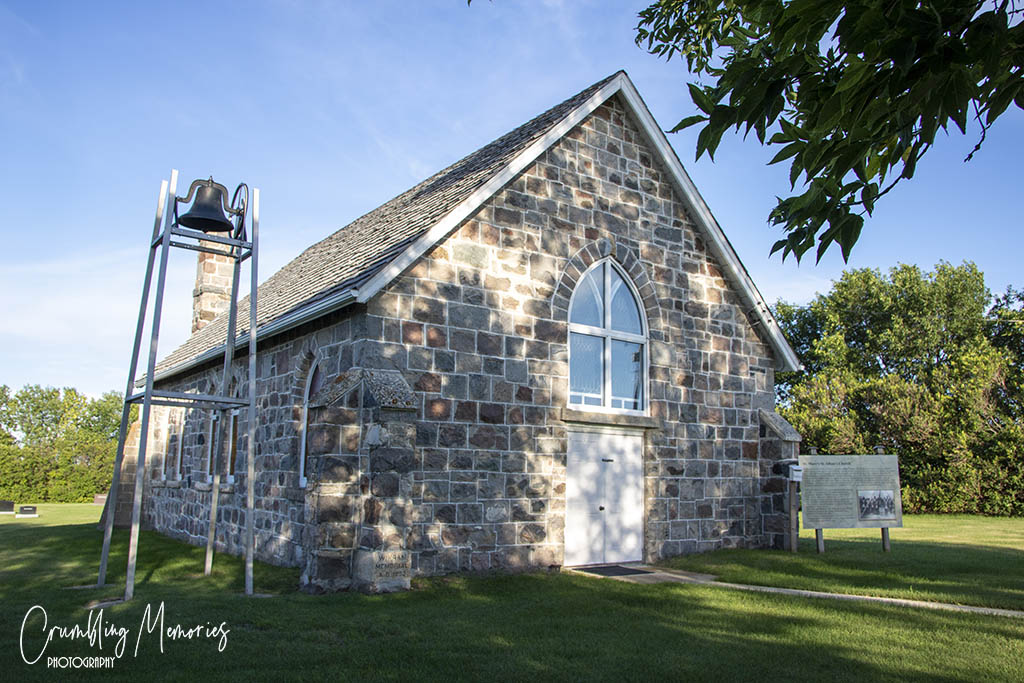
This impressive 28-foot by 44-foot stone church south of Manitou, just passed the town of Kaleida was designed by Winnipeg architect, Charles Wheeler. Built in 1892 for a cost of $6,500 by W. H. Bowler and the construction firm of Kerr and Magee.
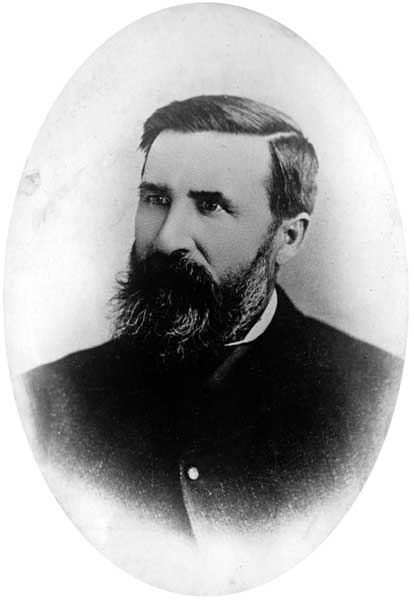
The church was originally named Winram Memorial Church in commemoration of W.J. Winram. Born in the Isle-of-Man on 8 January 1838, and the son of shipbuilder, he worked as a mechanical engineer in his father’s shipyard. Upon coming to Canada around 1866 he settled in Simcoe County, Ontario and resided there until May 1878, when he came to Manitoba.
In 1860 he married Catherine Ingersoll and together they had 3 children. He won his first seat in the Manitoba Legislature by acclamation in 1879 and was re-elected or acclaimed at the general elections of 1883, 1886 and 1888. He was also a Speaker of the Legislative Assembly from 1888 until his death.
Upon my arrival at the church which is down a horrid PTH (that’s not surprising in this Province right now) to this well kept church and cemetery, it wasn’t what I was expecting. When I came around the back I found the headstone of a friend’s Dad. She told me today that her parents were also engaged at this church and her Mom grew up not far from here. Her maternal grandparents are buried beside her Dad.
I’m happy I made my way down here. Of course I tried to avoid going back down the PTH and ended up in a maze of gravel roads and pouring rain but with Colton’s keen Snapchat mapping skills, we made it home.
Well, not really but this house would be right smack in the middle of a section of land and of course, I can’t confirm anything with the material that I have here.
I have had permission to photograph this house for some time. I went in the Fall and it was muddy.
I
So Cade and the kids stopped with me on the way home from Brandon one day and Cade drove in part of the way and I hiked in the rest. I didn’t go into the house but I did wander around as far as the snow would permit to get this tractor and a couple different angles of the house.
While it was the house that got my attention and led me to this old homestead, once I was there it was this barn that I really liked. Its held its own in our harsh Manitoba weather.
When we were driving out, Cade spotted this little rodent in our tire tracks so I got out of the car to chase him away so that we wouldn’t drive over him. I truly think he was blind because I could literally reach out and grab him if I wanted to and I followed him down our tire tracks for some time.
The Belfry School District was established in January 1891 on land donated by local farmer, Warren Belfry from whom the school name was derived.
Five years later, the building was moved to its present location where it remains somehwat stable. The floor is caving in so I did not attempt to enter beyond the front step.
Due to low numbers, the school was closed between June 1940 and January 1945. The school closed permanently in June 1962 and the remaining students were bused to Elva School, Pierson School, or Melita School.
Some of the teachers who worked at Belfry School included: Miss Hope (1907), Miss Wheeler, Miss Rodgers, Miss Carson, Miss Fizzell, Miss Pheonix, Miss Archibald, Miss Strong, Miss Wells, Miss Shands, Olive House, Ruby Fletcher Reddaway (1939-1940), Miss Munro, Melba Dobbyn, Miss Cooper, Miss Stamper, Hazel McLintock, Mrs. Baker, Mrs. Roblin, and Mrs. Betty Pederson (1961-1962).




































 CRUMBLING MEMORIES