
I cannot believe that I have still not posted these photos. I do beleive that part of my hesitation or procrastination was getting my info together for this family and making sure I could identify the whales I photographed correctly.
Now this is likely going to be a long, boring post if you are not at all interested in killer whales. First let’s start of by clarifying that they aren’t actually whales, they are the largest member of the dolphin family.
Let’s also talk about the name killer whale. In today’s society, people do not like the name killer whale and don’t want us to use it anymore. Let’s face it, they are the apex predator of the ocean so the name fits. Well I guess aside from the whale part but you get my drift. Anyways, instead they want us to call them orca. And orca means demon from hell.
So you may know that there is a pod of orca that are considered endangered. They are known as the Southern Resident Killer whales and they travel the waters of the west coast from northern British Columbia down into Washington. They only eat salmon. And this is why they are endangered and are heavily protected in the waters in which they live. Currently there are only 74 of them as at December, 2023. If you were on a whale watching tour, they would not stop to allow you to observe them.
Then there are the Biggs or Transient Killer Whales. This eco-type eats anything. Dolphins, sea lions, baby humpbacks, seals, birds. Given they will eat a wide variety of marine life, their population is a lot healthier.
You read that right, baby humpbacks. And this year we saw a humpback that was attacked by orcas three times. I shouldn’t say attacked because Valiant has started some of these encounters with orca. But that’s a story for a different day. We did see Valiant on our last trip to B.C.
So, some history. Since seeing orca at Vancouver Aquarium at about 8 years old, I have been obssessed. I read books about them and tried to learn all I could about them. Then last summer, last minute, Colton wanted to go watch them. So I went. He has never seen them before and I had never seen them in the wild. So of course when they surfaced, it was pretty exciting.
That day we came upon a Bigg’s family. There were 3 whales traveling together. Sam, Tread and her 2022 born, unnamed calf.
Let’s start with Sam.

In the summer of 2013, this then 2-year-old orca T46C2 or Sam, was stranded in a small cove near remote Aristazabal Island on the North Coast of B.C. for several weeks. He had swum into a shallow bay and became psychologically stuck, afraid to swim back over the shallow sand bar. He was not eating, was quickly losing weight and was calling loudly for his family.
Luckily this little whale was found by the Vancouver Aquarium who monitored the situation for a few weeks before deciding this animal was not going to leave on its own. In Augst of 2013 on their first try to get T46C2 out of the bay, they were successful! The next dilemma this young whale would face would be locating his family again. In October 2014, Sam was spotted swimming with his mother and siblings in Blackfish Sound, near Telegraph Cove.
On July 22, 2023, I took this photo of Sam swimming happily with members of his extended family. Male orcas are said to be the ulitimate Momma’s boys and they stay with their Mom’s their entire lives. Sam doesn’t travel with his Mom often and moves from family to family.

Here is the 3 of them together. Now in the whale world, there are 3 ways to identify a killer whale. Eye patch, saddle patch and for some, dorsal fin because some have a visible dorsal fin injury or a very distinct shape. On this day we were told that this was an entirely different pod of orca. I was able to confirm otherwise with another naturalist out of Naniamo. She is my go-to whale question person now. In this picture Sam is following behind and the youngster is travelling in echelon position with its mother, Tread.
The other two are T46B Tread and her 2022 calf T46B1C.
Firstly, let’s talk about Tl’uk. In 2018 Tl’uk (T46B1B) was born to Tread.
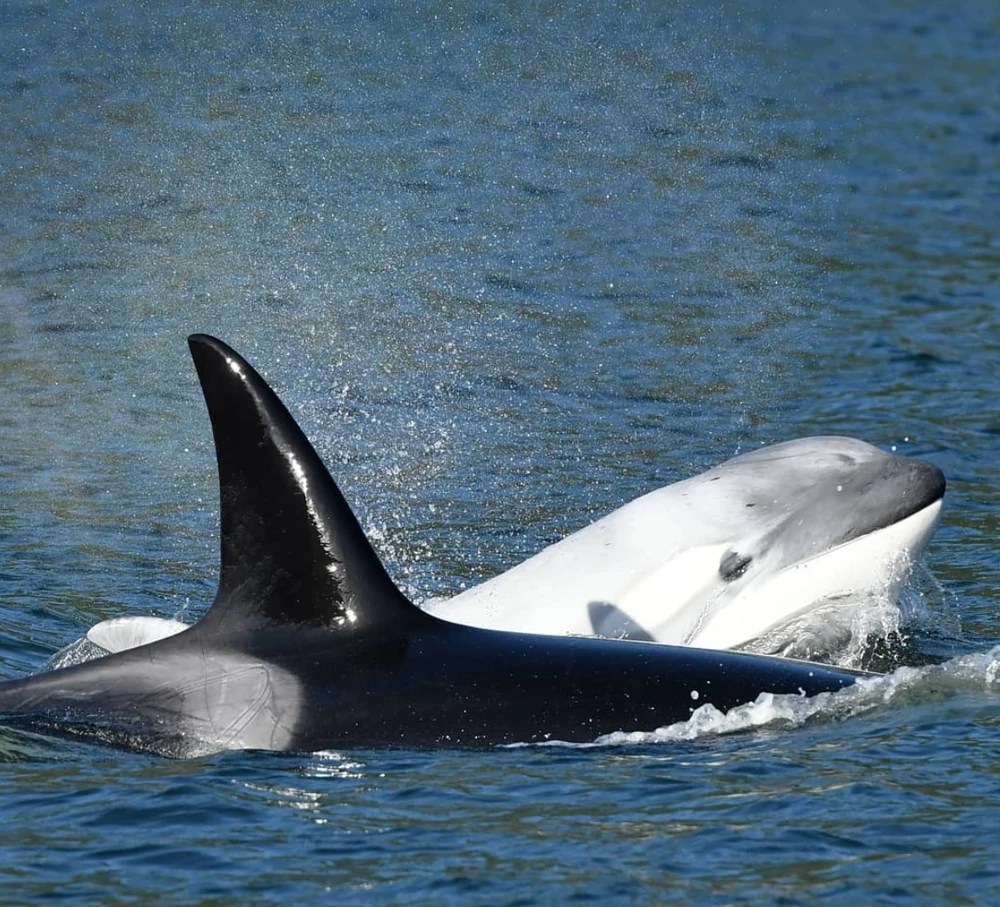
Tl’uk not only caught the eye of local whale watchers and researchers, he also drew the attention of people globally because he is not your average black and white orca. Tl’uk looks like he has been white-washed and scientists are not entirely sure what condition Tl’uk had that caused the muted pigmentation in his cells. Some suspect a condition called leucism may have been the culprit. His pale colouration resulted in naming him Tl’uk, which is a Coast Salish Halq’eméylem name for moon.

Tread was born in 2003 to Raksha who was born in 1988. Tread has had 3 calves including this 2022 born calf who is not named and as far as I know, they haven’t confirmed the sex of. You will note that the little one has a yellowish tinge to its white? This is normal. As the youngster grows and fattens up, that color will turn white.

I was really hoping that these 3 would do something other than just swim along beside us. I was hoping for a belly flop or some spyhopping or some fluke but they just cruised along beside us. Rules say that there is a limited amount of time that a boat can stop and observe and there were a few in this area.

I’m not going to bore you with anymore whale talk.

To me this was a very successful whale watching tour. We were out on the boat about 5 hours. We seen the killer whales and then headed back to Vancouver. Aside from not being able to identify the whales correctly, the tour was okay. We left from Granville Island and went with the Prince of Whales company. After the trip that Colton and I just made to B.C. where we did 3 trips out to look for orcas, I do think I would try another company next summer and the plan is to get over to the island and try either Naniamo or head up to Telegraph Cove. I think we will decide that once we get ourselves to the coast.


 CRUMBLING MEMORIES