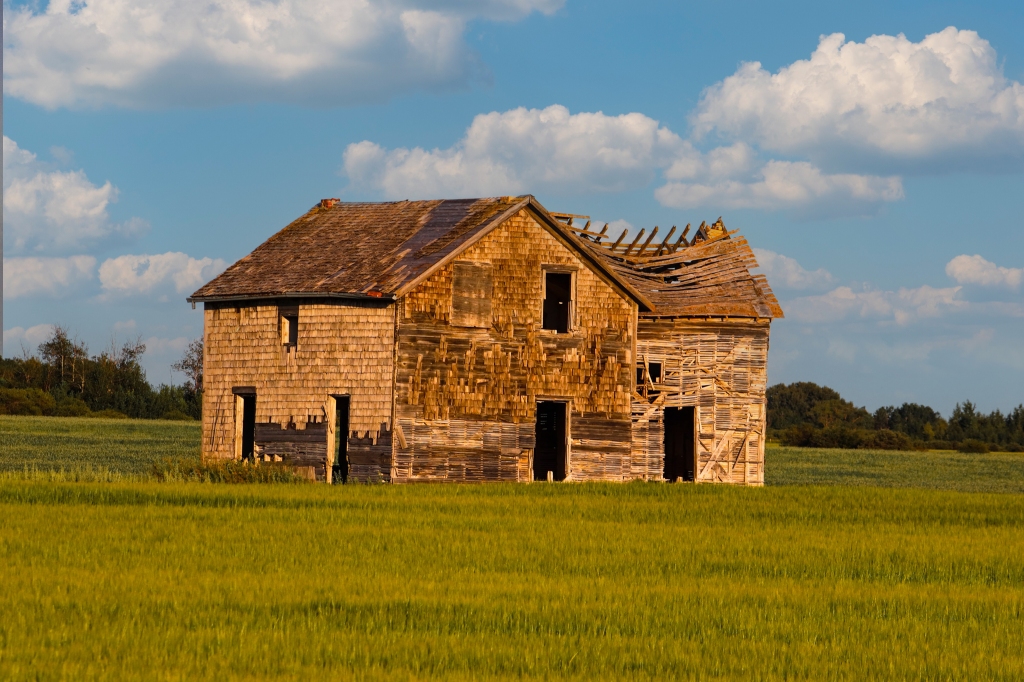
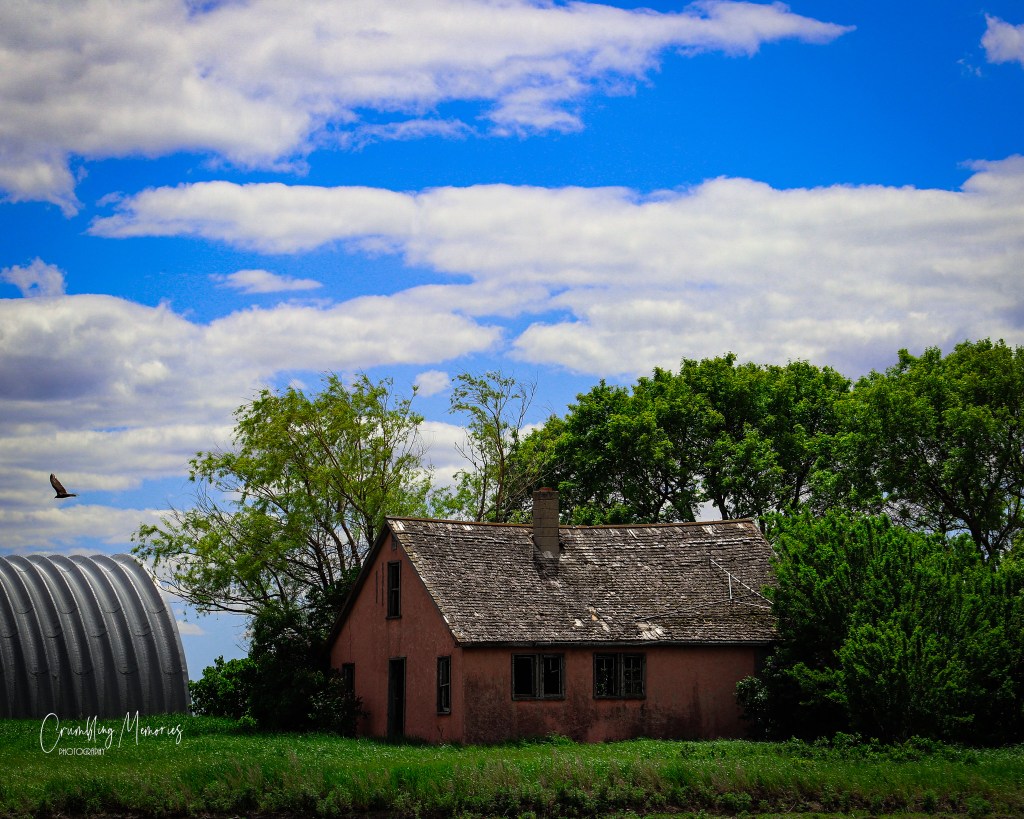
This old house, perfectly situated in a crop didn’t require us to get any closer than this roadside shot.
While I always want to know more, this was another that left me empty-handed. It happens more often than not.
That being said, it also makes me think about house much longer this hobby is going to last. While I have hundreds of markers of houses to see, more and more landowners are burning them down.
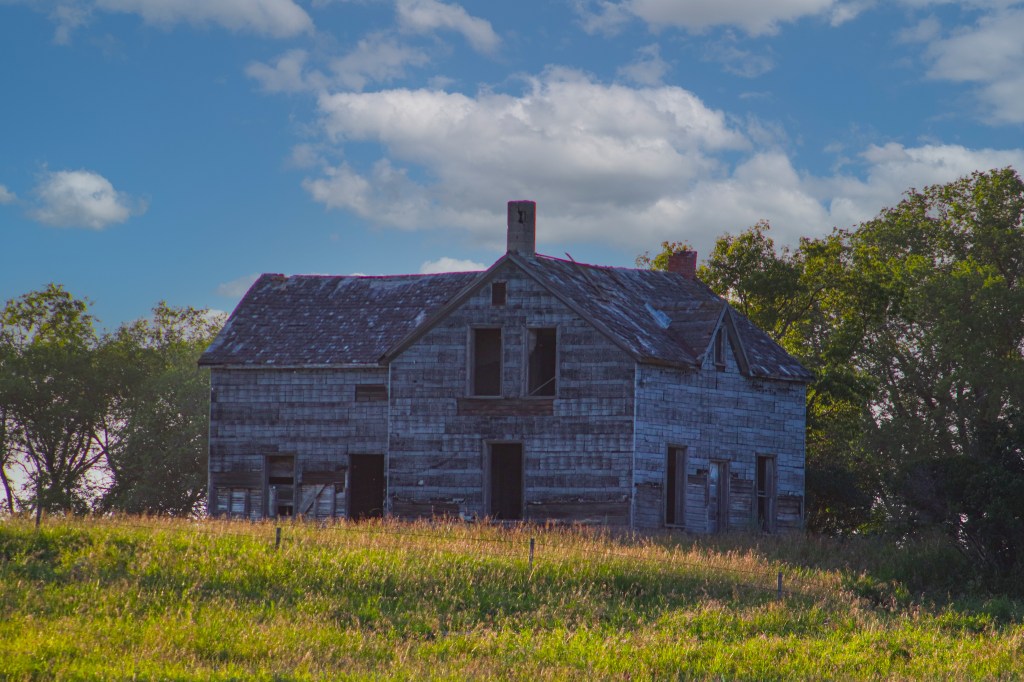
Leaving a roadside stop, we came across this house tucked away in the trees. Taken across the field with my unsteady hand and 300mm I managed to get an okay photo.
I wasn’t too terribly disappointed when I got home and noticed the poor quailty of the shot and made the discovery that there was little to no info on this homestead.
A young couple moved to this property around 1918 and here they raised 5 sons and 1 daughter. They dubbed the property the Graves Estate after the original homesteader who claimed this land in 1882.
The first recorded landowner for this property is listed in 1891. I can find no history for that family or the 3 families after them which allegedly lived and farmed on this section of land before Mr. Laidlaw settled here. I can also tell you that the current residents are not so welcoming. While I only saw one who decided to photo bomb my roadside stop, there is two vultures who now reside at this house.
I can tell you about Walter though. Walter came to Canada when he was 28 years old. He left Scotland by steamship in 1904 and landed in Halifax. He carried on to Brandon and from wagon headed to Newdale, Manitoba where he worked for a few months. He worked for a few years firing a steam engine for a local man and then was a stooker for other farmers in the area. Walter and his wife settled here sometime around 1918.
In 1918 Walter married Jeanne from Switzerland. Jeanne immigrated from Switzerland to the Cartwright area and ran the millner shop. Two years later she married and the couple went on to raise 5 children of their own. All but one of their children served in the miltary except the eldest who as a child was kicked in the forehead but a horse. The boy was stitched up at the kitchen table but as a result of the accident, the injury left him with muscle damage to his eye which caused his eye to turn inward. Because of this, he was unable to serve like his siblings so he farmed with his Dad. It is said that the injury to his eye didn’t prevent him from being an excellent shot during hunting season.
In January, 1946, upon his return from serving with the Queen’s Own Cameron’s, in France, Belgium and Holland, the second eldest son, Herman, returned to the area and started farming his parents land. Herman later married but did not have children of his own. Herman passed away at the age of 82 years.
What is the Queen’s Own Cameron’s? Well I had to google it. Given that the family was of Scottish decent, it makes perfect sense as to why and how Herman ended up serving with them. Winnipeg has always had a strong Scottish tradition so after years of intense pressure from the local Scottish community, the government finally authorized the raising of a highland regiment in Winnipeg. Gazetted in 1910, the Queen’s Own Cameron Highlanders of Canada are the oldest highland regiment in Western Canada.
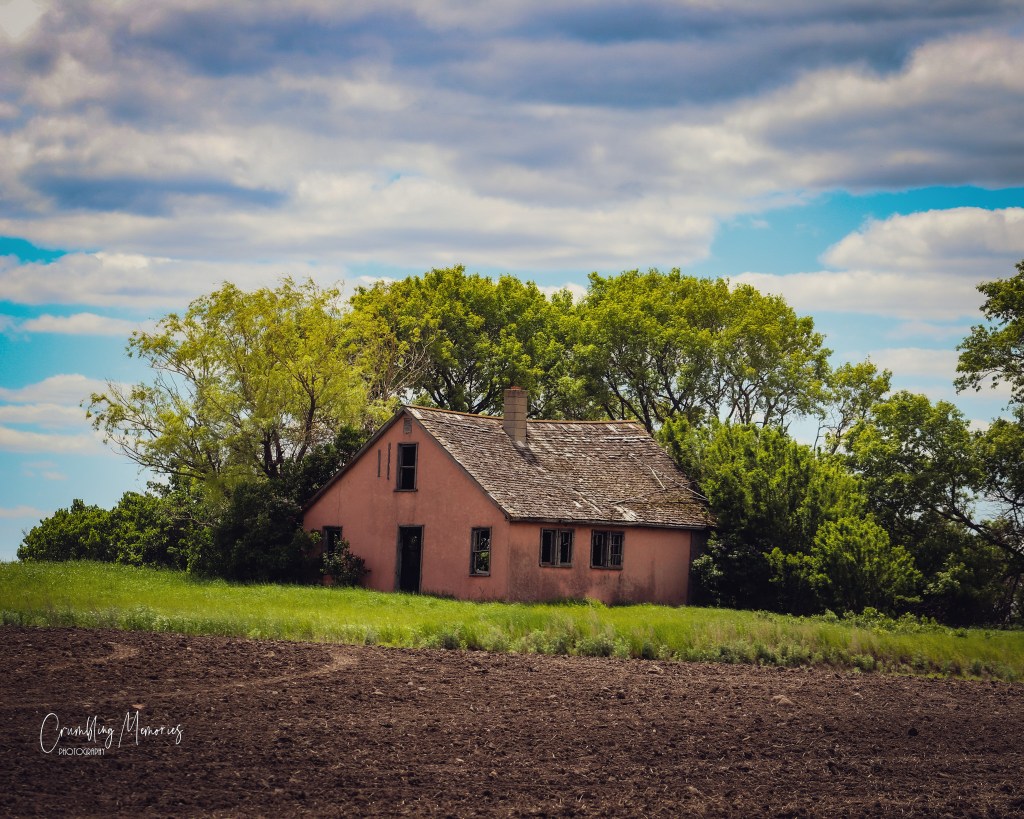
I love the color of this house! These were roadside shots so I don’t know how well the inside is holding up but one day I would love to get a closer look.





 CRUMBLING MEMORIES