MEET THE T46’s OR SOME OF THEM

I cannot believe that I have still not posted these photos. I do beleive that part of my hesitation or procrastination was getting my info together for this family and making sure I could identify the whales I photographed correctly.

Now this is likely going to be a long, boring post if you are not at all interested in killer whales. First let’s start of by clarifying that they aren’t actually whales, they are the largest member of the dolphin family.

Let’s also talk about the name killer whale. In today’s society, people do not like the name killer whale and don’t want us to use it anymore. Let’s face it, they are the apex predator of the ocean so the name fits. Well I guess aside from the whale part but you get my drift. Anyways, instead they want us to call them orca. And orca means demon from hell.

So you may know that there is a pod of orca that are considered endangered. They are known as the Southern Resident Killer whales and they travel the waters of the west coast from northern British Columbia down into Washington. They only eat salmon. And this is why they are endangered and are heavily protected in the waters in which they live. Currently there are only 74 of them as at December, 2023. If you were on a whale watching tour, they would not stop to allow you to observe them.

Then there are the Biggs or Transient Killer Whales. This eco-type eats anything. Dolphins, sea lions, baby humpbacks, seals, birds. Given they will eat a wide variety of marine life, their population is a lot healthier.

You read that right, baby humpbacks. And this year we saw a humpback that was attacked by orcas three times. I shouldn’t say attacked because Valiant has started some of these encounters with orca. But that’s a story for a different day. We did see Valiant on our last trip to B.C.

So, some history. Since seeing orca at Vancouver Aquarium at about 8 years old, I have been obssessed. I read books about them and tried to learn all I could about them. Then last summer, last minute, Colton wanted to go watch them. So I went. He has never seen them before and I had never seen them in the wild. So of course when they surfaced, it was pretty exciting.

That day we came upon a Bigg’s family. There were 3 whales traveling together. Sam, Tread and her 2022 born, unnamed calf.

Let’s start with Sam.

In the summer of 2013, this then 2-year-old orca T46C2 or Sam, was stranded in a small cove near remote Aristazabal Island on the North Coast of B.C. for several weeks.  He had swum into a shallow bay and became psychologically stuck, afraid to swim back over the shallow sand bar.   He was not eating, was quickly losing weight and was calling loudly for his family.

Luckily this little whale was found by the Vancouver Aquarium who monitored the situation for a few weeks before deciding this animal was not going to leave on its own. In Augst of 2013 on their first try to get T46C2 out of the bay, they were successful! The next dilemma this young whale would face would be locating his family again. In October 2014, Sam was spotted swimming with his mother and siblings in Blackfish Sound, near Telegraph Cove.

On July 22, 2023, I took this photo of Sam swimming happily with members of his extended family. Male orcas are said to be the ulitimate Momma’s boys and they stay with their Mom’s their entire lives. Sam doesn’t travel with his Mom often and moves from family to family.

Here is the 3 of them together. Now in the whale world, there are 3 ways to identify a killer whale. Eye patch, saddle patch and for some, dorsal fin because some have a visible dorsal fin injury or a very distinct shape. On this day we were told that this was an entirely different pod of orca. I was able to confirm otherwise with another naturalist out of Naniamo. She is my go-to whale question person now. In this picture Sam is following behind and the youngster is travelling in echelon position with its mother, Tread.

The other two are T46B Tread and her 2022 calf T46B1C.

Firstly, let’s talk about Tl’uk. In 2018 Tl’uk (T46B1B) was born to Tread.
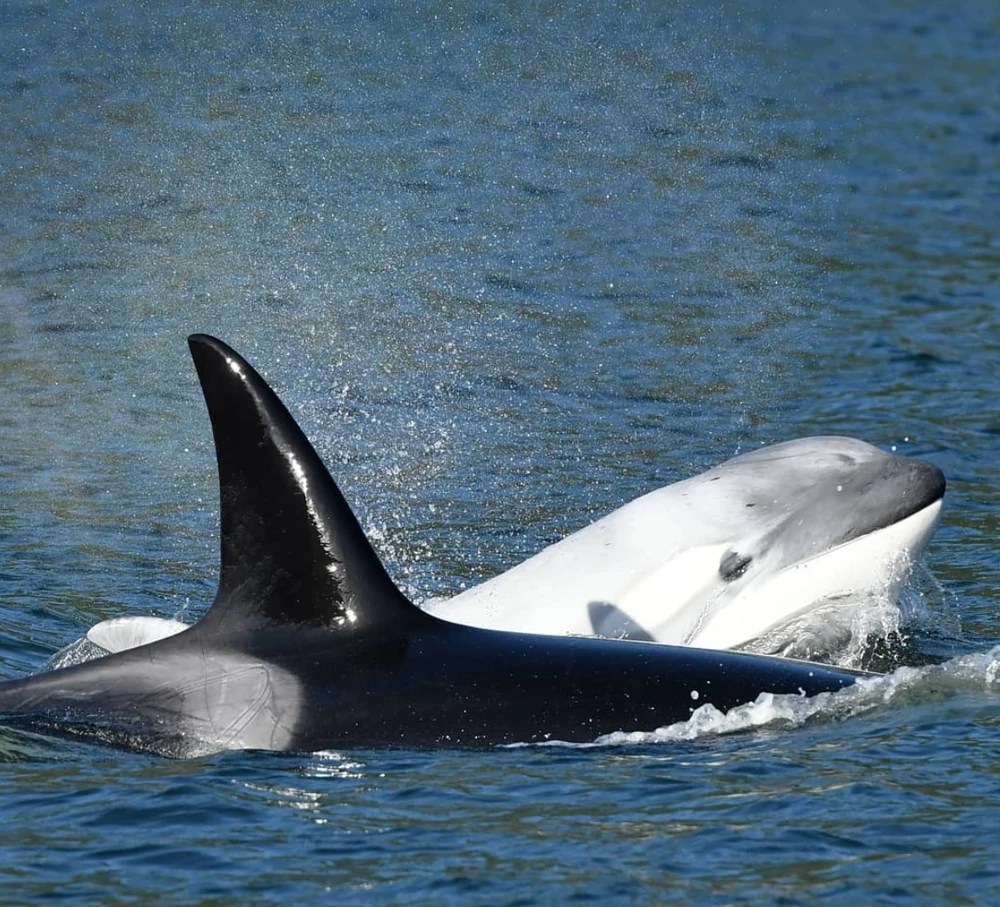
Tl’uk not only caught the eye of local whale watchers and researchers, he also drew the attention of people globally because he is not your average black and white orca.  Tl’uk looks like he has been white-washed and scientists are not entirely sure what condition Tl’uk had that caused the muted pigmentation in his cells. Some suspect a condition called leucism may have been the culprit. His pale colouration resulted in naming him Tl’uk, which is a Coast Salish Halq’eméylem name for moon.

Tread was born in 2003 to Raksha who was born in 1988. Tread has had 3 calves including this 2022 born calf who is not named and as far as I know, they haven’t confirmed the sex of. You will note that the little one has a yellowish tinge to its white? This is normal. As the youngster grows and fattens up, that color will turn white.

I was really hoping that these 3 would do something other than just swim along beside us. I was hoping for a belly flop or some spyhopping or some fluke but they just cruised along beside us. Rules say that there is a limited amount of time that a boat can stop and observe and there were a few in this area.

I’m not going to bore you with anymore whale talk.

To me this was a very successful whale watching tour. We were out on the boat about 5 hours. We seen the killer whales and then headed back to Vancouver. Aside from not being able to identify the whales correctly, the tour was okay. We left from Granville Island and went with the Prince of Whales company. After the trip that Colton and I just made to B.C. where we did 3 trips out to look for orcas, I do think I would try another company next summer and the plan is to get over to the island and try either Naniamo or head up to Telegraph Cove. I think we will decide that once we get ourselves to the coast.

SEA LIONS AND BEARS ARE COUSINS?

Ya, that was my reaction at first. How?

The closest relatives to bears are seals, sea lions and walrus. Pinnipeds (the name given to the scientific order for seals, sea lions and walrus) are the sea-going cousins of bears.

Twice the size and just as ornery as a polar bear, these two creatues have almost identical skulls and are marine predators.

Stellar sea lions are abundant in the coastal waters of the pacific ocean but are still considered near threatened.

Males arrive on what scientists called a rookery. Territorial, this sends other dominant males elsewhere as the reproductive rookery is claimed and within weeks the females and immature young arrive.

I wouldn’t say we were close to this island but close enough to hear how loud these animals are. Especially the dominant male who plays a key role in reproduction.

We found fthese three a little further up from the island covered in sea lions. The one didn’t even move. This buoy is in the middle of the ocean, no island or coast nearby. These three are lucky there were no orca sightings in the area!

COUNTING CROWS

Not the band. On my last trip to BC, after years and years of hearing about the crows that fly over my parents house, I went to see them for myself. She would tell me that every night, hundreds of crows fly over her house. I truly was starting to question her sanity a little.

So last Spring when Colton was out visiting they took him to see where all the crows go when they fly over at dusk. It was disgusting. You could hear the crap hitting the ground like big drops of rain there were so many of them.

Well it truly is a thing. First stop, the Costco. This is a just a stop off down the road from where they actually roost for the night. I am convinced that this is where they go to clean up the parking lot because people don’t know where to put their garbage. This lot is full of them.

This picture does not come close to telling you how many crows are in this lot. I have a video of Colton shaking a tree and the crows scattering. But they don’t stay here. This is just a layover to where they actually sleep. And again, this lot is so full of garbage, why not some for a quick meal.

I have renamed this particular Costco to Costcrow. They were in the carts, on the buildings, in the trees, walking along the ground eating people’s garbage. They lined the top of the store by the entrance. It was like The Bird’s.

We then headed back to the actual roosting spot. Now, I didn’t know this but crows are communal sleepers, so they gather in massive groups to roost together at night. As the sun begins to set, crows will fly in from long distances to a central location where they can share warmth, safety from predators, and even exchange information relevant for survival. I have also read that crows don’t see well at night so they will pick a location where there is light so that they can see what is going on.

This is only the beginning. By the time we left they were sitting on the lines, side by side from one pole to the next. Some guy was coming up to the intersection and noticed them and almost ran the light.

Now it really hard to see how many crows in these photos how many crows there really are coming in but there are A LOT.

If you are interested in seeing this for yourself, search where the crows roost in your city and

SHANNON FALLS

One of the things on our to-see list for our trip was a ride up to the Sea to Sky Highway to ride the gondola and see the Shannon Falls.  Well once the clouds roll in, everything “socks in” and ruins the views of the ocean and mountains.

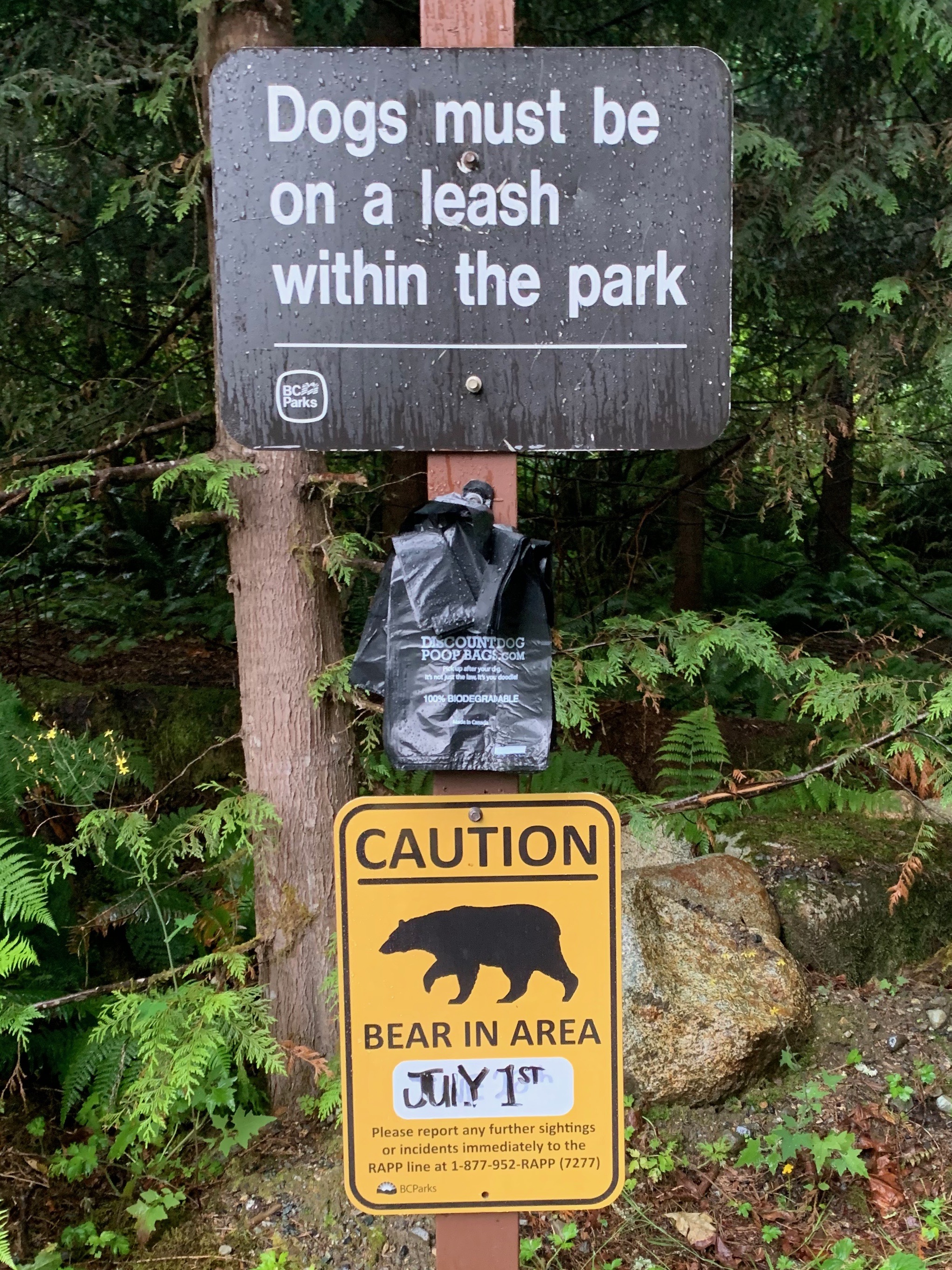
Drizzling, we headed up the highway anyways.  The ocean was completely covered and I couldn’t see anything on the way there.  When we finally came upon Shannon Falls, it started to rain just a little bit harder!  Go figure.  Thankfully the trails to the falls are treed in so the rain was more of a drizzle.  This was not what I wanted to see as we headed up!  It certainly brought back our trips to the Grand Beach Campground as a kid, being paranoid of coming across a bear on the trail.  It was at this point that I announced to my family that if a bear was to come, it was each man for himself!

IMG-3855

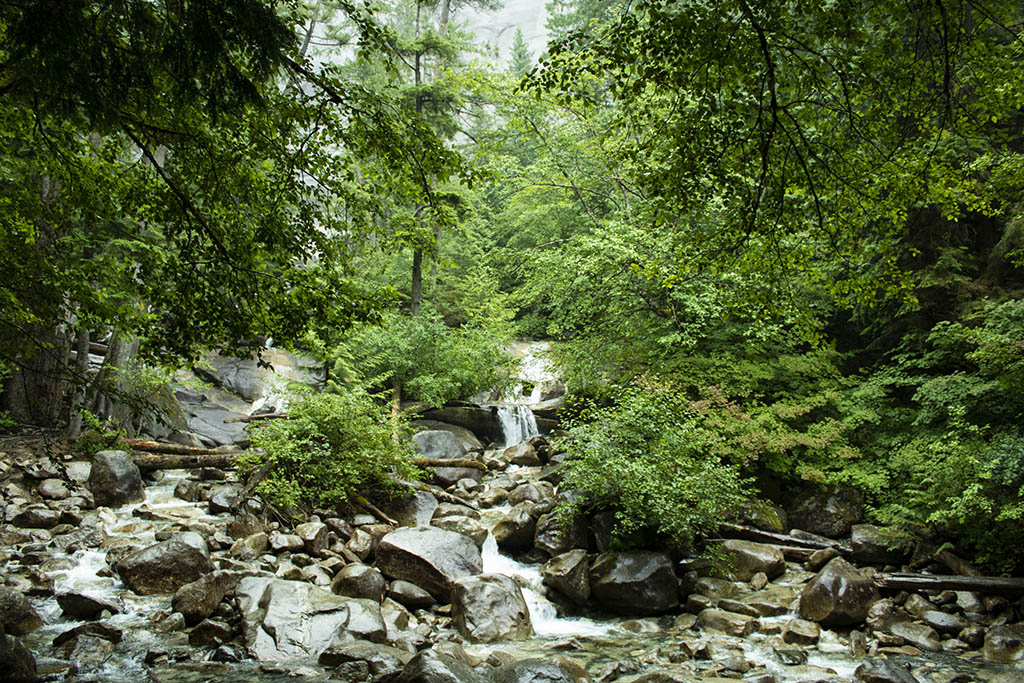
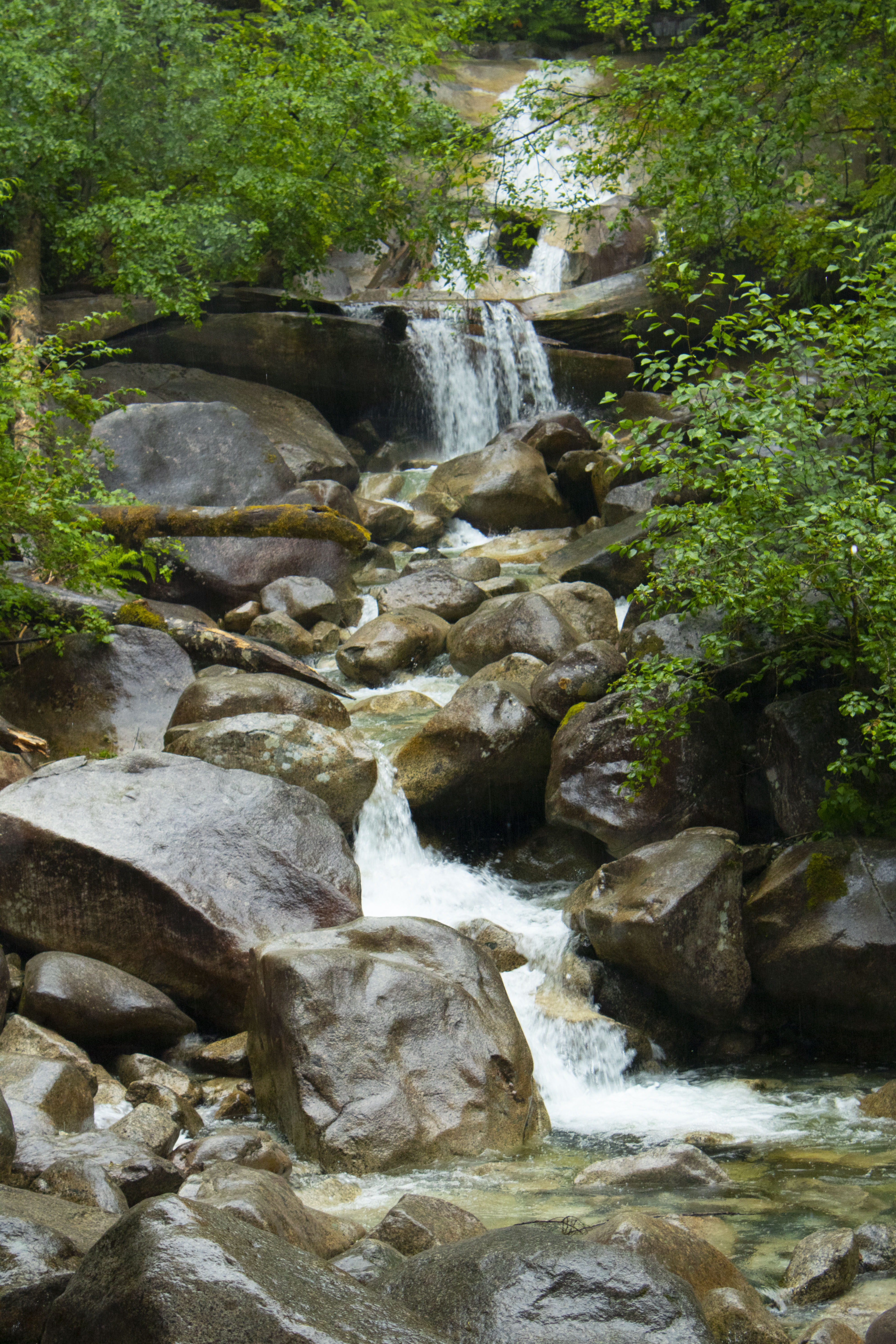
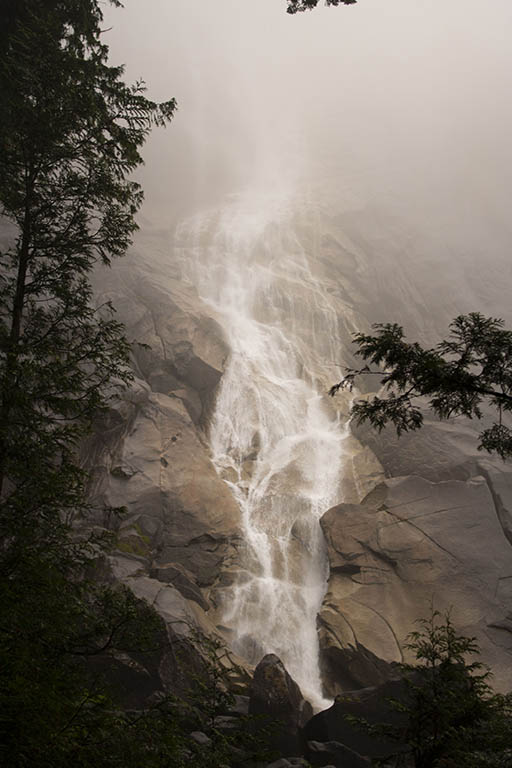
Shannon Falls is composed of a series of cliffs, rising 335 metres above Highway 99, making it the third highest falls in the province.  The tumbling waters of Shannon Falls originate from Mount Habrich and Mount Sky Pilot.

shannon falls bottom email.jpg

In 1792 Captain George Vancouver set up camp just west of the falls. The falls were named after Shannon who in 1890-1900 owned the falls and surrounding area and used the clay deposits to make bricks. He then sold the land to Brittania Copper Mines in 1900. In the 1930’s, the area was used as a relief camp for the workers building Highway 99. In 1976 the area was purchased by Carling O’Keefe Brewery, who used the pure mountain water to brew their beer, and made the area a logging show park. In 1982 O’Keefe donated the land to BC Parks. Throughout the park area there is evidence of logging activity that occurred here roughly 90 years ago. A number of excellent spring board notches on old stumps are scattered throughout the forested area and much of the deadfall also exhibits evidence of the logging techniques of this period.

shannon falls 2.JPG

This park holds significant spiritual value to the Squamish First Nation, the first people to live in this area. They told of a two headed sea serpent, Say-noth-ka who lived in and around Howe Sound. According to legend this beast travelled both on land and in water. Some versions say it was Say-noth-ka who formed Shannon Falls by slithering and twisting his powerful body up the mountainside on repeated expeditions, Say-noth-ka gradually wore down a spillway for those cascading waters.

shannon falls 3email

We only went as far as the third view point of the falls as the higher we went, the thicker the cloud cover became.  And because of the rain, the trail got muddier and muddier and of course, more slippery.  This would be a place I’d like to go back to on a clear, warm, sunny day.

BLUE HERON

I love the blue heron.  Last Spring the one in town liked getting its photo taken.  The bird hanging around this year, does not feel the same and really is quite shy.   I’ve hidden in the tall grass but as soon as he sees me, he takes off and watches me from across the bay, on the dock where I am just out of range with my regular 300mm lens.

Well, the heron is B.C. aren’t shy.  I found this one in Stanley Park on my first outing out with the new lens.

IMG_0530 cropped for email

This bird was very photogenic.  I had to group this photo as Speedo clad swimmer stepped into my viewer!  I got a lot of shots of him but this is one of my favourites.  This bird stood in the ocean, not far from swimmers.  And I saw a few more when we were out fishing for sturgeon on the Fraser River in Chilliwack.

Regardless, I was happy with the shot and am looking forward to taking was more photos with this lens.  This photo was handheld and I must say, while the lens is heavy, its not out of this world and impossible to use without a monopod/tripod.

MONKEY PUZZLE TREE

Araucaria araucana or commonly called the monkey puzzle tree, monkey tail tree, piñonero, or Chilean pine is an evergreen tree that grows from 1–1.5 m (3–5 ft) in diameter and 30–40 m (100–130 ft) in height. It is native to parts of Chile and Western Argentina.  The monkey puzzle tree is the official tree of Chile.  This one grows in my parents front yard in Burnaby, B.C.

The origin of the popular English language name “monkey puzzle” derives from its early cultivation in Britain in about 1850, when the species was still very rare in gardens and not widely known. Sir William Molesworth, the proud owner of a young specimen at Pencarrow Garden in Cornwall was showing it to a group of friends when one of them remarked, “It would puzzle a monkey to climb that”.  As the species had no existing popular name, first “monkey puzzler”, then “monkey puzzle” stuck.

6725144991521665100-IMG-0502.JPG

Known for its longevity, it is described as a living fossil.  It is suspected that they can live up to 1000 years.  Saying that, tts conservation status was changed to endangered in 2013 due to the dwindling population caused by logging, forest fires, and grazing.

The leaves are thick, tough, and scale-like, triangular, 3–4 cm (1.2–1.6 in) long, 1–3 cm (0.39–1.18 in) broad at the base, and with sharp edges and tips, rather similar to the leaves of the unrelated succulent.  The leaves have an average lifespan of 24 years and cover most of the tree.  You can see some of the brown branches in my parents tree.

IMG-3624.JPG

The monkey puzzle tree is dioecious, with the male and female cones on separate trees, though occasional individuals bear cones of both sexes. The male (pollen) cones are oblong and cucumber-shaped and approximately 1.6 in long at first, expanding to 3.1–4.7 in long by 2.0–2.4 in broad at pollen release. It is wind pollinated. The female (seed) cones which mature in autumn about 18 months after pollination, are globose, large, 12–20 cm (4.7–7.9 in) in diameter, and hold about 200 seeds.   This is a seed pod in my parents tree.   I would say that my parents have a female tree.

.

The cones disintegrate at maturity to release the 1.2–1.6 in long nut-like seeds which are edible AND tasty.  The piñones are similar to pine nuts but larger; these roasted seeds are 3 cm and 5 cm long, from two different cultivars.  We found some of the little brown seed pods on the ground but when we opened them, the nut inside was tried up and only a powdery substance remained inside.

We seen a couple more of these while we were in B.C but none were as full and mature as the one that grows in my parents yard.  Most were spindley and small.