THE WILLOW ROW FARM

The original homesteaders of this property came to this land at the turn of the 19th century. The first official recording that they were the landowners is dated 1901. Owned originally by one of the brothers of this family, the first brother to own this land, William, turned the sod making it ready for farming and construction of a forever home.

In 1904 William sold the land to his brother James who lived here until he retired. At that time he son, namesake of his uncle and his dad, took over.

This property has a long drive and is beautifully treed. This is also the spot where Christian and I got most of our wood ticks that day. I’m sure that we picked off at least 50 at the end of this driveway before we got back in the vehicle.

In 1920 this land was sold Mr. Taylor but then repurchased it. James later sold the land again, this time moving to a different district to farm, but again bought the land back. It does not state why the land was sold but it does say it was purchased back due to adverse conditions.

James and his wife Bessie raised three children, mostly on this homestead. In 1930 they retired from active farming and moved to the closest town. Mr. died in September, 1953 and Mrs. not long after in April, 1954.

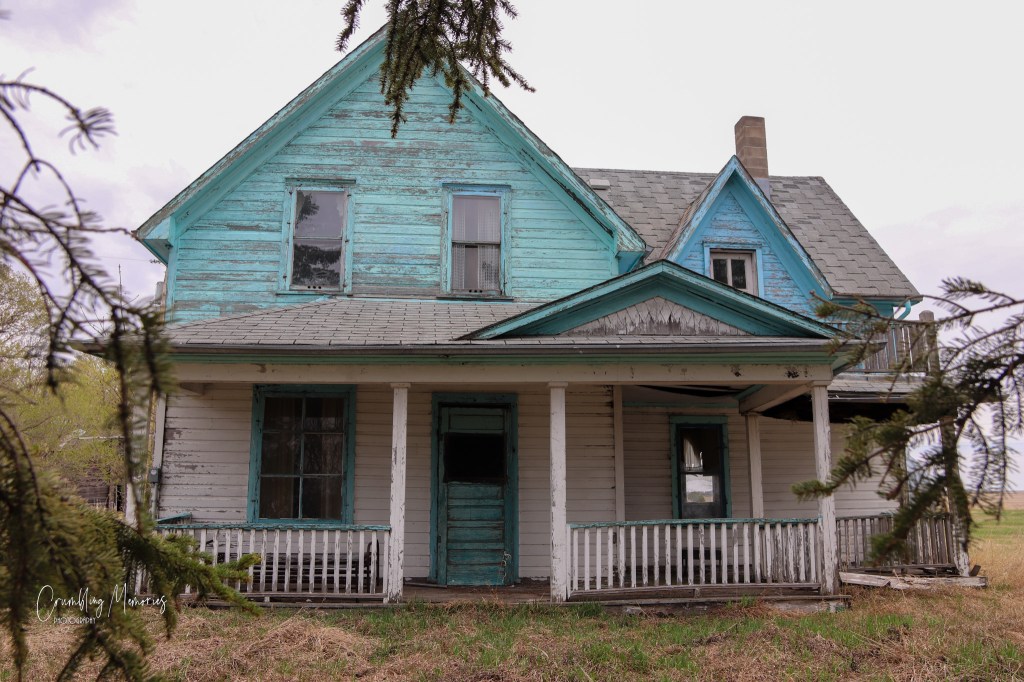
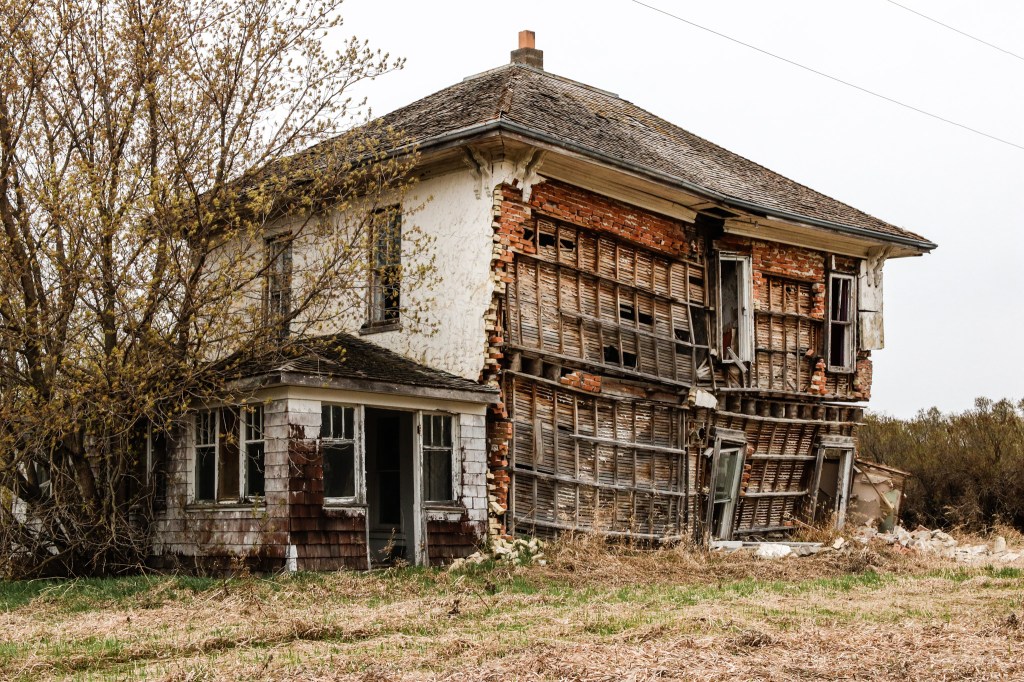
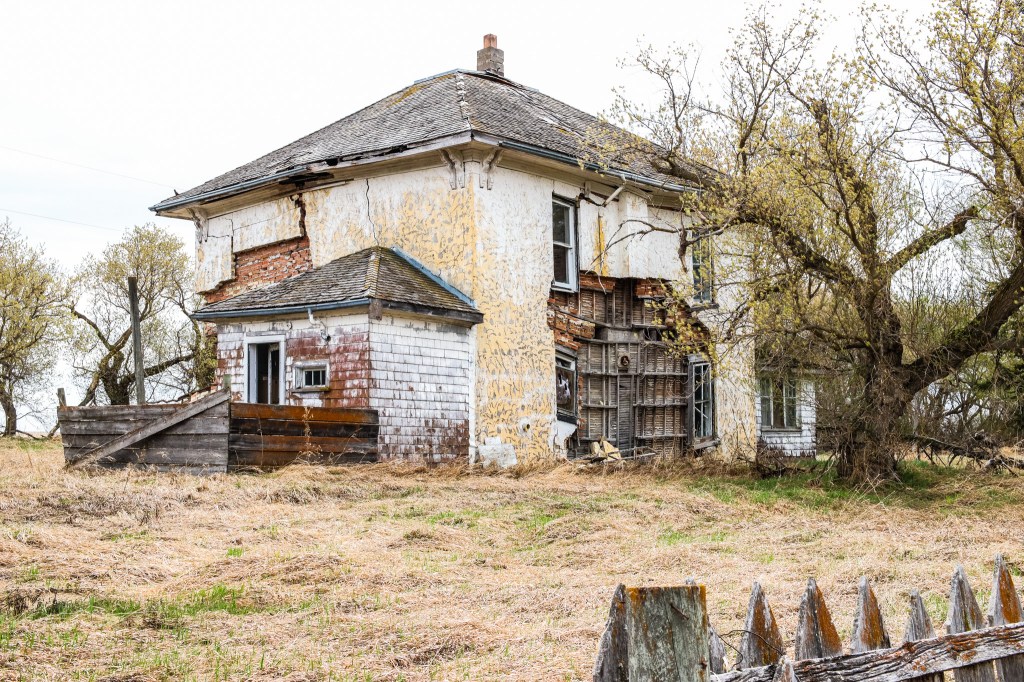
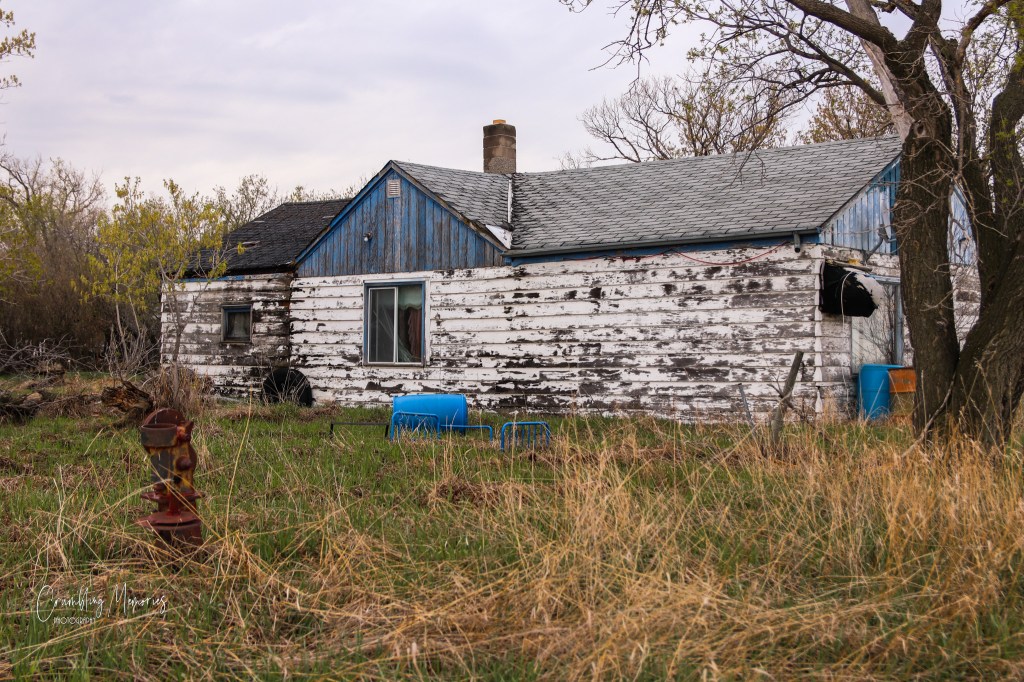
This was not the first house we went to on this day that was suffering from the same sort of decay. I am going to make the assumption that at one time, these were brick homes. In an effort to modernize them, stucco was applied over the brick. With time, the roof began to leak and the water ran between the two layers causing this deterioration to happen.

Inside the house we could see the remains of furniture and a bookshelf with puzzles and games.

IT WAS ONCE THE MITCHELL’S

Back to that day when Christian and I went out, one of the first houses we stopped at on our venture was this one.

Visible from the road, this was an easy stop. After fiddling around with my camera for a bit we got ourselves on the other side of the trees.

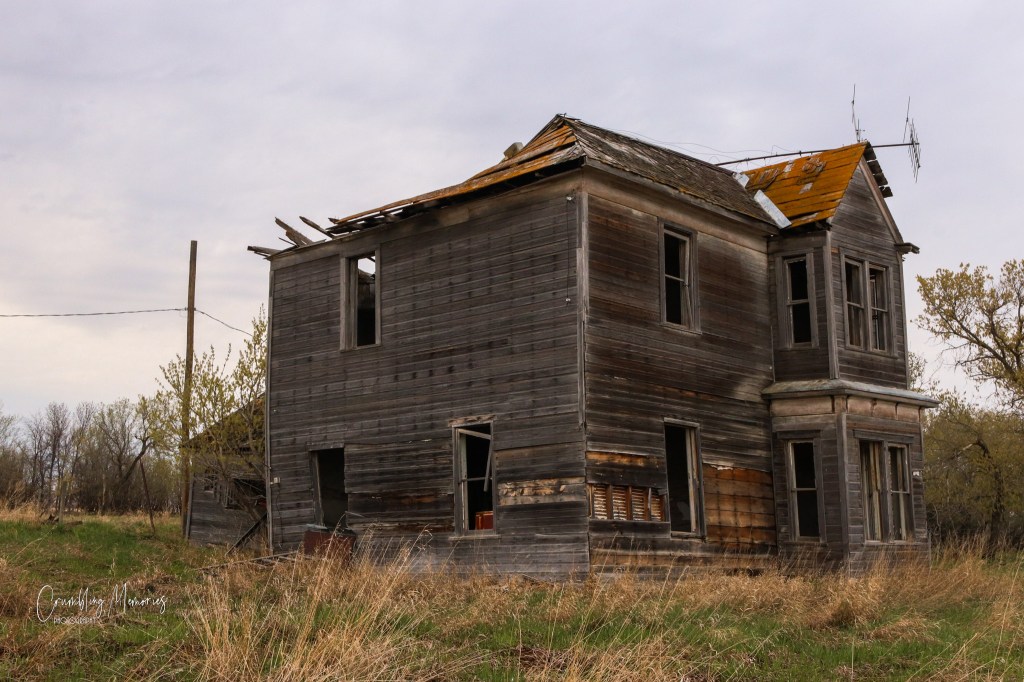
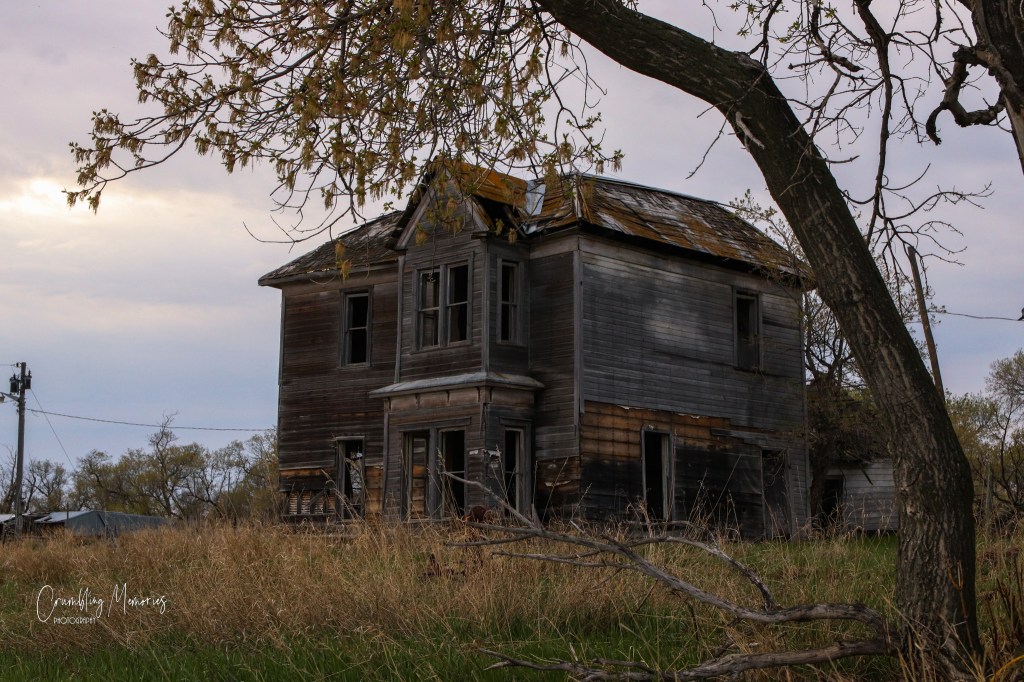
This big old two story house with the missing door upstairs wouldn’t want to be something I came across at night time. I wasn’t at all freaked out here but with the dead trees in the front, I could see how one would be.

The history I found on this homestead is not of the original homesteaders. That is of course somewhat disappointing to me but its better than nothing. That being said, here we go. The second homesteader of this land immigrated to Canada in 1903. Born in 1881 in Country Cork, Ireland, he moved to the area and married in 1908. Having worked for many farmers in the area and renting land to farm, he moved from the land he originally lived on and in 1921 eventually moved to Neepawa. In 1927, Mrs. passed away and he came back to the area.

In April, 1928 to be exact, the family moved back to Elgin, Manitoba but he again rented land. It wasn’t until 1942 that him and his children moved to this homestead.

Mr. retired from farming in 1951 at the age of 70 and moved to Brandon where he lived until he passed away in 1964. Mr. and his wife raised 6 children on various farms in the area as well as in Neepawa. Upon Mr.’s retirement, his youngest son and his wife took over this farm and raised their family here.

MISUMENA VATIA 

Last week I was out with a student taking her graduation photos. We were making our rounds and stopped at an old church. Well, the upkeep at the church isn’t what it used to be but we got her up there on the step and took a couple photos.

There was a nice rose bush by the door and she decided that she would like to lie down on the step with the bush beside her. So we started cleaning off the step and she looked at one of the big roses and inside was this BIG whitish/pink spider.

Of course our first reaction is to gross out and then flick it away. I wanted to try and get a couple of photos of the spider too because I had never seen one like it before and then proceed with the photography shoot. So we did that.

Tonight I posted these photos on Instagram and my nephew commented that he had seen these spiders before out at the cottage and wondered what they were so, I searched it.

This is the goldenrod crab spider or the flower spider. They are called crab spiders because of their unique ability to walk sideways as well as forwards and backwards. They have the ability to change between these colors based on their surroundings through the molting process or depending on the color of flower they are eating from. on that color.

These spiders do not spin webs but they do use silk to catch their prey. Once the female lays her eggs and the eggs hatch, the female dies.

NOT ONE BUT TWO

The first recorded landowner recorded for this section of land is 1889 but there is no family history. So, I don’t know who built this house. Regardless, she’s a beauty.

In 1906 Mr. quit his job at the chair factory in Orangeville, Ontario to move to the area. He boarded a freight train with the machinery, furniture and household effects of the Anderson Family. Upon his arrival to the area he was hired as a farm hand on another farm. In 1911 he rented this land from the previous landowner.

In January, 1912 he married Helen, the daughter of the family whom he traveled with to the area with their belongings. They bought the land and lived there until 1954.

When they left the land they retired to Melita. During his active years Mr. was on the school board in the area and was a counsellor for 13 years. Their youngest son took over the farm and raised his family here.

Before marrying Mr., Helen was a school teacher at Brown’s School from 1909 to 1911. She began teaching at 16 years of age.

While walking up to this property we discovered that the Souris River runs through it. The water was full of ducks and small birds. In the distance I could hear an owl taunting me but I could not spot it.

There were two houses on this property . This newer house must have been what the family moved into when the original farm house was no longer livable. I love that the house was preserved to some extent.

Mr. & Helen raised 9 children on this farm, 4 boys and 5 girls. Mr. passed away in 1963 and the history that I found for this family was written on May 26, 1982 by Helen who was in her 90th year. I visited this house on May 13, 2023.

At the time that Helen wrote her family’s history, there were 25 grandchildren, 30 great-grandchildren and 5 great-great-grandchildren.

Then the 30’s rolled around and the family faced the depression, the dust bowl and the grasshoppers. At the time the family had a car, a piano and a telephone. Mr. sat down with his family and said something had to go. Helen said that the telephone had to stay, in case of an emergency. The children all wanted to piano for entertainment. So, Mr. put the car up on blocks and parked it. The family relied on a Bennett Buggy for transportation.

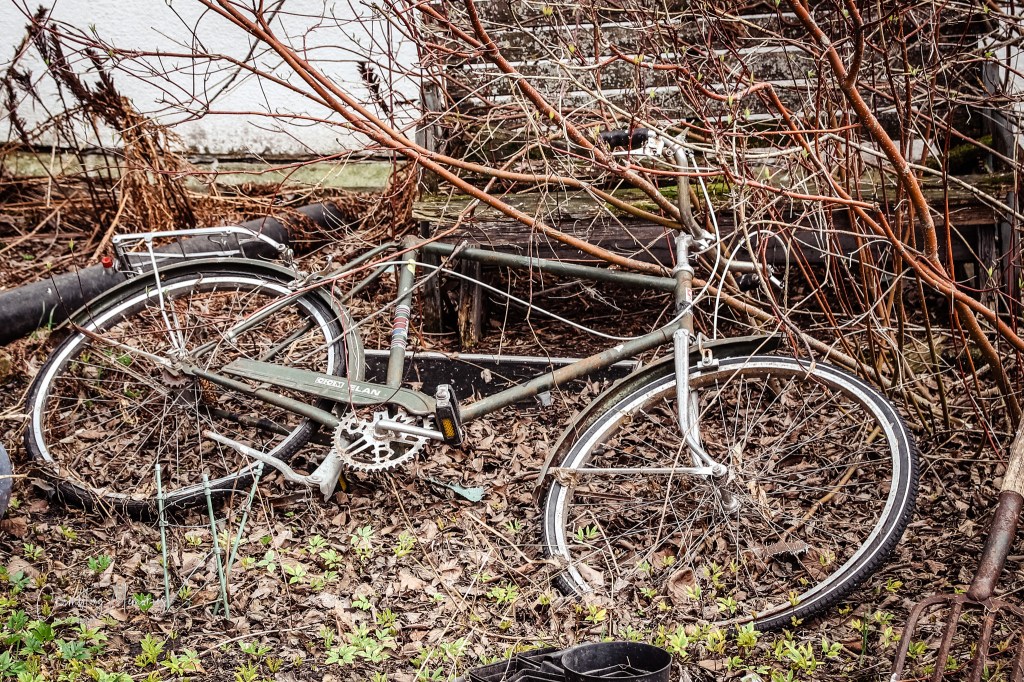
I did find this one strange piece of equipment in the yard. I took a photo of it with the hopes that my husband could identify what it might be but he wasn’t sure.

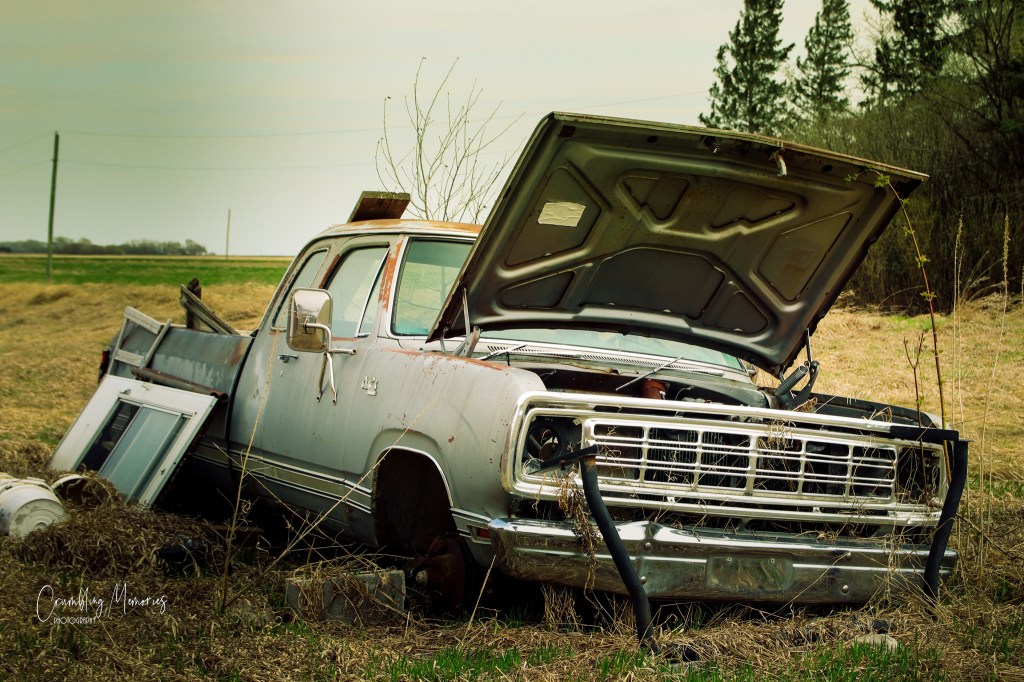
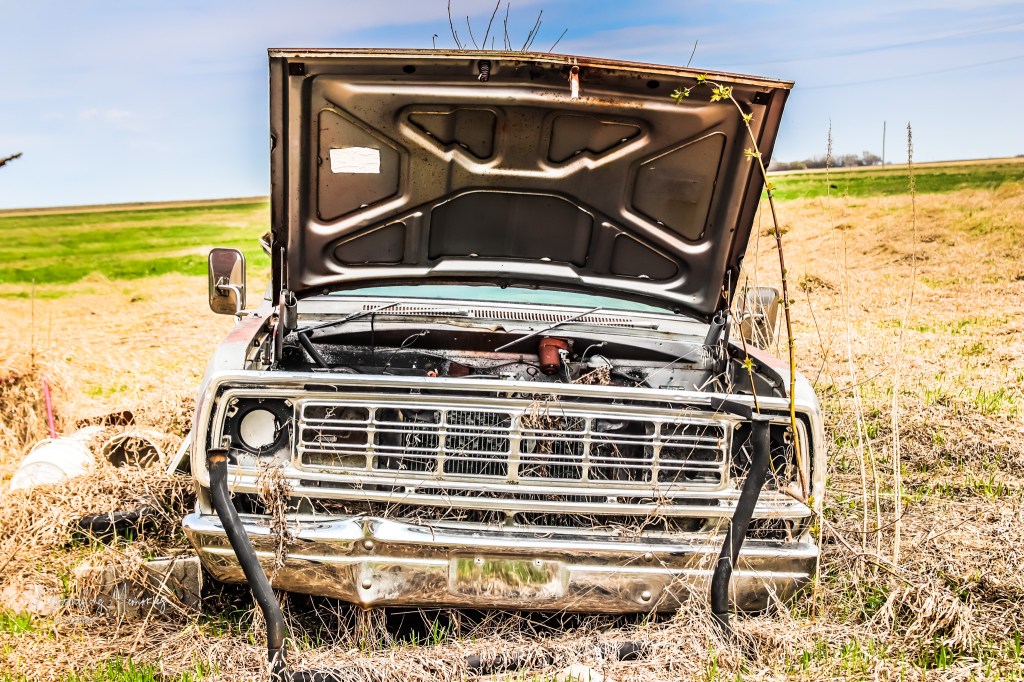
Now I’m wondering if the old car is somewhere on this property. Maybe the owl was trying to lure me further into the yard in the tall grass and treed area so I would see it!

AURORA IN SOUTHERN MANITOBA

Many moons ago, I remember that Northern Lights were something that you only saw when you headed North of the city. And the darker it was outside, the better they were. I do remember going to the cabin and see them, occasionally. I remember that when you were able to see them, it was a big deal because you didn’t get to see them very often. Not from the city anyways.

So what are Northern Lights? Well, they are electrically charged particles that have entered the Earth’s upper atmosphere at a very high rate of speed. They are said to be more common in the winter. That being said, are we seeing them more now because of all the smoke in the air?

Anyways, on the night of May 19th Colton came into the house after I had already snuggled in for the night to watch The Handmaid’s Tale. He said “you might want to grab your camera and come outside.” He showed me his phone. He said, I just got this photo of the Northern Lights at the end of the driveway with my phone.

Well, I got out of bed, grabbed my camera and went out to the driveway and that is not what I saw. I could see them faintly but nothing like Colton had captured. This is what Cade & I used to see when we lived up in Waywaysecappo. I haven’t seen them like Colton’s picture since we lived up there. I remember driving up highway 16 coming home from somewhere and watching them dancing in the sky while Cade drove. It was mesmerizing. I haven’t seen them do that since. Nor have I seen the colors I’ve been seeing lately on Facebook and Instagram. And maybe I’m seeing them more because I follow those pages more closely now but who knows.

Anyways, Colton agreed to drive me further North up highway 18 to see if they got better as we got out of town. I also envisioned an abandoned house that I like worked into my photo. No luck. At this point I decided my best bet was to message my friend Christian who in my opinion is a Northern Lights photography expert. He said, go home, set up your camera and try again later. They are there, there is no cloud cover. You just aren’t seeing them to the naked eye and you need to trust your camera. So I did.

Well, you can definitely see them but nothing like Colton’s photo. I must say though, I was excited to see all those stars. This also confirmed that there was in fact no cloud cover. So as per Christian’s suggestion, I went to bed but set my alarm for 2:30 a.m. to try again.

Okay, not to shabby. Again, stars galore. I must try to do more night photography this summer. I’m positive I say this every summer and never get out to do it. Now, in my defense, milky way season is over.

So, I’ll be watching my new Aurora Forecast app with the hopes I’ll get a shot.

BANK OF TORONTO VAULT

In 1919 the Bank of Toronto built a wood frame building. Inside the building was a solid brick structure with a heavy iron door. This structure served as the bank’s vault. Three years later the bank closed so the building was repurposed and used post office and then a residence. In 1991 the building was demolished except the vault, which is now a historic site in this small town. Inside the vault is a small desk and chair and a guest book for visitors. On top of the vault is the bell from the town’s school.

BILLY’S PLACE

One night last winter on my way home from exploring an abandoned town, I couldn’t help but notice the sunset.  I was really close to a location that I thought would make a great photo.  A spot that I have driven by many, many times.  I wanted to get a photograph of this machinery up on the hill.

brogden house 9 email

I couldn’t get a decent shot so I turned around to head home and found this!

barn email

I took a couple shots from the road and wrote down the location to investigate and find landowner information for.

house by barn email

A couple weeks ago I was speaking to a gentleman about another property and asked about this one and he gave me the information I needed.  I thought I better get out there before the grass gets to long.

brogden house 10 email

Unfortunately, I cannot confirm who lived here first (and any info I do have I cannot confirm with any written history that I have access to) nor can I confirm who built what buildings, when.

As you can see from this new photo, the caragana or peashrub have taken over and the bees were buzzing around like crazy.

brogden house 3 email

Bill was born on a farm south of Cartwright on July 11, 1916.  He never married but was said to be a dedicated family man who was always there for those in need.

IMG_9644

Bill, an enthusiast with the Heritage Village in his community and served on the committee for many years.   Bill purchased this land in 1944 and proudly displayed the advertisement for the Heritage Park on his property where everyone that went by it could see it.

brogden house 4 email


Bill began farming as a young boy with his father and his love for farming kept him busy until he was in his 70’s.  When he wasn’t farming, Bill sang with the United Church choir and served on their committee for many years.

brogden house 6 email

After a trek through the farm yard I headed out to the pasture and up the hill.  I cam alone some old wagon wheels and then almost tripped on a piece of wire in the grass.  I also picked up a lot of hitchhikers on my journey.

brogden house 5 email

Being alone I also started to think about skunks, badgers and of course, well holes.  I am a chicken shit.  Not sure that exploring is really for me, lol.

brogden house 8 email

I have passed by Bill’s old threshing machine (or separator) and Cockshutt tractor many, many times.  I never did notice this little machine way up on the hill until I walked closer to it.

brogden house 7 email

I do not know anything about tractors except that this is what they call McCormick Deering or a Cockshutt tractor.  I believe this one is approximately built in 1924.  At least that’s what a quick search on Google tells me.

On my way back to my car I again started to think about all the critters and as I was going through the ditch I found two lady slippers, all alone.  Of course I searched for more but I couldn’t find any.

ladyslippers-2 email


THE DAILY MILK RUN

W.S.S was born in Tyner, North Dakota on December 22, 1881.  He worked on various farms until 1910 when he decided to seek a “non-flooding area to farm” and moved to Canada.

family

He came to this area and purchased this land.  He didn’t live there right away and lived in a rental or “boarded” across the road in a small village.  In 1922 he purchased a house that he purchased from the local blacksmith and moved it onto his property.

Smirl 2_1 email

I do not know if this is the original house that was hauled onto the property but I do know from the current land owner that the house was small and as the family grew they added more and more on to it.  It makes perfect sense to me that this could very well be the original house just from the layout of it.

Smirl 5 email

W.S.S. eventually got married and together they raised 3 children on this farm, not to mention the grandchildren that would also be raised here.  The family pasture was the site of many baseball games.

Smirl 3 email

W.S.S. and his wife were community minded people and his efforts were instrumental in forming the local elevator, Co-Op and united church.

Smirl 6 email

The family kept Percheron horses and they jointly owned a Case tractor and separator with another family.

Smirl 1 email

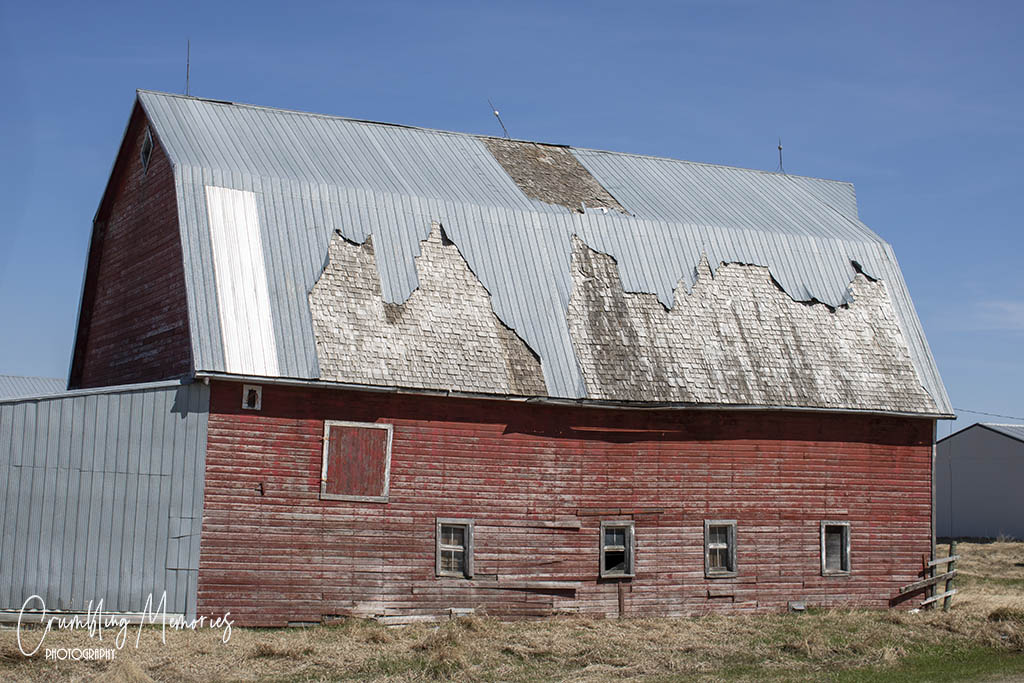
In 1927 this barn was built and the family ran a dairy cow operation.  The cows were milked in the morning and the children would deliver the fresh milk in little bottles to village members, by cart, on their way to school.

The boys farmed with their Dad for some years until the oldest left and moved to Oregon.  Father and remaining son farmed together until Mr. & Mrs. retired and moved to town.  Mr. passed away in 1968 and Mrs. in 1972.  The son continued farming on the land and married and raised 4 children of his own on the family farm until he moved to town in 1990.  The current landowner purchased the property in approximately 1996/97.

Smirl 7 email

M & M were very active in their community, just like his parents.  For many years the basement of their home was used to collect, sort and wrap gifts for the Christmas cheer.  Upon moving to town Mr. was very active in establishing the recycling project.