BLUE HERON

I love the blue heron.  Last Spring the one in town liked getting its photo taken.  The bird hanging around this year, does not feel the same and really is quite shy.   I’ve hidden in the tall grass but as soon as he sees me, he takes off and watches me from across the bay, on the dock where I am just out of range with my regular 300mm lens.

Well, the heron is B.C. aren’t shy.  I found this one in Stanley Park on my first outing out with the new lens.

IMG_0530 cropped for email

This bird was very photogenic.  I had to group this photo as Speedo clad swimmer stepped into my viewer!  I got a lot of shots of him but this is one of my favourites.  This bird stood in the ocean, not far from swimmers.  And I saw a few more when we were out fishing for sturgeon on the Fraser River in Chilliwack.

Regardless, I was happy with the shot and am looking forward to taking was more photos with this lens.  This photo was handheld and I must say, while the lens is heavy, its not out of this world and impossible to use without a monopod/tripod.

MONKEY PUZZLE TREE

Araucaria araucana or commonly called the monkey puzzle tree, monkey tail tree, piñonero, or Chilean pine is an evergreen tree that grows from 1–1.5 m (3–5 ft) in diameter and 30–40 m (100–130 ft) in height. It is native to parts of Chile and Western Argentina.  The monkey puzzle tree is the official tree of Chile.  This one grows in my parents front yard in Burnaby, B.C.

The origin of the popular English language name “monkey puzzle” derives from its early cultivation in Britain in about 1850, when the species was still very rare in gardens and not widely known. Sir William Molesworth, the proud owner of a young specimen at Pencarrow Garden in Cornwall was showing it to a group of friends when one of them remarked, “It would puzzle a monkey to climb that”.  As the species had no existing popular name, first “monkey puzzler”, then “monkey puzzle” stuck.

6725144991521665100-IMG-0502.JPG

Known for its longevity, it is described as a living fossil.  It is suspected that they can live up to 1000 years.  Saying that, tts conservation status was changed to endangered in 2013 due to the dwindling population caused by logging, forest fires, and grazing.

The leaves are thick, tough, and scale-like, triangular, 3–4 cm (1.2–1.6 in) long, 1–3 cm (0.39–1.18 in) broad at the base, and with sharp edges and tips, rather similar to the leaves of the unrelated succulent.  The leaves have an average lifespan of 24 years and cover most of the tree.  You can see some of the brown branches in my parents tree.

IMG-3624.JPG

The monkey puzzle tree is dioecious, with the male and female cones on separate trees, though occasional individuals bear cones of both sexes. The male (pollen) cones are oblong and cucumber-shaped and approximately 1.6 in long at first, expanding to 3.1–4.7 in long by 2.0–2.4 in broad at pollen release. It is wind pollinated. The female (seed) cones which mature in autumn about 18 months after pollination, are globose, large, 12–20 cm (4.7–7.9 in) in diameter, and hold about 200 seeds.   This is a seed pod in my parents tree.   I would say that my parents have a female tree.

.

The cones disintegrate at maturity to release the 1.2–1.6 in long nut-like seeds which are edible AND tasty.  The piñones are similar to pine nuts but larger; these roasted seeds are 3 cm and 5 cm long, from two different cultivars.  We found some of the little brown seed pods on the ground but when we opened them, the nut inside was tried up and only a powdery substance remained inside.

We seen a couple more of these while we were in B.C but none were as full and mature as the one that grows in my parents yard.  Most were spindley and small.

SUNNY BANKS

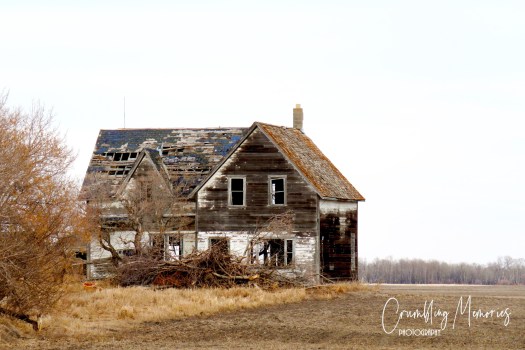
Remember the house who was lived in by the little lady whom never married and would ocassionally get on the school bus and go to town for the day and return home on the school bus?  Well her sister married the gentleman who bought this land in 1939. Her nephew still farms the land.

IMG_9874 email.jpg

It was here that Mr. farmed cattle and hogs on the land until his death in 1977. His Mrs. lived on and passed in the home in 2001, the last time this house was occupied.

Mr.’s grandfather was born on July 13, 1883 and moved to Canada when he was in his 20’s.  Here he met and married his wife and together they raised 4 children.  They farmed in Holmfield for many years and moved to Killarney in 1961.

IMG_9869 email.jpg

When I first posted this photograph on Facebook, my post received a comment advising me that as a child, the poster played in this house with his childhood friend.

IMG_9876 email.jpg

Speaking to the new Mrs. of this land she advised me that years ago they had inquired about repairing the roof and replacing the windows in this old family home.  They were quoted an amount near $20,000.00.  I often read people’s comments “oh, what a beautiful home, why don’t they save it?”  I think we forget how much these sorts of repairs can cost. We are working hard to keep our own homes maintained, let alone a century old home that likely needs a new foundation, windows, upgrades to the heating and water systems and likely a host of other issues due to its age. I can’t imagine it’s easy to watch these old home deteriorate beyond repair, especially for the generations of family still here that have fond memories of the home.

This home has been on my to see list for some time.  This weekend I called and after some hesitation, was granted permission to take a couple photos.  I am happy I was able to find and receive some history.  Thank you Mr. & Mrs.


KISINAA or COLD

In November, 2012 my family and I headed to the Christmas parade in town to see the floats.  It was cold that evening, -26 if my memory serves me correctly.

On our way home from the craft sale in the mall, we heard a kitten crying.  It ran past us down the street.  Of course I ran after it and caught it.  I took it inside one of the local businesses and asked the people inside if it belong to anyone.  It was tiny.  It fit in my hand and I could cover it up with my other hand.

I stuck the kitten in my jacket and drove home.  It licked my face the whole way.  Long story short, no one claimed it and there was no way the kids were giving it up anyways. My husband then started looking for the perfect name for our frozen little kitten who had frost bite on her feet.  Her name would be Kisinaa, the word for cold in Ojibway.

kisinaa email

Now on to the point of my post.  The other night after playing 21 with my son and husband and getting beat again, I sat down and here she came for cuddles.  So I got the camera out to play around.  Now instead of putting the 50mm on, I went with my standard 50-85mm f 4-5.6 kit lens and got this shot of her.  I would say its a pretty decent shot, sharp around her face and eyes and then blurs out to a perfect DOF.  Now unlike my other attempt with the 50mm with Payton and Walker, the sun is not nearly as bright as it was coming upon the golden hour.  The days of just turning on the camera, making sure its on auto mode and taking a photo is something I want to get away from.  No matter what lens I have, if I adjust my camera to the appropriate settings, I’ll get a good shot, regardless if I have a kit lens on or some other fancy lens that I likely didn’t need to buy.

I’m also trying to convince myself that I don’t really need a 600mm lens for shooting birds and wildlife although I really, really want it and my husband is sick of hearing about it and has already told me to buy it.

Now let me tell you a funny story about Kisinaa.  Last year around this time, my husband came home from town, clearly unsettled.  When I asked him what was going on he advised me that he found Kisinaa on the highway and she was in the back of the truck and I needed to tell him where I wanted her buried!  After some arguing I went with him to the driveway to see if it was really her.  I have to admit that it looked a lot like her but something was off in her face.  She has all the right markings, white tip on the tail, but she was too big.  So off her went to the back field to bury her.  I was sent off to pick up the kids from friends and when we had gathered them up we were going to tell them.

After we all settled down it was time to make supper so Cade was out on the deck BBQ’ing when he felt something brush up on his legs.  At our house that could mean anyone as we have more than 1 cat.  We have more than 5 cats actually.  When he looked down to see who was loving him up, he said he almost fell to his knees when Kisanaa was standing there looking up at him.  His first thoughts were Pet Semetery.  We never did find or hear of anyone missing their cat who looked like our Kisanaa.  And clearly, our Kisinaa is alive and well.

TWO CUTIES & THE NIFTY FIFTY

At my first photography class it was suggested that we purchase a 50mm prime lens.  Last Christmas I did just that and got myself one on sale on Boxing Day off Amazon.

I have to admit that the lens was purchased for the sole purpose of night photography.  This 1.4 lens was going to capture all the light I needed to get a sky full of stars or the milky way.  I have to admit, I haven’t tried that yet.

Its also supposed to be the best portrait lens around.  With the small aperture number, this means that the lens is open wider and lets in more light.  With a 1.8 I should get a great DOF (depth of field) and my subjet should remain crystal clear.

Saturday I thought I’d give it a go with our friend’s gorgeous little girl who loves the camera.

IMG_9675 email

I’ll tell you what I did wrong!  First off, its a warm, sunny day.  Why would I need to use the lens with the small apeture.  I’ve got enough light as is.  Second off, we were at the baseball diamond so my background was limited so I shot towards the sun which cast to many shadows.  The shadows make this little one’s face grainy, in my opinion.

Her big brother turned out a little different.

IMG_9700 email

He was slightly turned so we captured less light although you can still see the shadows on him.

So, just because you have the lens, doesn’t mean your going to take great photos.  This was a good lesson to me.  Auto mode is a safety zone for many of us but if you really want to get serious and take great photos, you need to learn to use your camera in all settings, in all conditions.  I can have all the “lens envy” in the world, I still wouldn’t be able to produce the kind of shots that most wildlife enthusiasts have, regardless of how well I knew Photoshop.

So while I want that $1,000 lens that will get me all that more reach to take photos of birds and wildlife, I’m not ready for it.  I would never be able to use it to its full potential as I’m just not there yet.

Practice makes perfect.

Regardless of my shortcomings with the “nifty fifty” lens, these two are beautiful children.

PELECANIFORMES

img_0258 email

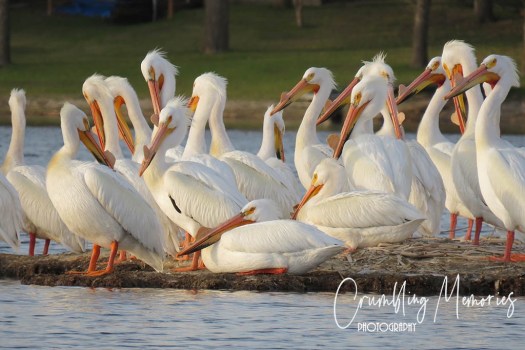
To me, pelican’s arriving back on the small lake in my community is a sign that warmer weather is truly on its way.  After our cold winter, they were certainly a welcome sight.  During the winter they are typically found in warm, coastal marine habitats.

They breed in large, dense colonies.  Flocks forage cooperatively by circiling around fish or driving them toward the shore where they are easier to catch.  During breeding season, adults often forage at night.  They eat mainly small, “rough” fish with little commercial value.  They will also eat salamanders and crayfish.

New pairs will nest close to another pair who are at the same stage of the breeding cycle.  Nests are typically located on open, bare soil.  Both sexes build the nest which consists of shallow depression surrounded by a low rim of gravel, soil or plant material.  Both sexes incubate two eggs.  The chicks are dependant on their parents for warmth and food.  Unfortunately, the second-hatched chick usually dies.  When the chick leaves the nest they gather in groups called “creches”.  Chicks are fed by the parents until the leave the colony at 10-11 weeks of age.  In the breeding season, there is a laterally flattened “horn” on the upper bill. The horn is shed after the birds have mated and laid their eggs.

The typical life span of a wild pelican is 10-15 years.

In Ontario, the species is listed as “threatened”.

CLIFFE

A few weeks back we were out and about as a family driving around when I realized that my husband has a talent for spotting houses, houses that I didn’t even notice.  He found two of them that day, this being one of them.

I took a roadside shot and then came home and contacted the landowner for permission for a closer look.

img_2758

I often rely on my Canon SX60 HS for those long difficult shots that the DSLR and my 300mm lens just can’t get without lens shake or some sort of distortion.  The point and shoot captured this home perfectly and honestly, I didn’t get a better shot when I returned.

IMG_9488 email

My son joined me on this adventure but didn’t get out  of the car to explore with me.

This is also another home that I couldn’t find a whole lot of history about.  Argh!

IMG_9495 email

The first recorded landowner was of Irish Decent and born in 1856 in the Township of Landsdowne, Ontario.  He had one daughter from his first marriage.  He married for the second time in 1885 and came to Manitoba in 1889 as per the individual recorded family history.  The history that I find on this property gives two dates for the purchase of this land.   The RM’s records list a date of  1912.

WHC settled into farming in Manitoba and the first land he broke was 17 acres.  Unfortunately it wasn’t until the 3rd year that the family would see a crop.  The first was frozen and the second was damaged by hail. When he wasn’t farming, WHC did carpentry work for others.

IMG_9503 email

WHC and his second wife had 3 children.  He passed away accidentally in 1911.  Mrs. passed in 1928.  One of their sons farmed the home land with his wife until 1937 when they retired to Boissevain where he did carpentry work and was an appliance repair man.

IMG_9514 email

You truly could not get a bad photo of this house.  The skies were incredible on my second visit and to be completely honest, I shot in auto mode all day and was 100% satisfied with all the shots I took.

While I cannot confirm who built this home and who lived in it when,  I do know that WHC’s son sold the property to the second recorded landowner in approximately 1945.  When he passed away his nephew bought the property and now farms the land surrounding the home, outbuildings and what is left of the barn.

IMG_9511 email

I would have loved to have seen this barn when it was standing.  I would assume with the carpentry background of father and son, it was likely well built and quite amazing.


EDITH & ROBERT

This couple purchased this land in 1911 when they married.  I am going to assume that they bought this land from one of Mr’s relatives as the same last name is listed as the first land owner of this section of land in 1891.  This couple retired from the farm to Boissevain in 1949.

IMG_9454 email.jpg

Their only son John Robert, who was better known as Jack, farmed the property next door after he married in 1947 and moved away from his parents home farm.  Mr. was a member of the Independent Order of Oddfellows and acted as a trustee and chairman of the Fairburn School Division.  His wife was active in the Royal Canadian Legion Auxiliary and the Fairburn District Ladies’ Group.

IMG_9475 email.jpg

The property was then sold to KA.  I cannot confirm any history of this family living here.  I can say that the home has been vacant for some time as there is no longer much of a floor in the home and it is teetering on what is left of the foundation.

IMG_9450 email.jpg

After KA owned the land the farm was sold to the Guide Family.  Again, I cannot find anything about this family even though it is recorded that they owned this property for approximately 17 years.  There is a good possibility that the land was purchased for the sole purpose of farming it and nothing more.

IMG_9451 email.jpg

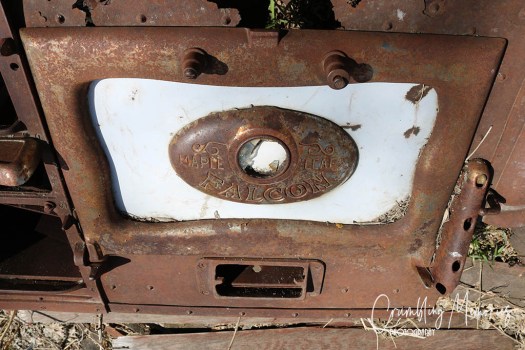
There were a lot of neat little finds around the yard, including this old ringer washer and stove.

IMG_9459 email.jpg

I did some googling but I could not confirm anything I found.

IMG_9463 email

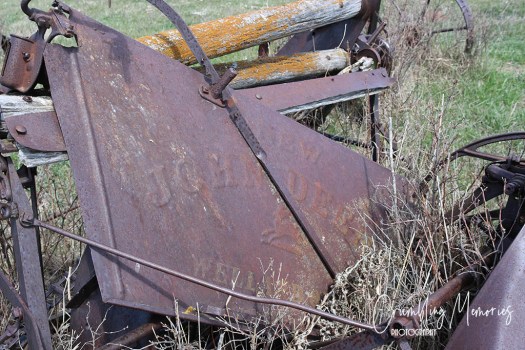
There was a lot of old equipment there as well and I have to say that this was probably the neatest thing I found, aside from the piece of stove.

IMG_9483 email.jpg

I contemplated going back to this property on this beautifully cloudy day, after I was told about it back in the winter.  I sure am happy that I did even though I didn’t get as much history as I would have liked, I sure did find some good photo opprotunities.


JOHN & MARY-ANN and PETER & ERNA

There’s a good chance that this home may look familiar to you.  I have been here 3 times now.  The first time I stumbled upon it with Makenna just as the sun was setting and I had one camera and one lens with me.  And honestly, the house creeped me out.  Makenna wouldn’t even get out of the Jeep.  A few months ago I went back for another look and made my way through knee high snow for a closer look.  The resident skunk let  me know that he was around by giving off his pungent aroma as a warning.  I went again this past weekend when I could wander around for some better shots.

I have to admit that I am slighting disappointed on the lack of history I can find!  I love the picture taking but I love the research too.  So, I can tell you that the first family to own this property was originally from Plymouth, England.  They came to Canada in 1850 then returned to England only to return again and settle in Ontario.

In 1890 John came West and chose this land as his farm.  He worked all summer and fall repeaing crops planted by earlier settlers.  Help walked from Souris to work the land in this area and grain was taken to Brandon by oxen or horses wherein the driver walked at least one way.

John returned to Ontario and in 1891 he married Mary-Ann.  They left for Manitoba on a colonial train, bringing with them a rail car load of lumber for a home and barn.  They also brought household furnishings, two cows and some horses.

IMG_9424 email

I’d like to think that this might be one of their carts, tucked away in the trees.  There are actually two there but the other one isn’t in as good condition as this one.

IMG_9431 email .jpg

The front of this home is very over grown and a good photograph is hard to get from any angle.  Its so overgrown in the front there just isn’t a good spot to get a shot without trees or branches.

IMG_9443 email.jpg

The second owner of this property,  PA being approximatley 47 years of age,  purchased this home and property with his wife.  Four short months later he died of a heart attack at the age of 47.  It is said that he lived a full life.  Born in Grigejewka, Russia in 1920, he moved to Manitoba with his parents at the age of 6.  He was only 11 years of age when his father passed away and at the age of 16 he and his mother took over the family farm.  He married in 1941.  purchased their own land in 1949.  They had 6 children.

He served on two school boards including the Turtle Mountain Scchool Division and was a member of the Gideon Organization for many years.

The back of the home is not as exciting and of course, this is where I can get the best shots.  I must admit that the open back door was very welcoming but aside from an old metal picnic like basket, there’s nothing inside to explore as the floor is caving in and is not at all safe.

IMG_9434 email

As I mentioned, the first time I set my eyes on this house, it kind of creeped me out.  I explored it alone this past weekend and I certainly did not get that feeling.  Its actually very peaceful and beautifully treed.  The back of the house was easily assessible with a large shop and off just into the field were two more outbuildings.  I’m sure this was a truly, beautiful home in its prime.

IMG_9432 email


MORTON, ET AL

The orignial owner of this land came to Canada in 1881 from Kingston, Ontario and I am assuming, built this home.  The family moved into the home in 1882 with they raised 7 kids.

IMG_9391 email

Many more families would rent this home and land and raise there families here as well.  The home continued to be resided in up until 1980, which is the last recorded date that I was able to find.

I will make the assumption that the home was lived in later than the 80’s given the PVC windows.

The yard was very soft and spongee and not knowing what I was in for – I usually ask but didn’t when I called yesterday – I did not know if there were any wells that I needed to know about.  I was also told that the home is known to be over run with masked bandits so I really wasn’t interested in taking a further look.

IMG_9403 email

What drew me to this house orignally was the brick fireplace outside.  From the road I thought the house had stone pillars.  When I pulled into the yard yesterday I found the stone stove/firepit near the driveway.

IMG_9394 email

I would have liked to explore a little more.  There were some out buildings and I would have liked to get some better photos of the front of the house but I didn’t want to bother the eagles anymore.  When we left the driveway, Dad was waiting for us high in a tree, giving us the stare down.  Oh and the noise he was making is not what I would expect out of an eagle.


ALMA SCHOOL

This school has been on my to see list for some time.  I was told that it was no longer there so a couple nights ago I wasn’t doing anything and thought I would go for a ride to check it out not expecting to find anything except a metal monument in its place.  Well low and behold, there it stood.

The Alma School District was established formally in July 1891, but wasn’t name until a year later by a student in the first class.

almaschool1

A wood frame schoolhouse served as the first school house on the property and was used until 1905 when it was replaced by this one room brick structure, complete with full a basement and an oil-fueled furnace.

IMG_9193.JPG

The school closed in January 1961 and its remaining students then attended the Belmont Consolidated School.

IMG_9200.JPG

At the back of the property is what I will assume was the outhouse and a small storage building.  The yard is well maintained.

IMG_9201-2.jpg

There is extensive structural damage to the side wall of the school and the front entrance is blocked by a large pile of plaster, likely renovations carried out by the schools newest tenants.

IMG_9227-2.jpg

A wooden stud wall inside the school was built in an attempt to stabilize the structure. A monument stands next to the former school.

IMG_9202-2.jpg

There is a rickety staircase that leads up into the back of the school.  As I wasn’t feeling much like a risk-taker and didn’t venture inside. This is likely due to the large “enter at your own risk” sign stapled to the door frame and the fact that I didn’t feel like running from any rabid racoons.

IMG_9209-2.jpg

Among the teachers of Alma School were Alexander Tumoth (1890), Percy Brether (c1900), Jean Williamson (1948), Miss Munroe, Miss Tisdale, John Sutherland, Miss Donna McLean, Miss Anne Hawn, Miss Alice Embury, Mrs. Shirley Dubyts, Miss Irene Fitzpatrick, Miss McIntyre, Miss Marjorie Cleave, Miss Eva Croll, Ed Arndt, Miss Myrna Wray, Mr. P. Lougheed, K. M. Prowse, Miss Jean Cowell, Miss Pat Williams, Mr. McRae, Miss Evett, Miss Muriel Robinson, Miss Pinn, Miss Marion Lewis, Miss Jean Campbell, Miss M. Stintson, Mr. Johnson, Miss Anna McLean, Norman Smith, Miss Margaret Downey, Miss Ruth Watson, Miss Kinley, Miss Wall, Miss Mae Berry, Miss Harrower, Miss Katie Playfair, Henry Woods, Miss Murgatroid, Miss Shorthose, Miss Hazel Cunningham, Miss Valance, Miss Carvell, Miss Bailey, and Miss McGowan.

IMG_9221-2.jpg

I’m glad I didn’t take someone elses word and drove out to see what was there.  It was worth the drive and my fingers did eventually thaw out.