ANOTHER RE-DO

Many moons ago I met Grandma & Grandpa Phillips for the very first time. We went out to their home out Henderson Highway where they had lived since the 60’s.

In the dining/living room was what I thought was a gorgeous cross stitch of a bowl of poppies. No one else shares my enthusiasm. The Phillips’s have many grandchildren, etc so I figured the chances of Cade ever being gifted that art was slim to none.
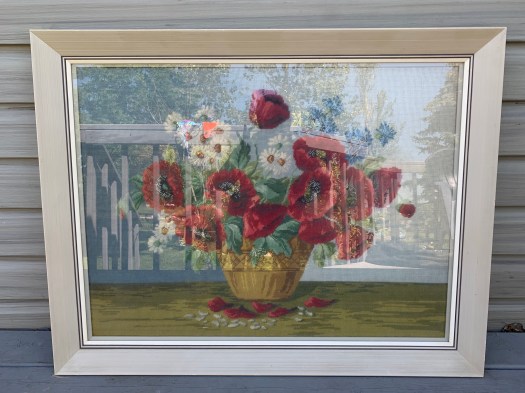
Many years later my BIL and I were clearing the belongings from the care home where Grandma was living when she passed away. Low and behold, there it was. My BIL looked at me and said, that thing is not coming to my apartment! I couldn’t believe it was now mine.

It must have been important to Grandma too cause of all the things in their large home, this was one of the personal effects she chose to take with her.

For many years it has hung on my walls, dusty and dated. A large part of my hesitation was what would happen to the cross stitch when I opened it. Would it fall apart? Every framed item in the Phillips’s home was done at Eaton’s, where Grandpa worked for many years in the shoe department. I should have known it was framed well.

Yesterday I took it apart and it came apart easily with no damage. The glass was very dusty but easily cleaned. I decided though that the frame needed to be changed and so, out came the chalk paint, again.

This piece was something Grandma started when they moved into the house in the early 60’s. My MIL figures she finished it a couple years later.

BLUE HERON

I love the blue heron.  Last Spring the one in town liked getting its photo taken.  The bird hanging around this year, does not feel the same and really is quite shy.   I’ve hidden in the tall grass but as soon as he sees me, he takes off and watches me from across the bay, on the dock where I am just out of range with my regular 300mm lens.

Well, the heron is B.C. aren’t shy.  I found this one in Stanley Park on my first outing out with the new lens.

IMG_0530 cropped for email

This bird was very photogenic.  I had to group this photo as Speedo clad swimmer stepped into my viewer!  I got a lot of shots of him but this is one of my favourites.  This bird stood in the ocean, not far from swimmers.  And I saw a few more when we were out fishing for sturgeon on the Fraser River in Chilliwack.

Regardless, I was happy with the shot and am looking forward to taking was more photos with this lens.  This photo was handheld and I must say, while the lens is heavy, its not out of this world and impossible to use without a monopod/tripod.

MONKEY PUZZLE TREE

Araucaria araucana or commonly called the monkey puzzle tree, monkey tail tree, piñonero, or Chilean pine is an evergreen tree that grows from 1–1.5 m (3–5 ft) in diameter and 30–40 m (100–130 ft) in height. It is native to parts of Chile and Western Argentina.  The monkey puzzle tree is the official tree of Chile.  This one grows in my parents front yard in Burnaby, B.C.

The origin of the popular English language name “monkey puzzle” derives from its early cultivation in Britain in about 1850, when the species was still very rare in gardens and not widely known. Sir William Molesworth, the proud owner of a young specimen at Pencarrow Garden in Cornwall was showing it to a group of friends when one of them remarked, “It would puzzle a monkey to climb that”.  As the species had no existing popular name, first “monkey puzzler”, then “monkey puzzle” stuck.

6725144991521665100-IMG-0502.JPG

Known for its longevity, it is described as a living fossil.  It is suspected that they can live up to 1000 years.  Saying that, tts conservation status was changed to endangered in 2013 due to the dwindling population caused by logging, forest fires, and grazing.

The leaves are thick, tough, and scale-like, triangular, 3–4 cm (1.2–1.6 in) long, 1–3 cm (0.39–1.18 in) broad at the base, and with sharp edges and tips, rather similar to the leaves of the unrelated succulent.  The leaves have an average lifespan of 24 years and cover most of the tree.  You can see some of the brown branches in my parents tree.

IMG-3624.JPG

The monkey puzzle tree is dioecious, with the male and female cones on separate trees, though occasional individuals bear cones of both sexes. The male (pollen) cones are oblong and cucumber-shaped and approximately 1.6 in long at first, expanding to 3.1–4.7 in long by 2.0–2.4 in broad at pollen release. It is wind pollinated. The female (seed) cones which mature in autumn about 18 months after pollination, are globose, large, 12–20 cm (4.7–7.9 in) in diameter, and hold about 200 seeds.   This is a seed pod in my parents tree.   I would say that my parents have a female tree.

.

The cones disintegrate at maturity to release the 1.2–1.6 in long nut-like seeds which are edible AND tasty.  The piñones are similar to pine nuts but larger; these roasted seeds are 3 cm and 5 cm long, from two different cultivars.  We found some of the little brown seed pods on the ground but when we opened them, the nut inside was tried up and only a powdery substance remained inside.

We seen a couple more of these while we were in B.C but none were as full and mature as the one that grows in my parents yard.  Most were spindley and small.

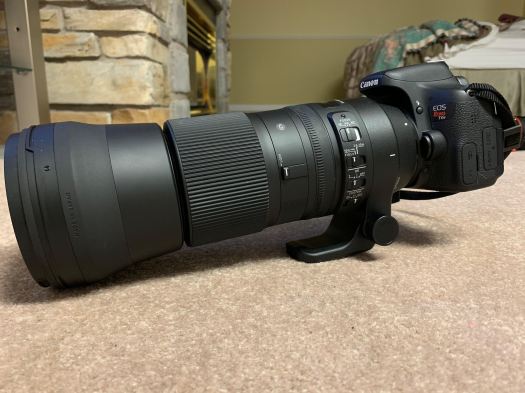
SIGMA CONTEMPORARY

For sometime I have been contemplating the purchase of this lens for many reasons.  First off, eventually I am going to run out of abandoned homes in this area, secondly, I love wildlife and thirdly, I wanted it.

I have been seeing all sorts of photos online of these amazing bird shots and I developed a severe case of lens envy.  I know that its not the camera and not the lens that makes the photos!

I found a good deal on one before I left for B.C. and decided that I did not want to go there without it in case I saw whales in the ocean or bears while up on the gondola.  I had it shipped to my parents place and it was there when I got there on Saturday evening.

I did a lot of searching when I decided I was going to take the plunge.  No one is selling these lenses.  I tried to rent one while in B.C. but most of the rental places were to far and the rental rate was a little high.

lens

Its heavy but not heavy enough that you cannot hand hold it, which I did with my first day out with it.  I will need to buy a monopod to get the best I can out of it though.  I also need to purchase a new camera bag.  While it does have its own case that fits inside the bag I’ve been using, its not ideal.

And not only that, it comes with its own manual which is okay for days like this when its too hot to go out.  Good day to read and get ready.

As I get aquainted with it and learn how to use it properly, I’ll write more.

Its so big I feel like I should name it.

FRASER RIVER TUG

We’ve spent most evenings down along the Fraser River, fishing.

There are a lot of tugs. Busy, busy River.

There’s an eagle that flies around but he’s to fast and once we spot him he hides.

So instead I take photos of the tug boats, this once towing a HUGE barge.

HELEN

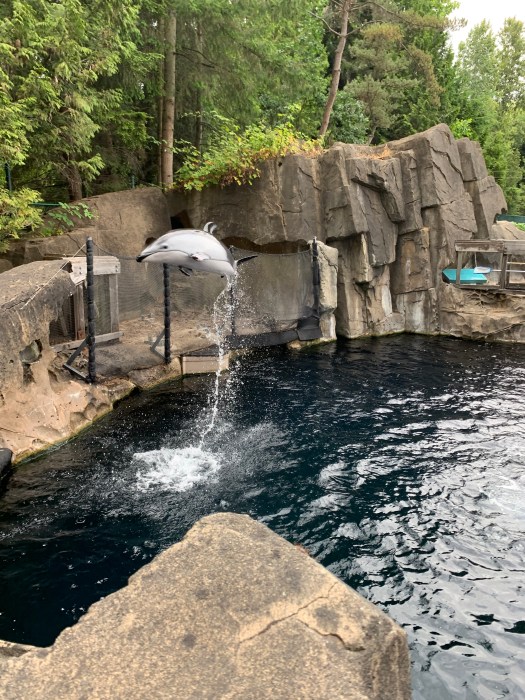
This is Helen. Helen is an approximately 31 year old Pacific White Sided Dolphin.

Helen has partially amputated front flippers due to her being entangled in a fixed fishing next. She was rescued and rehabilitated and then deemed unreleasable.

Helen was highly entertaining and is the only whale/porpoise remaining at the Vancouver Aquarium.

LILAC THIEF

My Aunt loves lilacs. So much so that she goes out in the middle of the night and cuts them so she can have them inside. The problem is, she doesn’t have a house, therefore, she doesn’t not have a yard or a garden. She’s an apartment dweller!

A couple weeks ago when my lilac bush flowered I took this picture for her.

Now I have to share with you that this is a learned behaviour. She got it from my Grandmother who always had fresh cut flowers in her apartment. She lived in downtown Winnipeg so she had to buy them from the local florist at The Bay.

NUBIVAGANT

My husband was sure he spotted a albino duck in a small body of water not far from our home. The duck turned out to be a snow goose!

I did at least get a shot of this sky and its reflection.

RAMPIKE

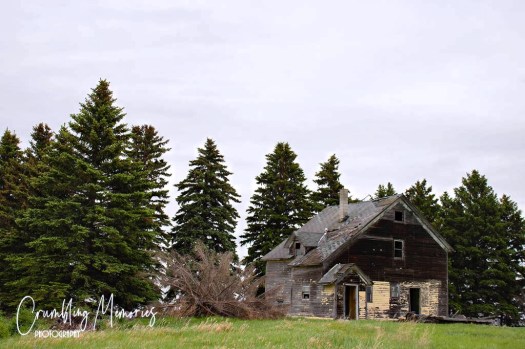
My lost stop on our Sprint Car Race journey was this home right along the way, close to home. All of the homes I found were right along side the road which make for perfect roadside shots, which I generally don’t like.

What I most enjoyed about this yard was that big, old, dead evergreen.

The front of the home was obscured by the other live trees.

I ONCE STOOD TALL

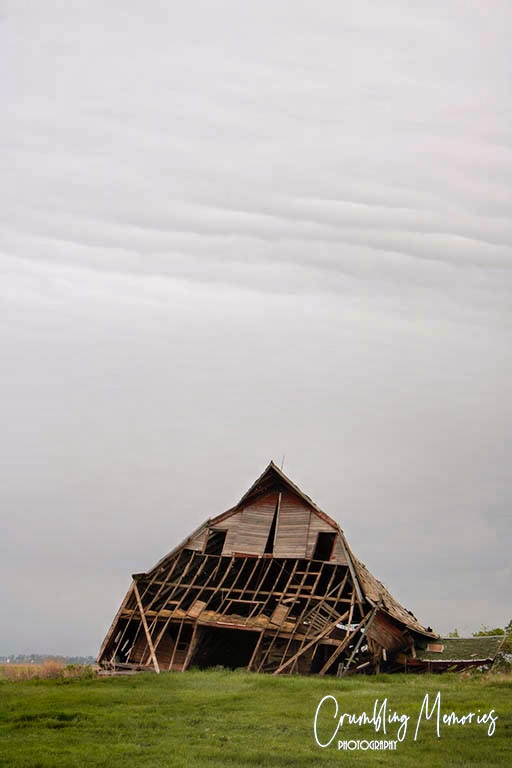
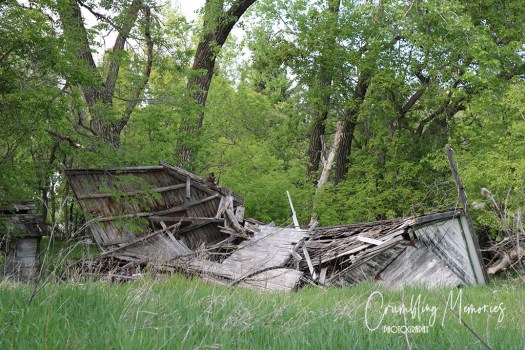
The first time I photographed this barn, we were on our way to Grand Forks for a hockey tournament. I’d have to say it was 2013 or so.

Each year after that I admired that it was still standing and relatively straight. This is no longer the case.

HIGHWAY 17 – Cando, ND

When our impromptu trip to Grand Forks was planned, I figured it would be the perfect time to wander out to an old church that has been on my to-see list since last summer.

Unfortunately it wasn’t going to be easy to get to with at least 10 miles of travel on unknown gravel roads that had been subjected to rain. I chickened out and decided to wait for my husband to travel with me.

I did find this one on the way though.

HIGHWAY 281

On our way to Grand Forks I spotted this house. Homeward bound I stopped for this shot. When we left Grand Forks it was pouring and cloudy. When we got to this one it was still drizzling but not enough to stop for a couple quick photos.  The sky was perfect so I stopped.

First stop, this house right on the side of the highway.

The skies were amazing and a little adjustment with my exposure produced this shot.

This is also where I discovered I have two flecks that I can see in my view finder but don’t appear on my photos!!

The weather continued to be off and on for the rest of the ride which gave for some very “moody and dreary” shots.

SITTING BULL and the RALPH ENGELSTAD ARENA

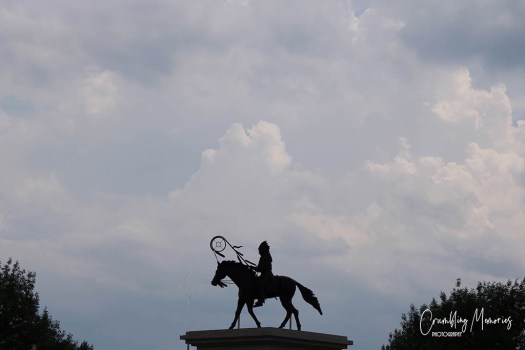
Sitting Bull was the leader who led his people during years of resistance to United States government policies. He was killed by Indian agency police on the Standing Rock Indian Reservation during an attempt to arrest him, at a time when authorities feared that he would join the Ghost Dance movement.

North Dakota and its University teams were famously known as the Fighting Sioux from 1930 until the university retired the nickname in 2012, ending a seven-year battle with the N.C.A.A. North Dakota had been one of 18 institutions the N.C.A.A. singled out in 2005 for American Indian mascots it deemed hostile or abusive.  The dispute dragged on, with the state Board of Higher Education and the Legislature weighing in. Ultimately, in June 2012, North Dakota voters overwhelmingly chose to phase out the nickname.

This statue of Sitting Bull sits outside the Ralph Englestadt Arena. Said to have cost the former Fighting Sioux goaltender $100 million. He spared no expense when the facility was built. He had granite imported from India to have the Sioux logo put into the floor of the main entrance. 3.2 miles of brass was also used in the building.

The arena truly is an amazing site with a whole lot of history. Kind of like Sitting Bull.

SUNNY BANKS

Remember the house who was lived in by the little lady whom never married and would ocassionally get on the school bus and go to town for the day and return home on the school bus?  Well her sister married the gentleman who bought this land in 1939. Her nephew still farms the land.

IMG_9874 email.jpg

It was here that Mr. farmed cattle and hogs on the land until his death in 1977. His Mrs. lived on and passed in the home in 2001, the last time this house was occupied.

Mr.’s grandfather was born on July 13, 1883 and moved to Canada when he was in his 20’s.  Here he met and married his wife and together they raised 4 children.  They farmed in Holmfield for many years and moved to Killarney in 1961.

IMG_9869 email.jpg

When I first posted this photograph on Facebook, my post received a comment advising me that as a child, the poster played in this house with his childhood friend.

IMG_9876 email.jpg

Speaking to the new Mrs. of this land she advised me that years ago they had inquired about repairing the roof and replacing the windows in this old family home.  They were quoted an amount near $20,000.00.  I often read people’s comments “oh, what a beautiful home, why don’t they save it?”  I think we forget how much these sorts of repairs can cost. We are working hard to keep our own homes maintained, let alone a century old home that likely needs a new foundation, windows, upgrades to the heating and water systems and likely a host of other issues due to its age. I can’t imagine it’s easy to watch these old home deteriorate beyond repair, especially for the generations of family still here that have fond memories of the home.

This home has been on my to see list for some time.  This weekend I called and after some hesitation, was granted permission to take a couple photos.  I am happy I was able to find and receive some history.  Thank you Mr. & Mrs.


KISINAA or COLD

In November, 2012 my family and I headed to the Christmas parade in town to see the floats.  It was cold that evening, -26 if my memory serves me correctly.

On our way home from the craft sale in the mall, we heard a kitten crying.  It ran past us down the street.  Of course I ran after it and caught it.  I took it inside one of the local businesses and asked the people inside if it belong to anyone.  It was tiny.  It fit in my hand and I could cover it up with my other hand.

I stuck the kitten in my jacket and drove home.  It licked my face the whole way.  Long story short, no one claimed it and there was no way the kids were giving it up anyways. My husband then started looking for the perfect name for our frozen little kitten who had frost bite on her feet.  Her name would be Kisinaa, the word for cold in Ojibway.

kisinaa email

Now on to the point of my post.  The other night after playing 21 with my son and husband and getting beat again, I sat down and here she came for cuddles.  So I got the camera out to play around.  Now instead of putting the 50mm on, I went with my standard 50-85mm f 4-5.6 kit lens and got this shot of her.  I would say its a pretty decent shot, sharp around her face and eyes and then blurs out to a perfect DOF.  Now unlike my other attempt with the 50mm with Payton and Walker, the sun is not nearly as bright as it was coming upon the golden hour.  The days of just turning on the camera, making sure its on auto mode and taking a photo is something I want to get away from.  No matter what lens I have, if I adjust my camera to the appropriate settings, I’ll get a good shot, regardless if I have a kit lens on or some other fancy lens that I likely didn’t need to buy.

I’m also trying to convince myself that I don’t really need a 600mm lens for shooting birds and wildlife although I really, really want it and my husband is sick of hearing about it and has already told me to buy it.

Now let me tell you a funny story about Kisinaa.  Last year around this time, my husband came home from town, clearly unsettled.  When I asked him what was going on he advised me that he found Kisinaa on the highway and she was in the back of the truck and I needed to tell him where I wanted her buried!  After some arguing I went with him to the driveway to see if it was really her.  I have to admit that it looked a lot like her but something was off in her face.  She has all the right markings, white tip on the tail, but she was too big.  So off her went to the back field to bury her.  I was sent off to pick up the kids from friends and when we had gathered them up we were going to tell them.

After we all settled down it was time to make supper so Cade was out on the deck BBQ’ing when he felt something brush up on his legs.  At our house that could mean anyone as we have more than 1 cat.  We have more than 5 cats actually.  When he looked down to see who was loving him up, he said he almost fell to his knees when Kisanaa was standing there looking up at him.  His first thoughts were Pet Semetery.  We never did find or hear of anyone missing their cat who looked like our Kisanaa.  And clearly, our Kisinaa is alive and well.

TESTING 1,2, 3 or 200

Monday afternoon I headed out to the Bay in town to see if I could get some photos of the pelican’s using manual mode! Within about 10 – 15 test shots I gave up and switched to priority mode and eventually ended up on auto, again.

I have done a lot of reading on shotting in RAW and JPEG mode and decided, after I purchased a bigger SD card, that this was a good idea.  There is always that chance that you may have gotten the perfect shot AND you do need to adjust the exposure in order to save it instead of hitting delete.

Anyways, long story short, I went out twice on Monday, took over 200 photos and kept maybe 10.

I did manage to save this shot because I was able to adjust the exposure (from the RAW file) and ligtning it a bit.

IMG_9759 email

Here is an instance when I would have liked a lens with a longer focal point but again, I’m not there yet.

A wise man who has an amazing talent for bird photography, told me, pick something, be it focus, white balance, apeture, whatever.  Learn it, learn it well and move on to the next thing.

Thank goodness I no longer have to pay for film and developing.

TWO CUTIES & THE NIFTY FIFTY

At my first photography class it was suggested that we purchase a 50mm prime lens.  Last Christmas I did just that and got myself one on sale on Boxing Day off Amazon.

I have to admit that the lens was purchased for the sole purpose of night photography.  This 1.4 lens was going to capture all the light I needed to get a sky full of stars or the milky way.  I have to admit, I haven’t tried that yet.

Its also supposed to be the best portrait lens around.  With the small aperture number, this means that the lens is open wider and lets in more light.  With a 1.8 I should get a great DOF (depth of field) and my subjet should remain crystal clear.

Saturday I thought I’d give it a go with our friend’s gorgeous little girl who loves the camera.

IMG_9675 email

I’ll tell you what I did wrong!  First off, its a warm, sunny day.  Why would I need to use the lens with the small apeture.  I’ve got enough light as is.  Second off, we were at the baseball diamond so my background was limited so I shot towards the sun which cast to many shadows.  The shadows make this little one’s face grainy, in my opinion.

Her big brother turned out a little different.

IMG_9700 email

He was slightly turned so we captured less light although you can still see the shadows on him.

So, just because you have the lens, doesn’t mean your going to take great photos.  This was a good lesson to me.  Auto mode is a safety zone for many of us but if you really want to get serious and take great photos, you need to learn to use your camera in all settings, in all conditions.  I can have all the “lens envy” in the world, I still wouldn’t be able to produce the kind of shots that most wildlife enthusiasts have, regardless of how well I knew Photoshop.

So while I want that $1,000 lens that will get me all that more reach to take photos of birds and wildlife, I’m not ready for it.  I would never be able to use it to its full potential as I’m just not there yet.

Practice makes perfect.

Regardless of my shortcomings with the “nifty fifty” lens, these two are beautiful children.

PELECANIFORMES

img_0258 email

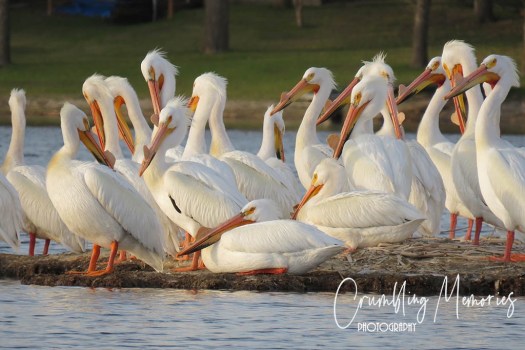
To me, pelican’s arriving back on the small lake in my community is a sign that warmer weather is truly on its way.  After our cold winter, they were certainly a welcome sight.  During the winter they are typically found in warm, coastal marine habitats.

They breed in large, dense colonies.  Flocks forage cooperatively by circiling around fish or driving them toward the shore where they are easier to catch.  During breeding season, adults often forage at night.  They eat mainly small, “rough” fish with little commercial value.  They will also eat salamanders and crayfish.

New pairs will nest close to another pair who are at the same stage of the breeding cycle.  Nests are typically located on open, bare soil.  Both sexes build the nest which consists of shallow depression surrounded by a low rim of gravel, soil or plant material.  Both sexes incubate two eggs.  The chicks are dependant on their parents for warmth and food.  Unfortunately, the second-hatched chick usually dies.  When the chick leaves the nest they gather in groups called “creches”.  Chicks are fed by the parents until the leave the colony at 10-11 weeks of age.  In the breeding season, there is a laterally flattened “horn” on the upper bill. The horn is shed after the birds have mated and laid their eggs.

The typical life span of a wild pelican is 10-15 years.

In Ontario, the species is listed as “threatened”.

MAMA GOOSE

For the last couple weeks Cade has been telling me about this goose he kept seeing in the Long River which he assumed was hurt as she would swim with her neck stretched out in front of her along the water.

The other night we all went out for a ride in the boat and wandered down the Long River a bit. Cade remembered a goose nesting on the corner of this lot so I zoomed in and there she was.

When we got around the tree she was laying with her head stretched out in front of her like the one Cade had seen in the water. So I googled it. The is typical behaviour for a female goose on or near her nest. Cade is lucky he didn’t wander down to check on the other goose cause I’m positive he would have been on the receiving end of the goose boots!